November 13, 2026
The book binding turnaround time benchmark at Publishing Xpress is 4 to 6 days from proof approval to shipment—not delivery. This 2026 guide compares that service-wide planning window across perfect binding, saddle stitch, plastic coil, and Wire-O, then explains how to schedule your book around it.
A printing deadline and an arrival deadline are different commitments. If your launch, class, fundraiser, or conference needs books in hand, a shipment window alone does not complete your schedule.
Publishing Xpress book printing is best for authors and organizations ordering at least 25 copies who can plan around shipment after proof approval. Its stated window gives you a clear scheduling reference, but you still need to account for file preparation, proof review, and transportation.
Book binding turnaround time needs a defined starting point and endpoint. The benchmark here measures proof approval to shipment; it is a stated service window, not a measured industry average or a binding-machine processing time.
| Binding type | Proof approval to shipment | Benchmark scope | Best for | Main limitation |
|---|---|---|---|---|
| Overall: Publishing Xpress book printing | 4 to 6 days | Service-wide stated window | Authors and organizations planning a short print run | Shipment is not arrival |
| Perfect binding | 4 to 6 days, service-wide reference | Use the overall window for planning; confirm your order | Novels, memoirs, and other paperback reading books | Does not open flat like a mechanically bound workbook |
| Saddle stitch | 4 to 6 days, service-wide reference | Use the overall window for planning; confirm your order | Short booklets, programs, and zines | Maximum of 80 pages |
| Plastic coil | 4 to 6 days, service-wide reference | Use the overall window for planning; confirm your order | Workbooks, planners, and hands-on manuals | Punched binding edge needs clear layout space |
| Wire-O | 4 to 6 days, service-wide reference | Use the overall window for planning; confirm your order | Presentation books, calendars, and reference materials | Exposed wire needs protection from crushing |
No binding leads or trails on the stated benchmark: the shared reference is 4 days at the low end and 6 days at the high end. These rows do not establish that every binding takes identical production time, or that switching bindings saves time.
Source and methodology: Publishing Xpress's stated service terms, supplied for this 2026 guide, specify shipment 4 to 6 days after proof approval; the table repeats that service-wide reference across the listed binding options. The limitation is that this is not an observed order dataset, so it cannot establish binding-specific averages, on-time shipment rates, or delivery dates.
Use the overall row as your scheduling yardstick. It identifies the production milestone you can plan around without assigning unsupported speed advantages to different bindings.
The range also matters. Do not build a fixed event schedule around the earliest end alone. A plan that requires shipment at the low end leaves no room within the stated window for shipment at the high end.
The binding rows connect the same scheduling reference to different reading experiences. A paperback novel and a workbook serve different purposes even when you use the same shipment window to begin planning.
Read the suitability and limitation columns together. A binding that meets your deadline but makes the book awkward to use is not the right choice.
Turn the benchmark into a decision with these practical rules. Each rule keeps the stated timing separate from the assumptions that require order-specific confirmation.
For your 2026 production calendar, record the approval deadline, expected shipment, expected receipt, and distribution date separately. That makes the schedule understandable to everyone involved, including a designer, school administrator, event organizer, or receiving team.
The physical differences between bindings are useful decision criteria. They are not evidence of different turnaround windows.
Perfect binding joins the pages at a glued spine and attaches a wraparound cover. It suits novels, memoirs, poetry collections, and other books readers hold while reading from beginning to end.
The trade-off is opening behavior. A perfect-bound book does not provide the same flat-open experience as plastic coil or Wire-O, so exercises near the inner margin require particular care.
Choose perfect binding for a paperback reading experience. Do not reject it solely because glue is involved; the benchmark does not establish a longer shipment window for this format.
Saddle stitching secures folded sheets through the fold. It suits event programs, compact catalogs, comic books, and zines when the content fits the format.
The firm limit here is 80 pages maximum. Confirm how your cover and interior are counted before you finalize the document, rather than discovering a mismatch during proof review.
Choose saddle stitch for a short, folded booklet. Its construction does not justify promising an earlier ship date than the stated service-wide reference.
Plastic coil passes through punched holes along the binding edge. Pages turn around the coil, making the format useful for workbooks, planners, recipe books, and training materials used beside a task.
That punched edge affects your layout. Keep text, answer spaces, diagrams, and important image details clear of the binding area using the printer's specifications.
Choose plastic coil when readers need an open working surface. Build that choice into the original file rather than switching after the interior layout is complete.
Wire-O uses paired wire loops through punched holes. It gives portfolios, presentation books, calendars, and reference documents a flat-open format.
The exposed wire also deserves care during handling and transportation. Avoid treating a bound sample as proof that packaging and receiving arrangements no longer matter.
Choose Wire-O when page handling and flat opening matter. Confirm the schedule for the actual specifications instead of assuming that a mechanical binding is automatically faster.
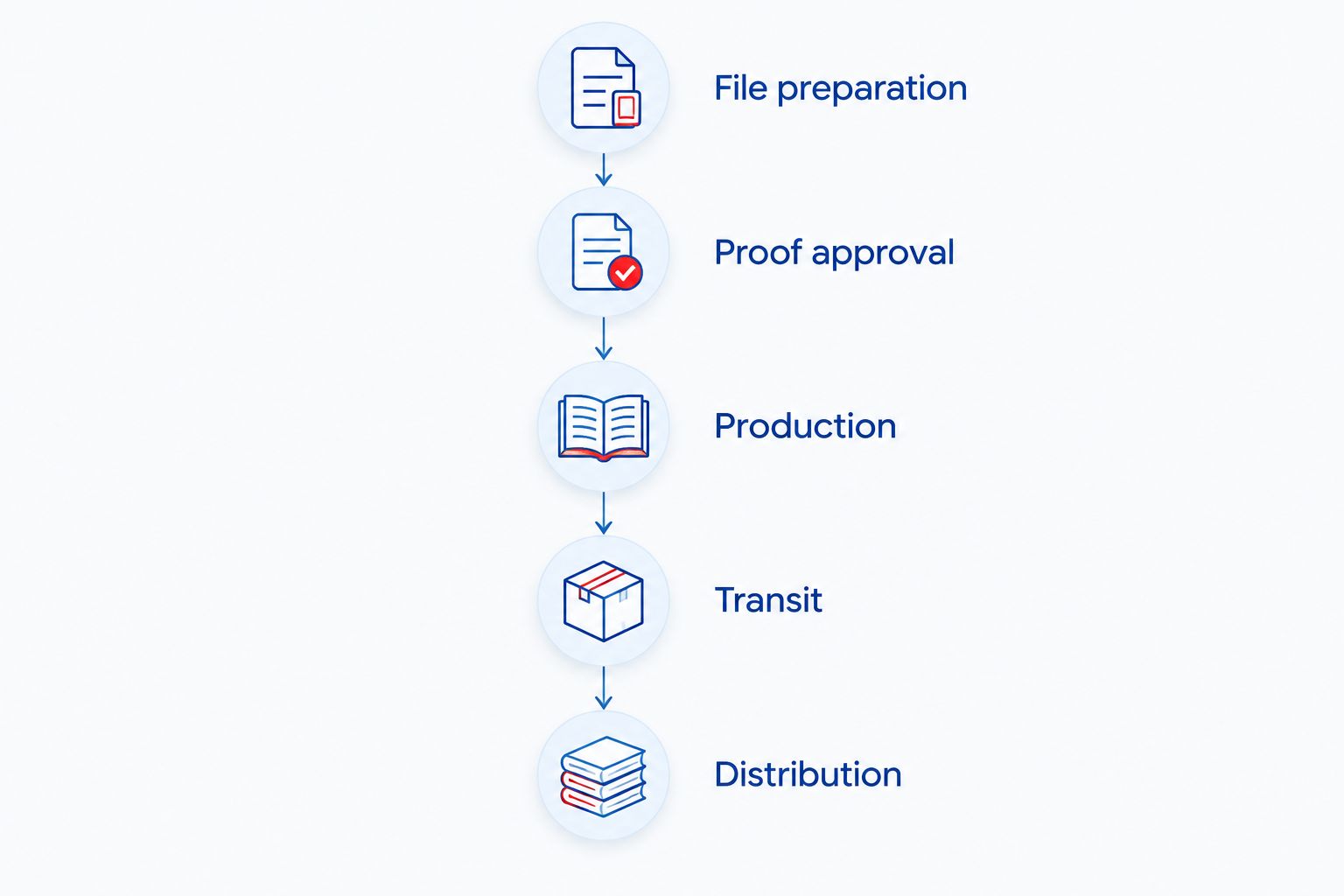
Your complete project schedule has several stages. Only the stage between proof approval and shipment carries the stated numerical benchmark in this guide.
Set the trim size, binding, page order, and cover layout before exporting your print file. These decisions belong together: changing the binding can change the space needed at the inner edge or the cover construction.
Keep a clearly identified final version. Sending several similarly named files makes it harder for your own team to know which document is ready for approval.
Review the proof against the exact file you intend to print. Check the cover, page sequence, contents, image placement, and binding-side margins—not just the opening pages.
Assign final approval to a named decision-maker. If several people need to review the book, gather their corrections before that person authorizes production.
The stated 4 to 6 days begins after proof approval. Use that interval for shipment planning, while confirming the schedule for your specific order.
Do not place unfinished editorial work inside this window. A manuscript still awaiting corrections has not reached the starting point used by the benchmark.
Shipment begins the transportation stage; it does not finish the project. Use the shipping service's estimate for the actual destination and selected method.
Check the delivery address carefully. A receiving location with restricted access or limited hours needs arrangements that match how the shipment will arrive.
Allow for what happens after receipt. You might need to inspect books, divide classroom sets, prepare event materials, or move cartons to another location.
An event deadline should therefore be a books-ready deadline, not merely a delivery target. Keep those milestones distinct in your 2026 schedule.
A useful turnaround comparison assumes the book specifications are settled. Before approval, check the details that connect the file, binding, and intended use.
Do not approve a known error to start the clock. The purpose of a proof is to settle what gets printed, not to mark progress while the content remains unresolved.
When comparing book printing services in 2026, ask each provider to define the same interval. A statement measured from file submission is not directly comparable to one measured from proof approval.
Ask these questions before treating any turnaround claim as useful:
Keep the answers beside the quoted timeframe. A shorter number with an unclear endpoint is not a better deadline commitment. This is especially important when someone else has already announced the launch or scheduled a class.
How long does book binding take in 2026?
Publishing Xpress states that book printing orders ship 4 to 6 days after proof approval. That is a service-wide shipment window, not an industry average or an arrival promise.
Which book binding type has the fastest turnaround?
The stated benchmark does not identify a fastest binding type. Use the shared 4-to-6-day proof-approval-to-shipment reference, then confirm the schedule for your selected specifications.
Does book printing turnaround include shipping time?
The benchmark here ends at shipment, so it does not include transit to your address. Add the selected shipping service’s transit estimate when planning when you need books in hand.
Does the turnaround clock start when I upload my book?
No, the stated window starts after proof approval. File preparation, corrections, and proof review belong before that milestone in your project schedule.
Are the 4 to 6 days business days or calendar days?
Confirm the day-count convention before assigning dates to your order. The stated benchmark uses days without defining business days or calendar days.
How many pages can a saddle-stitched book have?
The maximum offered for saddle-stitch books is 80 pages. Confirm how the cover and interior are counted before you approve the final layout.
Can I order fewer than 25 printed books?
The minimum print quantity is 25 copies. Use that minimum when deciding whether this short-run printing option fits your project.
Should I change my binding to meet a deadline?
Do not change binding solely on an unsupported assumption that another format ships faster. Ask for order-specific timing first, because changing binding also changes layout and how readers use the book.
Put your required arrival date in the conversation before you approve the proof. A printer can discuss the production schedule more usefully when the destination and real deadline are clear.
Then keep the approved file, approval record, and shipment information together. For a repeat order, those records give you a concrete starting point without turning one project's experience into a universal turnaround promise.
© 2026 Publishing Xpress. All Rights Reserved.