October 7, 2026
Perfect bound book printing takes the production time confirmed for your specific order; plan your delivery deadline around file preparation, proof approval, production, and shipping—not production alone. For a 2026 book launch, ask when the production clock starts and whether the quoted completion date means ready to ship or delivered to you.
Use an order-specific schedule, not a general number of days. A useful turnaround estimate identifies what must happen before production starts, when finished books leave the printer, and when you expect to receive them. Those are different milestones.
Start with this sequence, then use the guide to calculating book printing turnaround time to organize your deadline.
You do not need to guess how long each stage lasts. Ask the printer to identify the relevant deadlines for your order, and put your own preparation tasks on the same calendar.
A book can be finished at the printer and still be unavailable for your signing, fundraiser, or presentation. Your real deadline is the date usable copies must be in your hands, not the date the printing equipment stops.
For a 2026 launch, work backward from that in-hand deadline. Include whatever you must do after delivery, such as checking cartons, signing copies, or sending books to another venue. Shipping to your office does not complete the job if the books still need to reach the event organizer.
Ask for dates attached to milestones. A statement about production time is useful only when you understand its starting point, its endpoint, and what happens outside that period.
Uploading a manuscript is not the same as approving a print-ready book. Your document still needs to match the chosen trim size, and your cover needs to fit the final interior. Resolve those decisions before treating a production estimate as your delivery plan.
The table below separates the stages you control from the milestones you need the printer to confirm. It is a planning checklist, not a promised schedule.
| Milestone | What you need to complete or confirm | What it tells you |
|---|---|---|
| Files submitted | Send the intended interior and cover versions | The printer has your files, not necessarily approval to print |
| Files accepted | Resolve technical questions and required corrections | The files meet the order's preparation requirements |
| Proof approved | Approve the final version through the required process | Your content and layout are authorized for production |
| Production complete | Confirm printing and finishing are complete | The books are finished, not necessarily delivered |
| Order dispatched | Confirm the shipment has left the printer | Transportation has started |
| Books received | Inspect the order and prepare it for use | You can move to signing, packing, or distribution |
Ask which milestone starts the quoted turnaround. Do not assume that submitting files, placing an order, and approving a proof are interchangeable events.
Your schedule needs to reflect the book you are actually submitting. Use these factors to structure the conversation with your printer rather than assigning yourself an unsupported delivery estimate.
Changing a specification does not tell you, by itself, how many days the order will take. Request a revised schedule whenever you change the approved job. That keeps the dates tied to the current files rather than an earlier version of the book.
For your 2026 printing calendar, begin with the date the books must be ready to use. Then identify the preceding milestones in reverse order. This makes unfinished tasks visible before they become urgent.
Write down where the books must arrive and who will receive them. If your event is at another location, decide whether you need delivery there or at your own address first. Include your signing, inspection, and packing tasks in the plan.
Ask for the expected delivery date associated with the proposed dispatch date and destination. Clarify what is an estimate and what, if anything, is a stated commitment. Keep the printer's production schedule separate from the carrier's transportation schedule.
Give the printer your final project specifications and required arrival date. Ask when production can finish for that exact order. If the answer assumes approved files, write that condition beside the date rather than leaving it buried in an email.
Find out how you will receive the proof and how approval must be submitted. Assign the review to a named person. For a shared project, collect feedback before approval instead of allowing contributors to request separate changes afterward.
Set your own deadline for a complete interior and cover. Resolve page count, paper choice, trim size, and cover layout before that handoff. Editing after submission leaves your printing calendar dependent on work you have not finished.
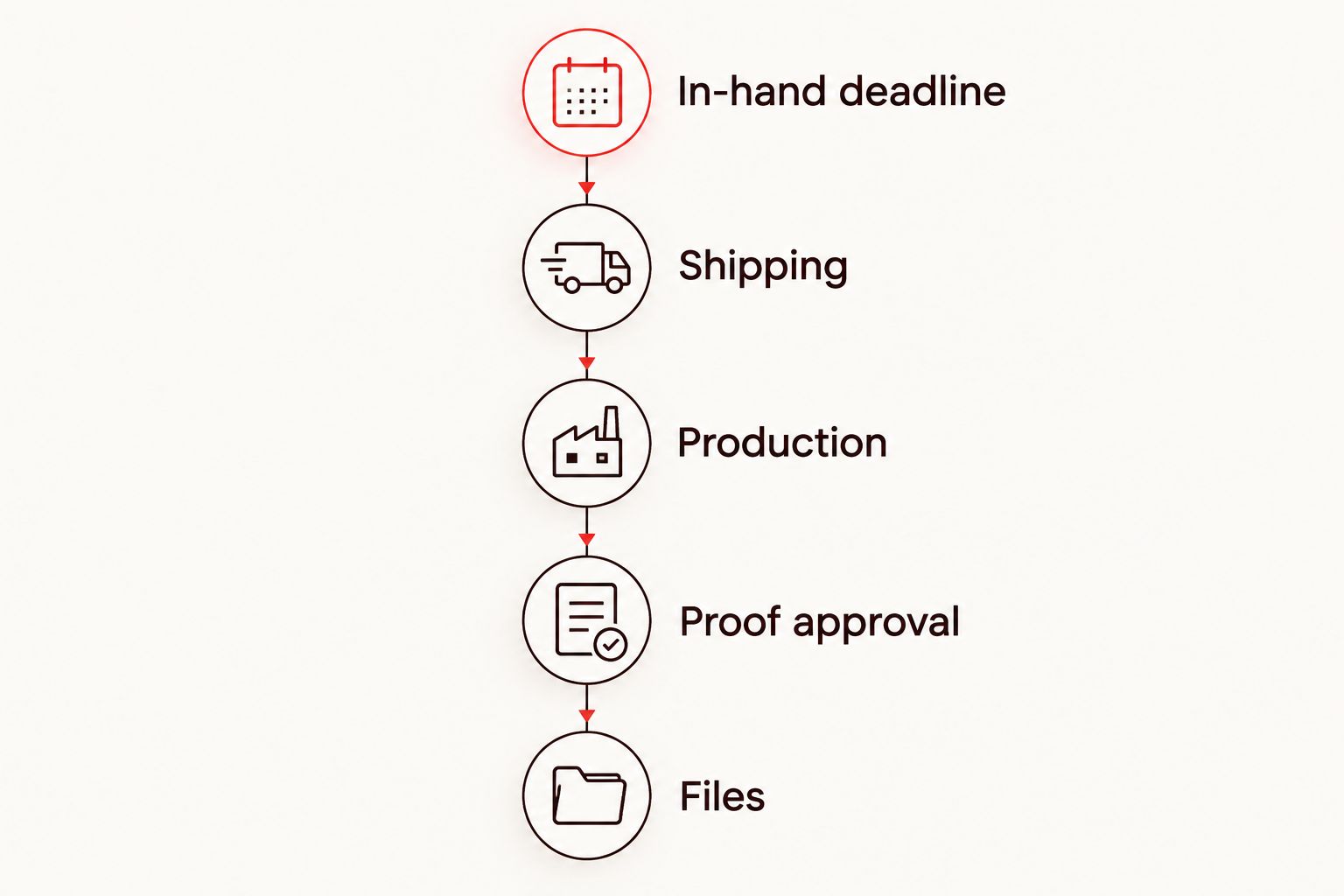
Once you have the milestones, put them in a shared calendar or project document. Record both the date and the person responsible. A deadline without an owner does not tell anyone who must review the proof or answer a production question.
A digital proof lets you inspect a file on screen; a physical proof lets you inspect a printed object. Neither removes your responsibility to check the content. Choose the review method around what you need to evaluate, and confirm the proof process for your order.
| Review method | Best for | What you can examine | Limitation |
|---|---|---|---|
| Digital proof | Checking content and layout before approval | Text, page order, placement, and the displayed cover layout | A screen does not reproduce the feel of paper or a finished binding |
| Physical proof | Evaluating a printed version before the full run | Printed appearance and the physical characteristics represented by that proof | Printing, delivery, review, and any corrections need room in the schedule |
Do not treat a physical proof as a shortcut. Its value is giving you something tangible to evaluate before authorizing the run. Ask what the proof includes and whether it represents your selected materials and binding.
For either method, review the entire book. Check the title page, contents, chapter openings, blank pages, image placement, running headers, and back matter. Review the cover as well as the interior; approval needs to cover the complete printed project.
A perfect bound cover includes the front, spine, and back in a coordinated layout. The spine width depends on the thickness of the book's interior. Changing page count or paper can therefore require a cover adjustment, even when the front-cover artwork stays the same.
Before approving a 2026 print run, confirm the final page count and selected paper, then use the printer's cover dimensions. Do not borrow a spine measurement from a different book or reuse a cover file without checking it against the current order.
Inspect spine text, the position of important artwork, and anything close to a trim or fold location. Follow the printer's requirements for bleed and safe placement. The goal is a cover that fits the approved interior, not simply a PDF that looks attractive on screen.
Send a clear project brief rather than asking only how quickly books can be printed. Include the final page count, trim size, quantity, paper preferences, color requirements, destination, and required arrival date. Identify any specifications you still need help choosing.
Publishing Xpress is best for self-publishers, nonprofits, and organizations seeking short-run book printing without large minimum orders. Its perfect bound book printing is relevant when you want that binding for your project; do not choose it solely on an assumed speed advantage.
Perfect binding gives a book a glued spine, but it does not offer the same fold-back handling as coil or Wire-O binding. Match the binding to how readers will use the book, then confirm the schedule. Changing formats late also means checking the files against the new binding requirements.
When discussing your project with Publishing Xpress, ask:
Plan your perfect bound book order
Confirm your book specifications, proofing steps, and required arrival date before committing to a schedule.
Faster shipping changes transportation, not file preparation, proof approval, or binding. Evaluate it against the dispatch date the printer confirms for your order. It cannot recover time spent on unfinished artwork before the books leave production.
If your deadline is tight, ask which part of the complete schedule needs attention. Keep production and shipping questions separate so you understand exactly what a proposed change accomplishes.
A smaller quantity is not a delivery promise. The order still needs accepted files, approval, printing, binding, and finishing. Ask for the schedule associated with the actual quantity instead of using order size as a substitute for confirmation.
Keep the final specifications consistent while you compare schedules. Otherwise, you are comparing different projects rather than finding out how quantity affects your own book.
Contact the printer before sending replacement files or approving another version. Ask whether production has started and what the change means for the schedule. Do not assume a new upload automatically replaces an approved file.
Keep approval tied to a clearly identified version. Save the approved interior, cover, and approval message together so everyone can identify the same book.
How long does perfect bound book printing take in 2026?
Perfect bound book printing takes the production time confirmed for your specific order. Add file preparation, proof approval, shipping, and any tasks you need to complete after delivery to plan the full deadline.
When does the book printing turnaround clock start?
The starting point depends on the printer’s stated process for your order. Ask whether the quoted period starts at order placement, file acceptance, proof approval, or another confirmed milestone.
Does book printing turnaround include shipping?
Do not assume book printing turnaround includes shipping. Ask whether the quoted endpoint is production completion, dispatch, or delivery to your address.
Will a physical proof add steps before my books are printed?
A physical proof requires printing, delivery, your review, and approval before the full run if that is the agreed process. Confirm what the proof represents and schedule any corrections before authorizing production.
Can changing my page count affect the perfect bound cover?
Changing page count can change the interior’s thickness and the required spine width. Recheck the cover against the final page count and paper before approval.
Is Publishing Xpress suitable for short-run perfect bound books?
Publishing Xpress offers short-run digital printing with perfect binding and no large minimum order requirements. Confirm your book’s specifications and order-specific schedule before planning delivery.
What is the most useful deadline to give a book printer?
Give the printer your required in-hand date and delivery destination. Also explain whether you need time after arrival to inspect, sign, pack, or distribute the books.
Put your arrival deadline beside your file-approval deadline. The relationship matters: a delivery plan based on approved files does not protect you while the manuscript is still changing.
For your 2026 project, keep a single final approval record with the interior filename, cover filename, and confirmed schedule. That small organizational step gives you a clear reference when a contributor asks which version is going to print.
© 2026 Publishing Xpress. All Rights Reserved.