August 22, 2026
Book printing turnaround time is the total number of business days between file approval and the day your books ship — and most self-publishers only count one of the four steps that actually make up that number.
Authors miss launch dates almost every time because they calculate turnaround as "how long does it take to print the book" instead of "how long from today until the box is on my porch." Those are different numbers, and the gap between them is where book launches, fundraiser deadlines, and conference handouts fall apart.
The fix is a formula, not a guess. Once you know which binding you're using — perfect bound, saddle stitch, Wire-O, or plastic coil — and you choose the right book binding type for your page count, turnaround time becomes math you can do on the back of an envelope, not a mystery you cross your fingers about.
Turnaround doesn't start when you place an order — it starts when your files are approved as print-ready and no further changes are coming. This matters because every day you spend fixing margins, re-flowing chapters, or swapping a cover file is a day added to your calendar, not subtracted from your printer's production time.
Write down the calendar date you actually expect to hit "approved, final, ship it." Common mistake: authors treat the day they upload files as the approval date, then lose two or three days to proofing questions they didn't budget for.
Most short-run printers send a digital proof before anything hits a press, and you need to review it, not rubber-stamp it. This step exists to catch a flipped page order or a cover that bled wrong before 200 copies come off the line — catching it here is free; catching it in the finished box is not.
Build in same-day turnaround on your end: open the proof, check trim marks, check spine text alignment on perfect bound jobs, and approve or flag it within 24 hours. Common mistake: sitting on a proof over a weekend and then wondering why the whole schedule slipped by two business days.
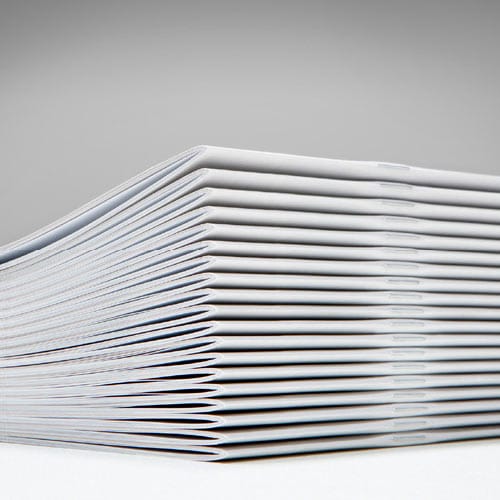
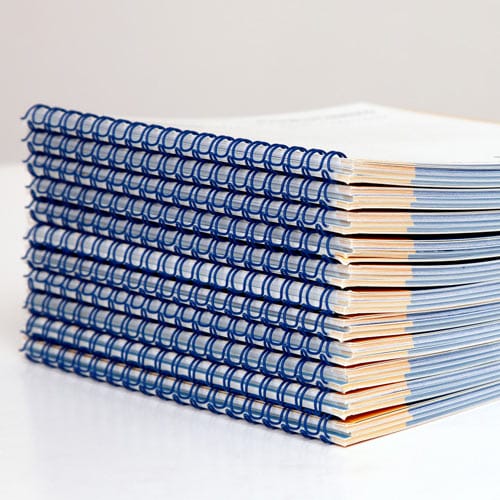
Binding type changes how many production stages your book passes through, and that changes your baseline turnaround. Saddle stitch is folded and stapled in one continuous run — it's the fastest binding for a 4- to 92-page booklet. Perfect binding requires the block to be collated, glued, and trimmed on three sides after the cover is applied, which adds a stage saddle stitch never touches. Wire-O and plastic coil both need holes punched or drilled before the wire or coil is inserted, which is its own separate step.
If your deadline is genuinely tight, binding choice is the lever you can pull. Read perfect binding vs saddle stitch before you commit to a spine that adds days you don't have. Expected outcome: you pick the binding that fits your calendar, not just your page count. Common mistake: choosing perfect binding for a 40-page booklet purely because it "looks more like a real book," then being surprised the schedule runs longer than a stapled saddle-stitch job would have.
Once files are approved and binding is set, the print run itself runs in press-and-bindery order: printing, drying or curing, cutting, binding, and quality check. Larger quantities and full-color interiors add press passes; black-and-white interiors move faster than four-color photo-heavy books.
Expected outcome: you now have a number that covers approval-to-boxed, before the box ever leaves the building. Common mistake: assuming a 500-copy order takes proportionally five times longer than a 100-copy order — digital short-run printing doesn't scale that way, but you should still confirm your specific quantity and page count with your printer rather than assume.
This is the step people forget entirely, and it's often the biggest swing in your final date. UPS Ground within the continental US typically runs 1 to 5 business days depending on origin and destination, while USPS Priority Mail typically runs 1 to 3 business days — both are widely published carrier estimates, not guarantees, and neither counts weekends.
Expected outcome: a real delivery date, not a "ships by" date. Common mistake: quoting a launch date based on the ship date instead of the arrival date, then scrambling when boxes are still in transit on launch day.
Once you've added proofing, binding, production, and shipping, add a buffer of at least a few business days before you commit to a public date — a book launch, a conference, a fundraiser mailing. Files get flagged in preflight, carriers hit weather delays, and 2026 holiday weeks compress everyone's calendar at once.
Expected outcome: a public deadline you can actually hit. Common mistake: announcing a launch date that equals your calculated turnaround exactly, with zero room for anything to slip.
Files get rejected in preflight. Low-resolution images, missing bleed, or fonts that aren't embedded are the most common flags — fix and resubmit before you assume your printer is running behind. Review common book printing mistakes before you upload, not after.
Proof approval drags on. If you're waiting on a co-author, editor, or board member to sign off, set an internal approval deadline that's earlier than your real one — build the buffer into your own process, not the printer's.
You changed binding mid-order. Switching from saddle stitch to perfect binding after files are submitted resets several production stages. Confirm binding before final file upload, not after.
Order lands during a holiday week. Late November through early January compresses everyone's schedule in 2026 just like every other year — order earlier, not closer, for any December event.
Wrong shipping method chosen at checkout. Ground shipping saves money but can cost three to four extra calendar days versus a faster method — match the method to the deadline, not the budget alone.
Bulk or nonprofit order underestimated. Larger quantities for fundraisers or bulk distribution need more lead time than a single author copy run — plan the order size into your calendar early, not after you've already picked a date.
Once your turnaround math is set, the next decision is usually format — perfect bound novel, saddle-stitch booklet, or something in between. Book printing for self-published authors walks through how format choice and order size work together once you're past the timeline question.
What is a normal book printing turnaround time in 2026?
Turnaround time in 2026 depends on binding type, page count, and shipping method — saddle stitch and coil-bound booklets move through production faster than perfect bound books because they skip the glue-and-trim stage. Always add proofing and shipping days on top of production time, not instead of it.
Does binding type actually change turnaround time?
Yes — perfect binding adds a gluing and trimming stage that saddle stitch and coil binding don’t need, so it typically takes longer end to end. If your deadline is tight, saddle stitch or coil is the faster binding choice for booklets under roughly 92 pages.
How much does shipping method affect my delivery date?
More than most people expect. UPS Ground and USPS Priority Mail both carry published transit windows that vary by distance, and neither counts weekends, so the shipping method you choose at checkout can shift your arrival date by several business days.
Should I count the file-approval date or the order date as day one?
Count the day your files are fully approved and print-ready as day one, not the day you first uploaded them. Revisions, proof corrections, and sign-off delays all happen before day one starts, and skipping that distinction is the most common turnaround miscalculation.
How do I calculate turnaround for a large bulk or nonprofit order?
Start the same way as a single-copy order — proofing plus binding plus production plus shipping — then confirm your specific quantity’s production time directly with your printer, since larger runs can add press passes. Price and lead time for bulk orders are usually discussed together, so raise both at once.
Does holiday timing affect book printing turnaround?
Yes. Late November through early January compresses schedules across the printing industry in 2026 the same way it does every year, so orders placed for a December event need to go in earlier than you’d think.
What’s the single biggest mistake authors make calculating turnaround?
Treating the print run as the whole timeline and forgetting proofing and shipping days entirely. The print run is often the shortest of the four steps — proofing delays and shipping transit time are what actually blow deadlines.
A file approved on a Friday afternoon doesn't just lose the weekend — it loses the following Monday too if your proof needs a same-day turnaround response, because most production teams treat weekend approvals as landing Tuesday morning at the earliest. If your deadline is close, approve files early in the week, every time.
“If your deadline is genuinely tight, binding choice is the lever you can pull — not the shipping method.”
© 2026 Publishing Xpress. All Rights Reserved.