October 26, 2026
The cost to self publish and print a cookbook depends on the work needed to finish your recipes and the specifications of your printed book; build your 2026 budget from separate publishing, printing, and delivery estimates. A printing quote alone does not account for recipe testing, editing, photography, layout, or sending finished copies to readers.
For a first run, start with the book your readers will actually use—not every feature you could add. Publishing Xpress has a minimum order of 25 copies, so match your project to that minimum before preparing the printing files.
Your cookbook budget needs separate allowances for creating the book, producing the copies, and delivering them. Keep those categories separate when comparing estimates in 2026. Otherwise, an estimate for printing alone can look equivalent to one that includes substantial preparation work.
Use this breakdown to decide what belongs in your project budget. These are planning categories, not a claim that every cookbook requires every service.
| Budget category | What to include | Decision to make before requesting an estimate |
|---|---|---|
| Recipe development | Ingredients, testing, and revisions | Which recipes are ready for another cook to follow? |
| Editing | Clear instructions, consistent measurements, and proofreading | What work can you complete yourself? |
| Photography | Original images, image preparation, and permissions where needed | Which recipes genuinely need photographs? |
| Book design | Interior layout and cover preparation | What trim size and binding will you use? |
| Printing and binding | Interior pages, cover, paper, and finished quantity | What are the final production specifications? |
| Delivery and distribution | Shipment to you, packaging, and delivery to readers | Who receives the books, and how? |
Ask each supplier to identify the work included in their estimate. Keep optional work separate so you can remove it without losing track of essential tasks.
For the production side specifically, the guide to custom cookbook printing costs helps you frame the printing questions separately from manuscript preparation.
A cookbook has to work as instructions, not just look finished. A beautiful photograph cannot fix a missing ingredient, and a tidy layout cannot fix a recipe that sends the reader back and forth between pages.
Protect usability before adding decorative features. Your 2026 budget should support readable recipes, clear organization, and a binding that fits how the book will be handled.
Doing your own editing, photography, or layout reduces the services you need to buy. It does not remove the work. Write those tasks into your schedule, even when they do not appear as payments in your budget.
Give each task a clear owner and completion point. For example, finish recipe revisions before laying out the interior; otherwise, changing instructions can mean rebuilding pages and updating the table of contents.
The number of copies printed is not the number you will sell. Copies reserved for contributors, gifts, demonstrations, or your own records belong in the distribution plan too.
Write down those uses before ordering. Choose a quantity you can explain with a distribution plan, rather than assuming every finished copy will generate revenue.
Binding affects how a cookbook opens, where you place text, and how the finished book feels in a reader's hands. Choose it before completing the cover and interior files.
The following comparison focuses on use, not a universal winner. Every option has a practical trade-off.
| Binding | Best for | Main advantage | Main limitation |
|---|---|---|---|
| Plastic coil | Recipes used beside a mixing bowl | Pages open flat and turn around the coil | Requires space for punched holes along the binding edge |
| Wire-O | Cookbooks used open on a counter | Pages open flat with paired wire loops | Exposed wire needs care during handling and packing |
| Perfect bound | Paperback cookbooks intended for shelves and gifts | Glued spine provides a conventional paperback format | Does not naturally stay flat like a punched binding |
| Saddle stitch | Short recipe collections | Folded, stapled construction suits booklet formats | Publishing Xpress limits saddle stitch books to 80 pages |
Choose plastic coil when keeping the recipe open matters most. A cook can turn the pages back around the binding, which helps when counter space is limited.
The trade-off belongs in your layout: keep ingredients, instructions, and page numbers away from the punched edge. Do not finish a tight-margin interior and assume it can move unchanged to coil binding.
Choose Wire-O when you want recipes to sit open with a paired-loop wire binding. This format works well when readers need to refer to a spread while preparing food.
Protect the wire during storage and packing. Wire-O also requires binding-edge clearance, so check the printer's file requirements before positioning photographs or text near that edge.
Choose perfect binding when the paperback shape and spine are central to the project. It suits a cookbook readers will browse, shelve, and give as a book.
The limitation is countertop use. A perfect-bound book does not have the same opening behavior as coil or Wire-O, so avoid placing essential instructions deep in the inside margin.
Choose saddle stitch for a compact recipe booklet that fits the page limit. Folded sheets are stapled through the fold, making this a different construction from a glued or punched book.
The maximum is 80 pages for this service. Count all planned content—not just recipes—before committing to the format, and confirm how the cover is counted when preparing your estimate.
For your 2026 project, compare these factors before changing suppliers. An estimate is only comparable when the underlying book stays the same.
Do not change all these factors at once. Hold the core specification steady, then request an alternative that answers a specific question, such as whether a different binding better suits everyday kitchen use.
A useful estimate starts with a written specification. Follow this sequence so every supplier receives the same description of your book.
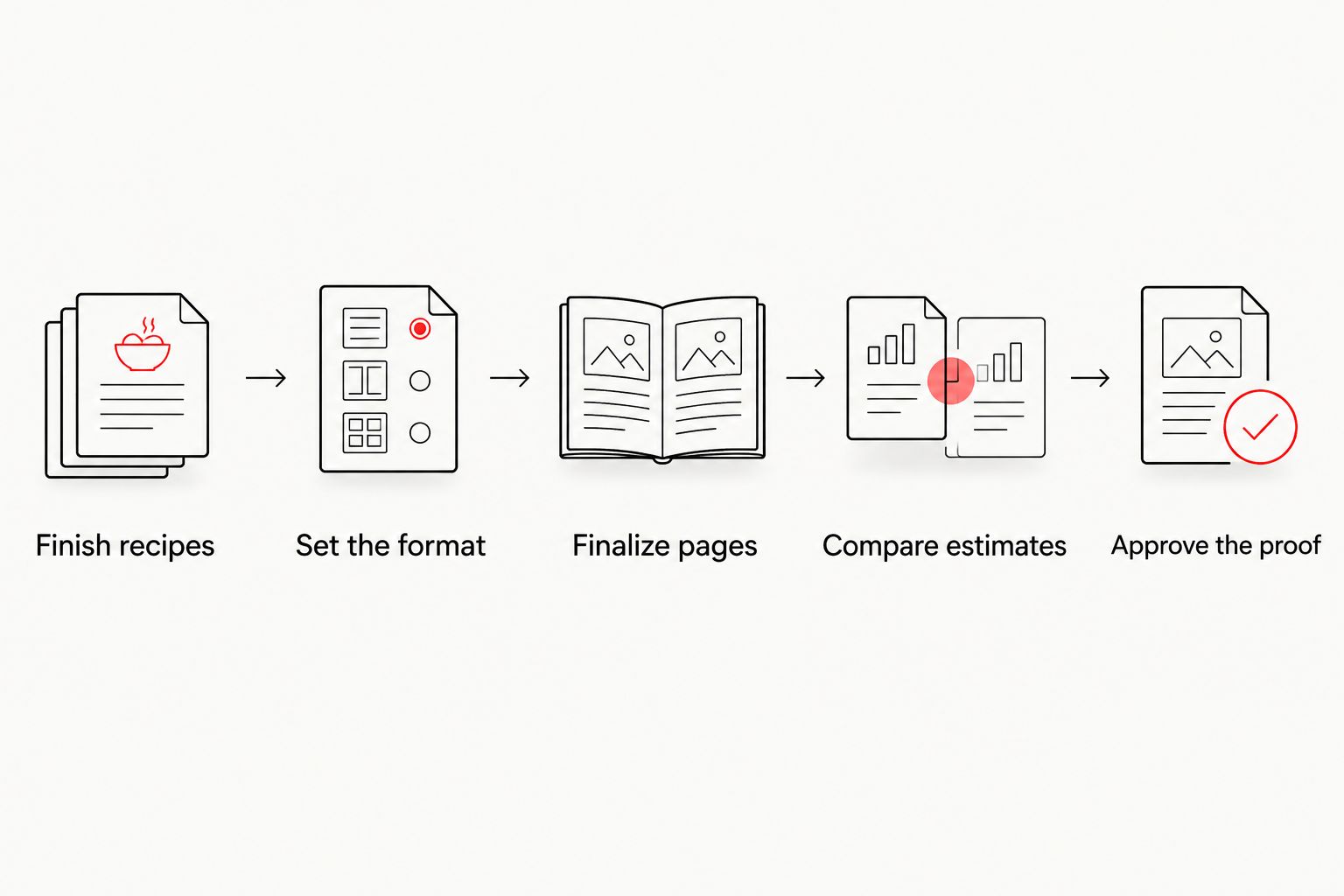
Use a small comparison sheet alongside the estimates. Record what is included, which decisions remain open, and whether the supplier is quoting from finished files or an early specification.
Publishing Xpress cookbook printing is best for self-publishers who need a short run of at least 25 copies. The minimum makes it unsuitable when you need fewer copies, and printing does not replace the recipe preparation and design work your project requires.
Plan your cookbook print run
Review printing options after choosing your quantity, binding, and finished page count.
Start with the useful version of your cookbook, then add features deliberately. A focused collection of clearly written recipes is a sounder production brief than an expanding manuscript with an unsettled layout.
Ask someone other than the recipe's author to follow the instructions. Check that every ingredient appears in the method and that the method explains preparation details the ingredient list assumes.
Read the laid-out pages again after editing. Line breaks, page turns, and photo placement can separate information that was easy to follow in the manuscript.
Use photographs where they help readers recognize texture, assembly, or the finished dish. If an image is decorative, decide whether it deserves the space it takes from instructions or notes.
Check that you have permission to print each image. Keep those permissions with your project files rather than trying to reconstruct them near the production deadline.
Do not judge estimates solely by the printing line. Compare the work you still need to complete, the delivery arrangements, and the files required for approval.
Keep a dated specification with your 2026 estimates. When the page count or binding changes, update that specification so an older estimate does not become the basis for an unrelated version of the book.
25 copies is the minimum order at Publishing Xpress. That makes a small batch possible without planning a large initial distribution.
Match the batch to a defined audience, such as contributors, family members, or participants in a cooking program. Keep a record of corrections readers identify so a later printing uses the revised files.
4 to 6 days after proof approval is the stated shipping window at Publishing Xpress. That window is not the full schedule for writing, editing, design, proof review, and transit.
For a 2026 fundraiser or launch, plan backward from the date readers need their books. Leave room to review the proof carefully instead of treating approval as a formality.
What’s included in the cost to self publish and print a cookbook?
Your cookbook budget includes preparation, printing, and delivery. Depending on the project, preparation includes recipe testing, editing, photography, interior layout, and cover design; compare those separately from producing the copies.
Can I save money by designing my cookbook myself?
Designing the cookbook yourself removes the need to buy that design service, but you still need a readable layout and print-ready files. Confirm trim size, binding clearance, image requirements, and proofing responsibilities before starting.
What’s the best binding for a cookbook that stays open?
Plastic coil and Wire-O are suitable choices when a cookbook needs to stay open on a counter. Both require room along the punched edge, while perfect binding suits a conventional paperback format but does not naturally stay flat in the same way.
Does every recipe in my cookbook need a color photograph?
Every recipe does not need a color photograph. Include images that explain a technique or help readers recognize the result, and make sure the instructions work without relying on decorative pictures.
Can I use saddle stitch for a long cookbook?
Saddle stitch is limited to 80 pages for this printing service. If your completed cookbook exceeds that limit, consider perfect binding, plastic coil, or Wire-O and confirm the requirements for your chosen format.
Should I finish editing before getting a printing estimate?
Finish editing and layout before relying on a final printing estimate. Early estimates help with planning, but changes to the page count, binding, paper, color, or quantity require an updated specification.
Is printing turnaround the same as delivery time?
Printing turnaround and delivery time are separate parts of your schedule. Account for manuscript preparation, proof review, production, and transit before promising a date to readers.
Test the layout with a recipe, not just a page of text. Print a draft spread at its intended size and use it while cooking. Check whether you can find the ingredient quantity, return to the correct step, and read comfortably from the counter.
That simple rehearsal tests the decisions your budget is funding. Fix the layout before approving the whole cookbook, when changes are still confined to your files rather than finished copies.
© 2026 Publishing Xpress. All Rights Reserved.