October 13, 2026
Custom cookbook printing takes the production time your printer confirms for your approved files and chosen specifications, plus shipping time. For a 2026 project, keep recipe editing, layout, and proof approval separate from that production estimate, and plan around the date you need the books in hand—not just the date they leave the printer.
Your cookbook's reliable timeline is the schedule confirmed for your specific order, not a generic book-printing average. Give the printer your finished page count, quantity, binding, color requirements, and delivery destination before asking for a completion date.
Use this sequence to establish the schedule:
For the scheduling basics, read how to calculate book printing turnaround time. Apply the same distinction to your cookbook: file preparation, production, and delivery are separate stages.
An uploaded manuscript is not the same as an approved print file. Before announcing a launch date, confirm that the printer has accepted the files and that you understand any remaining approval steps.
A cookbook deadline usually belongs to something larger: a family reunion, fundraiser, cooking class, restaurant event, or gift presentation. Books that ship on the event date do not meet an in-hand deadline.
For a 2026 launch, write down 2 dates: the printer's expected ship date and your required receipt date. Keeping those dates separate prevents a production estimate from becoming an accidental delivery promise.
You also need time after receipt. Inspect the books, organize contributor copies, and prepare any mailing or event distribution before handing them to readers.
Binding changes how the cookbook works on a kitchen counter and how its files need to be prepared. It is not a detail to choose after approving the layout.
Publishing Xpress offers 4 binding options: perfect bound, saddle stitch, Wire-O, and plastic coil. Publishing Xpress is a good fit for self-publishers and organizations seeking short-run cookbook printing with a choice of these bindings.
The benefit is format choice without a large-run requirement. The limitation is that the service description is not an order-specific delivery commitment; confirm the schedule for your files, quantity, and binding before planning distribution.
| Binding | Best for | Practical advantage | Trade-off | What to confirm for scheduling |
|---|---|---|---|---|
| Perfect bound | Shelf-style recipe collections | A glued spine creates a conventional paperback format | Standard perfect binding does not lie completely flat | Cover setup, spine dimensions, and finishing schedule |
| Saddle stitch | Short recipe booklets | Folded sheets and spine staples suit booklet formats | Page count and paper thickness limit the format | Accepted page count and booklet layout |
| Wire-O | Cookbooks used open on a counter | Double-loop wire binding lets pages lie flat | Exposed wire can deform if crushed | Punching clearance and finishing schedule |
| Plastic coil | Hands-on kitchen reference books | Pages lie flat and fold back around a continuous coil | Exposed binding differs from a conventional bookshelf spine | Punching clearance and finishing schedule |
Choose the format for the reader's cooking habits, then confirm its production schedule. Do not assume that a binding with fewer visible parts is automatically faster to produce.
Perfect binding suits a cookbook intended to look and handle like a paperback. It works well when readers browse recipes, photographs, and stories rather than keeping the book open unaided beside a mixing bowl.
Finalize the page count and paper choice before finalizing the spine artwork. Spine dimensions depend on the book block, so changing the interior after preparing the cover creates another file-checking task.
Recommendation: choose perfect binding for the paperback format, not as a shortcut to a deadline. Ask for timing after the printer has the final specifications.
Saddle stitching suits a compact recipe collection, event handout, or introductory cooking booklet. Its folded-sheet construction requires the finished page count to work in multiples of 4 pages.
Count the entire document, including title pages, credits, and intentional blanks—not just recipe pages. Ask the printer how the cover is counted and whether the selected paper and page count suit the format.
Recommendation: choose saddle stitch when your content fits a booklet. Do not squeeze a longer cookbook into the format merely to simplify the order.
Wire-O binding lets a cookbook lie flat, helping readers follow instructions without holding the spread open. That makes it a practical choice for teaching recipes and countertop reference books.
Keep ingredient quantities, instruction text, and image details clear of the punched edge. Confirm the required binding margin before designing the interior, rather than moving content after the proof arrives.
Recommendation: choose Wire-O when open-page use matters. Protect the exposed wire during storage and distribution, and confirm the finishing schedule for the order.
Plastic coil binding lets readers open the cookbook flat or fold pages back. This suits a working recipe collection used beside ingredients, utensils, and preparation notes.
The punched edge still needs space. A full-width photograph or ingredient list that looks balanced on screen needs to remain readable after punching and binding.
Recommendation: choose plastic coil for hands-on reference use. Accept the exposed-binding appearance as part of that practical format.
The calendar changes when the job specifications or approval status change. These are the factors to settle before treating an estimate as your working schedule:
A 2026 turnaround estimate should identify its starting point. Ask whether the quoted production period begins with file acceptance, proof approval, or another order milestone.
Do not compare estimates unless those starting points match. A shorter production estimate with unfinished approval work is not directly comparable to an estimate for an approved job.
Resolve recipe and layout decisions before asking the printer to commit to a production plan. A clear specification gives both you and the printer the same project to discuss.
Read each recipe as an instruction sequence, not just as prose. Every listed ingredient should have a clear role in the method, and every ingredient mentioned in the method should appear in the list.
Check quantities, units, oven settings, serving information, and contributor names against your source material. Printing preserves the approved file; it does not correct a mistaken measurement.
For a community cookbook, appoint a final approver. Contributors can review their own recipes, but conflicting changes need to be resolved before the production version is released.
Look for ingredient lists separated from their instructions, awkward page turns, and headings that become isolated at the bottom of a page. Read the layout at its intended printed size rather than judging everything while zoomed in.
Check the contents page and index after pagination is final. A recipe moved during layout can leave a reference pointing to the wrong page.
Follow the printer's instructions for interior and cover files. Check page size, image quality, fonts, margins, and any required bleed without assuming that an export preset fits every printer.
Open the exported files and inspect them again. The editable document is not the file being printed, so approval should refer to the submitted version.
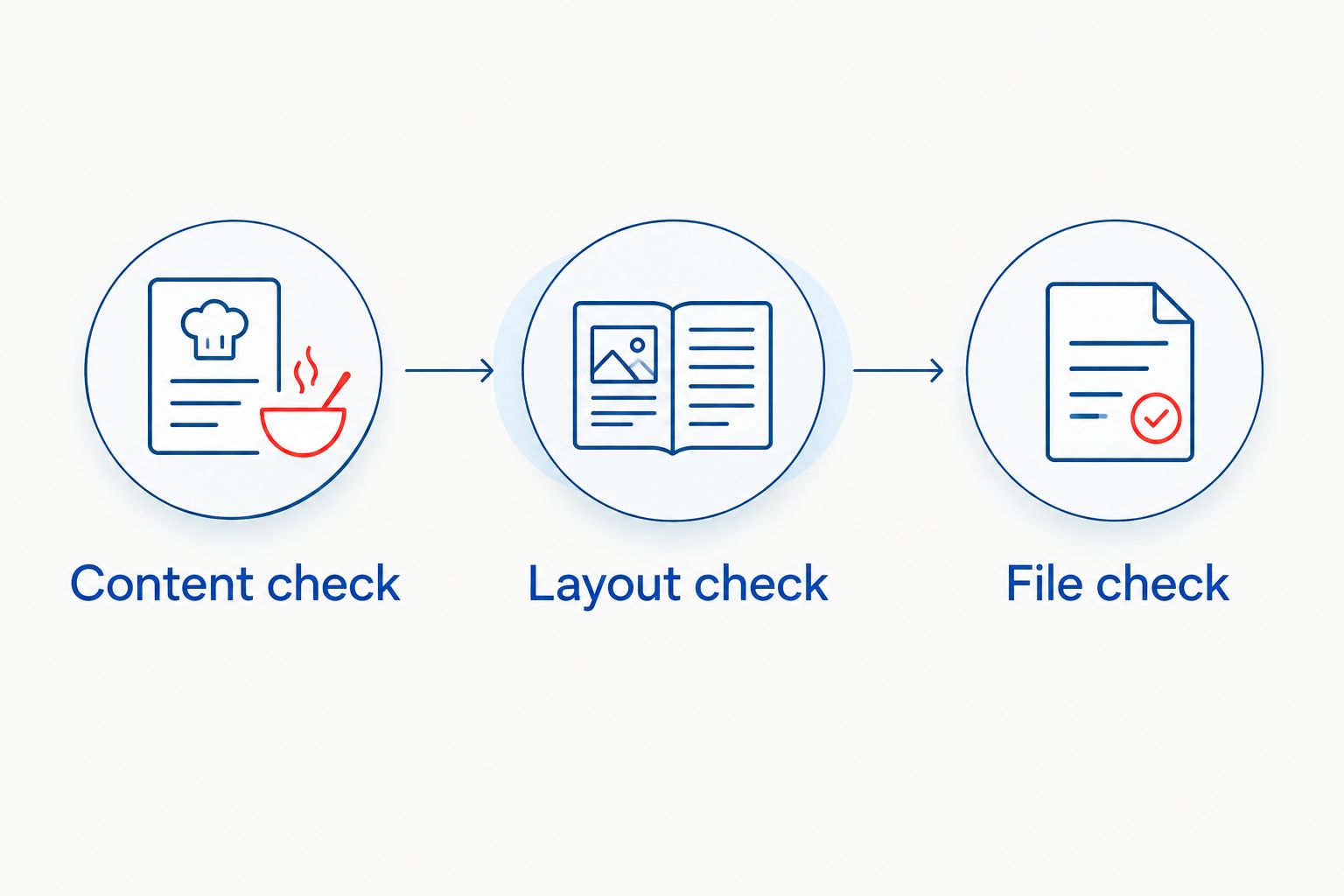
Use 3 checks: content, layout, and files before sending final approval. This is a practical review structure, not a substitute for the printer's technical requirements.
Start with the date the books must be ready for use. For a 2026 fundraiser, that means the date volunteers need usable copies—not the date the fundraiser begins advertising them.
Ask the printer to work backward with you from that requirement. Keep the following milestones in your project notes:
Assign someone to handle each approval and monitor messages during the order. If a printer asks a technical question, an unanswered message leaves a decision unresolved.
When you discuss Publishing Xpress cookbook printing, provide the required receipt date alongside the specifications. Ask for the production and delivery assumptions in writing so your schedule refers to the same job throughout.
You can shorten your own preparation and approval delays by submitting settled specifications and checked files. Ask the printer about expedited production for the exact job rather than assuming that an urgent event changes the production schedule.
Reduce unnecessary revision cycles, not necessary proofreading. Send consolidated corrections, approve a clearly identified version, and make sure the person authorizing production is available.
If the deadline is tight, discuss acceptable format changes before redesigning the book. Changing binding or removing photographs without confirmation creates work without establishing that the revised job will arrive sooner.
Shipping is separate from production unless the printer explicitly includes it in the quoted timeline. Ask for both the expected dispatch date and the estimated receipt date.
Check whether the schedule uses business days or calendar days. For a 2026 event, review the relevant weekends and holidays with the printer and carrier rather than counting every date as a working day.
Give the complete destination when requesting the schedule. Delivery planning for books sent to your home is different from planning your later distribution to contributors or customers.
Approve the production version before authorizing the cookbook to print. Confirm what proof format the printer offers and what that proof lets you evaluate.
A digital proof helps you inspect text, page order, and placement. It does not let you handle the paper or binding, and screen appearance is not a physical print sample.
If you request a physical proof, include its production, delivery, review, and any resulting corrections in your schedule. Confirm that process before making it part of your deadline plan.
How long does it take to print a cookbook in 2026?
Cookbook printing takes the production period confirmed for your approved order, plus shipping time. Ask for a schedule based on the final page count, quantity, binding, color requirements, and destination.
When does the cookbook printing turnaround clock start?
The turnaround clock starts at the milestone specified by your printer. Confirm whether that milestone is file acceptance, proof approval, or another order requirement.
Is coil binding faster than perfect binding for a cookbook?
Do not assume coil binding is faster than perfect binding. Request production estimates for the same page count, quantity, and deadline before comparing the formats.
Can I print a cookbook before all contributors approve their recipes?
Finish contributor approvals before authorizing production. Assign a final approver to resolve conflicting edits and identify the exact file being printed.
Will adding photographs change my cookbook schedule?
Adding photographs creates additional image and layout checks before approval. Ask the printer to reassess the schedule if those changes affect an order already under review.
Does a short print run mean my cookbook arrives sooner?
A short print run does not establish a delivery date. Publishing Xpress offers short-run printing, but your order still needs a confirmed production and shipping schedule.
What’s the best binding for a cookbook that stays open?
Wire-O and plastic coil are practical choices for cookbooks that need to lie flat. Perfect binding provides a conventional paperback format but does not lie completely flat.
Proofread the ingredient quantities separately from the recipe stories. Familiar wording is easy to skim, while a misplaced measurement changes what the reader cooks.
Before your final approval, follow a recipe from its ingredient list through every instruction in the exported file. Your cookbook deadline matters, but the version readers receive matters more.
© 2026 Publishing Xpress. All Rights Reserved.