October 14, 2026
There is no universal copy count that defines a short run in book printing in 2026; the printer's production method and order requirements determine what qualifies. The useful number is the quantity that printer will produce for your exact book specifications, not an industry-wide cutoff. A small batch also leaves you responsible for storing and distributing the copies you order.
A short run is a relatively small production batch, not a standardized number of books. Printers use the term to describe work suited to their equipment and production process. The same quantity does not necessarily receive the same label from every printer.
When you compare book printing options for short print runs, separate the printing method from the ordering model. Digital printing describes how pages are produced; short-run printing describes a batch; print on demand describes production triggered by demand.
| Option | Best for | Main advantage | Main limitation |
|---|---|---|---|
| Short-run digital printing | Authors and organizations needing a planned batch | Produces books without offset printing plates | You manage the copies you order |
| Print on demand | Publishers producing books in response to orders | Avoids committing to a larger batch in advance | Formats and fulfillment depend on the provider |
| Offset printing | Publishers comparing production for substantial, predictable demand | Spreads press setup across the production quantity | Requires plate preparation and press setup |
These are not copy-count tiers. A digital printer can produce a short batch, and a print-on-demand provider can use digital equipment. Ask about your actual project instead of treating these terms as interchangeable packages.
Choosing a quantity just to qualify as a short run reverses the decision. You need books for a purpose: preorders, an event, a course, a family project, or an organization's distribution list. That purpose should determine the order.
For your 2026 printing plan, start with copies you can assign to readers or recipients. Then account for author copies, review copies, and any deliberate reserve. Keep hoped-for sales separate from commitments already made.
A small batch gives you room to correct a later edition without replacing a large quantity of printed books. Its drawback is that you must plan another order when you need more. Order against a distribution plan, not against the word “short.”
The short-run label depends on more than how many books leave the printer. These project details explain why a printer needs specifications before confirming an order:
Do not turn these factors into a guessed cutoff. Ask whether the printer can produce your chosen quantity with your chosen format. A clear answer to that question tells you more than a general claim that the company handles small orders.
No. The run refers to the number of copies produced, while the book's length refers to its page count. Those are separate specifications.
A lengthy manuscript does not become a large print run because it has many pages. Likewise, a brief booklet does not become a short run if you order a substantial batch. Give the printer both the finished page count and the requested copy count.
Choose a short-run batch when you need books together for a defined purpose. Choose print on demand when production should follow individual orders. The difference is how you handle demand, not a universal threshold between small and large quantities.
A book launch, workshop, or organizational distribution gives you a reason to hold copies in advance. A batch lets you allocate those books to the event or recipients. The trade-off is responsibility for the remaining copies, packing, and distribution.
Print on demand suits a different workflow: books are produced in response to orders rather than drawn from a batch you already hold. Check the provider's printing and fulfillment arrangements separately. Printing a book and delivering it to its reader are distinct tasks.
For a 2026 release, you can evaluate both models without assuming that either replaces the other. Decide how each group of readers will receive the book. Direct handouts and individual purchases do not have to follow the same production plan.
Build your quantity from destinations, not from a round number that sounds impressive. The following process gives you an order you can explain and manage.
The result is your planned batch. It is not a promise that every copy will sell, but it makes the assumptions visible before you commit.
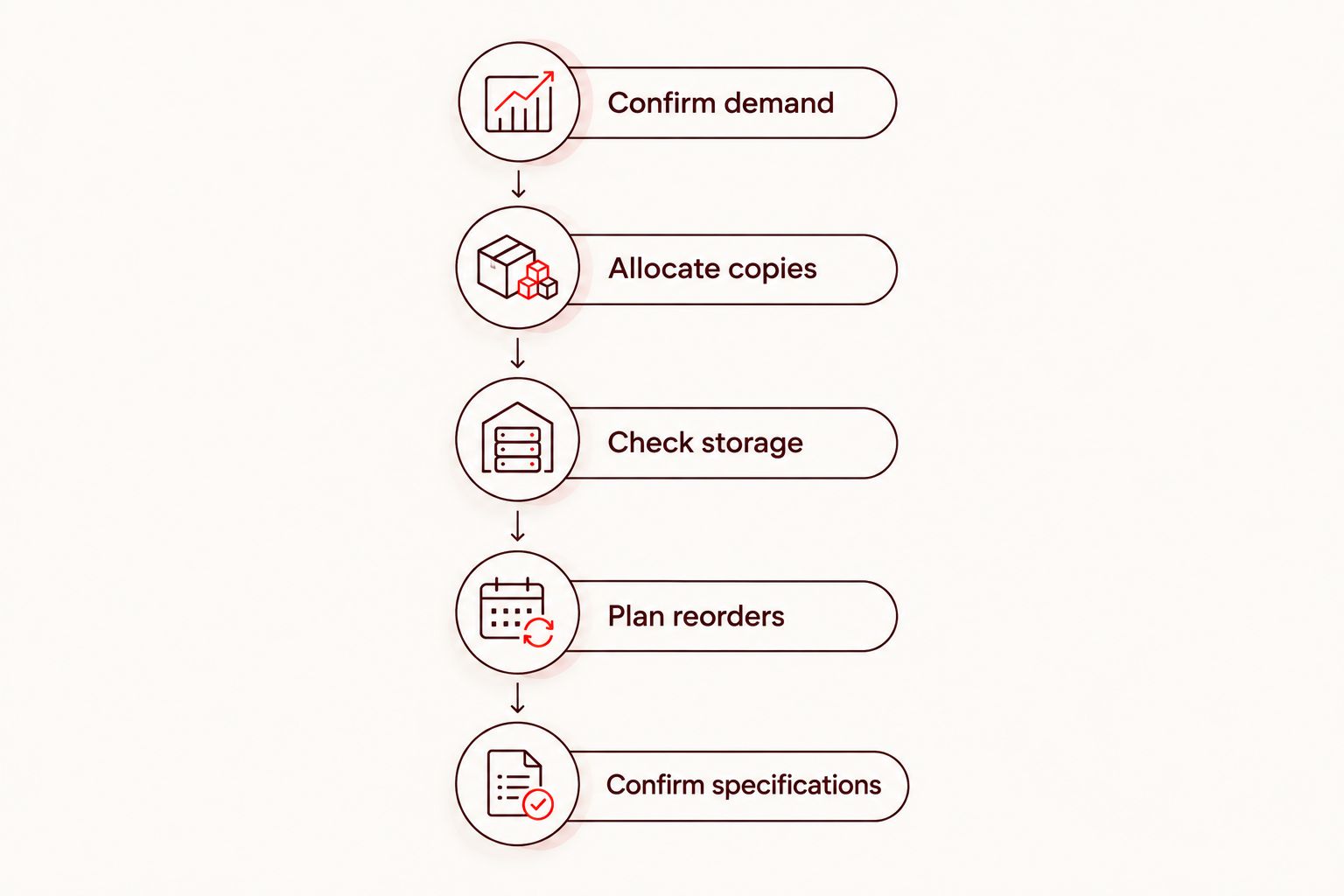
A confirmed recipient and a possible buyer should not occupy the same line in your plan. Keep a committed list and a separate forecast. That distinction lets you see how much of the order depends on expectations rather than known destinations.
For an event, attendance alone does not establish book demand. Decide whether each attendee receives a book, purchases one separately, or simply has the opportunity to browse. Your distribution arrangement determines the relevant count.
Extra copies need a reason, too. You might want books for later presentations, contributor requests, or ongoing direct sales. Name that purpose instead of adding an unexplained cushion.
A reserve without a destination is still a decision to hold more books. Review it against your storage space and your ability to distribute those copies. A smaller, defensible reserve is more useful than an optimistic pile.
Binding changes how the book works, but it does not establish a universal short-run copy count. Choose the binding for the reader's use, then confirm whether the printer supports it at your requested quantity.
Publishing Xpress offers short-run digital printing with 4 binding options: perfect bound, saddle stitch, Wire-O, and plastic coil. Publishing Xpress is best for self-publishers and organizations seeking short-run digital book printing. A batch order still requires you to plan what happens to the books after printing.
| Binding option | Best for | Practical advantage | Practical limitation |
|---|---|---|---|
| Perfect bound | Books intended for conventional shelf reading | Uses a glued spine for a familiar paperback format | Does not offer the same flat-opening behavior as coil or Wire-O |
| Saddle stitch | Booklets and event programs | Fastens folded sheets along the fold | Format suitability depends on the finished thickness |
| Wire-O | Reference books and working documents | Allows pages to lie flat | Exposed wire loops need care during handling |
| Plastic coil | Workbooks and hands-on reference materials | Allows pages to turn around the binding | Punched holes require space in the page layout |
Treat these 4 binding options as functional choices, not quantity tiers. A workbook reader needs room to write; a novel reader needs comfortable reading and handling. Neither use tells you how many recipients you have.
For a useful 2026 inquiry, describe the finished book rather than asking only whether the printer does “small orders.” The printer needs enough information to connect your quantity to a producible document.
Include the following details:
Ask the printer to distinguish production from delivery. Also confirm what happens if the files need corrections before printing starts. A requested date does not replace approval of the production schedule.
When comparing quantities, hold the book specifications constant. You want to understand the effect of ordering a different batch, not accidentally compare different books.
Yes, a later batch is a separate printing order. Confirm the printer's current requirements and retain the approved production files so you can identify exactly which version should be printed.
Save the final interior, cover, and a written record of the specifications together. If you revise the text or layout, label the new files clearly. Do not assume that a revised page count leaves a perfect-bound cover unchanged; the spine depends on the book's thickness.
For repeat orders in 2026, review the recipient list again rather than automatically repeating the original quantity. A successful event batch and an ongoing sales batch serve different purposes. Let the new demand determine the new order.
Future sales belong in a forecast, not in the confirmed-demand column. Printing additional copies is a commitment to hold and distribute them before those sales exist.
Increase the batch only when you can explain the intended channel, the storage arrangement, and the reason to print ahead. An established distribution plan is different from hoping a book finds readers. Keep that difference visible when you approve the order.
What’s the exact number of copies that makes a book order a short run?
There is no universal copy count that makes a book order a short run. Confirm the printer’s requirements for your quantity, binding, and document specifications.
Is short-run book printing the same as print on demand?
No, short-run book printing produces a planned batch, while print on demand produces books in response to orders. Both can use digital printing equipment.
Does a short run mean my book must have fewer pages?
No, a short run concerns the number of copies, not the number of pages. Give the printer your copy count and formatted page count as separate specifications.
What binding choices does Publishing Xpress offer for short-run printing?
Publishing Xpress offers 4 binding options: perfect bound, saddle stitch, Wire-O, and plastic coil. Select the binding for how readers will use the document, then confirm your project specifications.
How do I decide how many books to print for an event?
Base the quantity on your distribution arrangement and confirmed recipients. Separate books promised to attendees from books you hope to sell at the event.
Should I order my entire expected readership’s books at once?
No, expected readership alone is not a distribution plan. Separate confirmed demand from forecast demand and decide how you will store and distribute any additional copies.
What should I keep for a later book reprint?
Keep the approved interior file, cover file, and printing specifications together. Clearly identify revised files so the next order uses the intended edition.
Before approving your 2026 book order, assign every planned group of copies a destination. Write down who receives them, who distributes them, and where any remaining books will stay.
If you cannot explain a group, reconsider that part of the quantity. The right short run is a batch you can use—not a number that earns the label.
© 2026 Publishing Xpress. All Rights Reserved.