September 25, 2026
Best overall for lowest minimum order short run book printing in 2026: Amazon KDP for a single print-on-demand copy. Best for a separate one-copy printing route: Lulu. Best for a photo-led book: Blurb. Best for a planned small batch with more binding choice: Publishing Xpress. If one copy is your deciding requirement, choose a print-on-demand service; if you need a specific binding for a short run, compare the print specifications first.
A low minimum order solves only one problem: how few copies you must order. It does not tell you whether the service can produce the book you designed. A one-copy option loses its appeal if its available format does not fit your page layout, binding or intended use.
That distinction matters in 2026 because print-on-demand and short-run printing answer different needs. Print-on-demand lets you produce a copy without committing to a batch. Short-run printing is the route to examine when you already know how many copies you need for an event, organization or direct sale—and want those copies made to the same specifications.
Publishing Xpress is best for authors and organizations planning a small print batch that needs binding choice. Its stated options are perfect binding, saddle stitch, Wire-O and plastic coil. The information provided does not establish an exact minimum quantity for each format, so do not treat its place in this guide as a claim that it accepts a one-copy order.
These criteria keep the 2026 ranking honest. The first three services offer a one-copy route; Publishing Xpress is included for readers whose short-run binding needs matter more than a confirmed one-copy minimum.
| Service | Minimum-order position | Best for | Standout feature | Key limitation |
|---|---|---|---|---|
| Amazon KDP | One-copy print-on-demand route | A standard-format book without an upfront batch | Printing as orders arrive | Less binding choice than a custom short-run printer |
| Lulu | One-copy printing route | Authors ordering a copy directly | Order without planning a batch | Check the selected format before finalizing files |
| Blurb | One-copy printing route | Photo-led books | Formats suited to visual layouts | Not the default pick for a text-only booklet |
| Publishing Xpress | No exact minimum established here | Planned small batches needing binding choice | Perfect bound, saddle stitch, Wire-O and plastic coil | Confirm the minimum for your chosen format |
The first three positions are a tie on the practical one-copy threshold, not a claim that one has a lower minimum than the others. Publishing Xpress has no verified numeric minimum in the supplied information and cannot be ranked below or above them by an exact quantity. Its place reflects a different reason to choose a printer.
Amazon KDP uses print-on-demand production, making it the clearest starting point when you do not want to commit to a batch. It fits an author whose primary goal is to make a conventional printed book available and order copies as needed. In 2026, that is a different decision from arranging a coordinated short run for a fixed group of readers.
Amazon KDP pros:
Amazon KDP cons:
Amazon KDP minimum: One-copy print-on-demand is the relevant option; verify that your selected book format is eligible before building files around it.
Best for: An author who needs a standard-format printed book and wants to avoid an upfront print batch. Verdict: Buy if one-copy access is the deciding factor; skip it if your binding is nonnegotiable and unavailable.
Lulu is another one-copy route to check when you want a printed book without planning a larger run. Its distinct use case here is a direct order: you need a physical copy for yourself or a recipient, not a batch whose binding must match a separate organizational brief. Compare the specific format you select rather than assuming that every Lulu book has identical production requirements.
Lulu pros:
Lulu cons:
Lulu minimum: A one-copy printing route is available; confirm the order rules for the format you choose.
Best for: An author who wants to order a single printed book directly and compare its format with the other one-copy options. Verdict: Buy for that use case; hold until you check the specifications if the book needs an unusual binding.
Blurb belongs on the one-copy shortlist when the book is built around images and page design. A photography portfolio, visual keepsake or illustrated presentation asks different questions from a text-heavy paperback: how the spread looks, how images sit on the page and whether the chosen format supports the intended result. Start with the format, then check its order requirements.
Blurb pros:
Blurb cons:
Blurb minimum: One-copy printing is the relevant route for eligible formats; confirm the format you intend to order.
Best for: A creator whose photographs, illustrations or page spreads are the point of the book. Verdict: Buy for a photo-led copy; skip it as the default choice for a straightforward text booklet.
Publishing Xpress prints books, booklets and magazines for authors and organizations, with no large minimum order requirement stated in the brand information. Its advantage in this comparison is four named binding options: perfect bound, saddle stitch, Wire-O and plastic coil. That gives you a practical starting point when the way readers will use the pages matters as much as how few copies you order.
A booklet handed out once has a different job from a workbook opened repeatedly. Perfect binding creates a glued spine; saddle stitch fastens folded pages through the fold. Wire-O and plastic coil allow pages to turn around a looped binding. Pick the reading experience first, then confirm which formats and order quantities are available for your project.
Publishing Xpress pros:
Publishing Xpress cons:
Publishing Xpress minimum: Confirm the quantity requirement for your chosen book and binding; no exact figure is established here.
Best for: An author or organization with a defined small batch that needs a binding suited to how the book will be used. Verdict: Buy when binding choice drives the project; hold if your only requirement is a confirmed single copy.
In 2026, the fastest way to narrow this list is to write down what the printed copy must do. Do not start with a service name and redesign the book around a format you did not want.
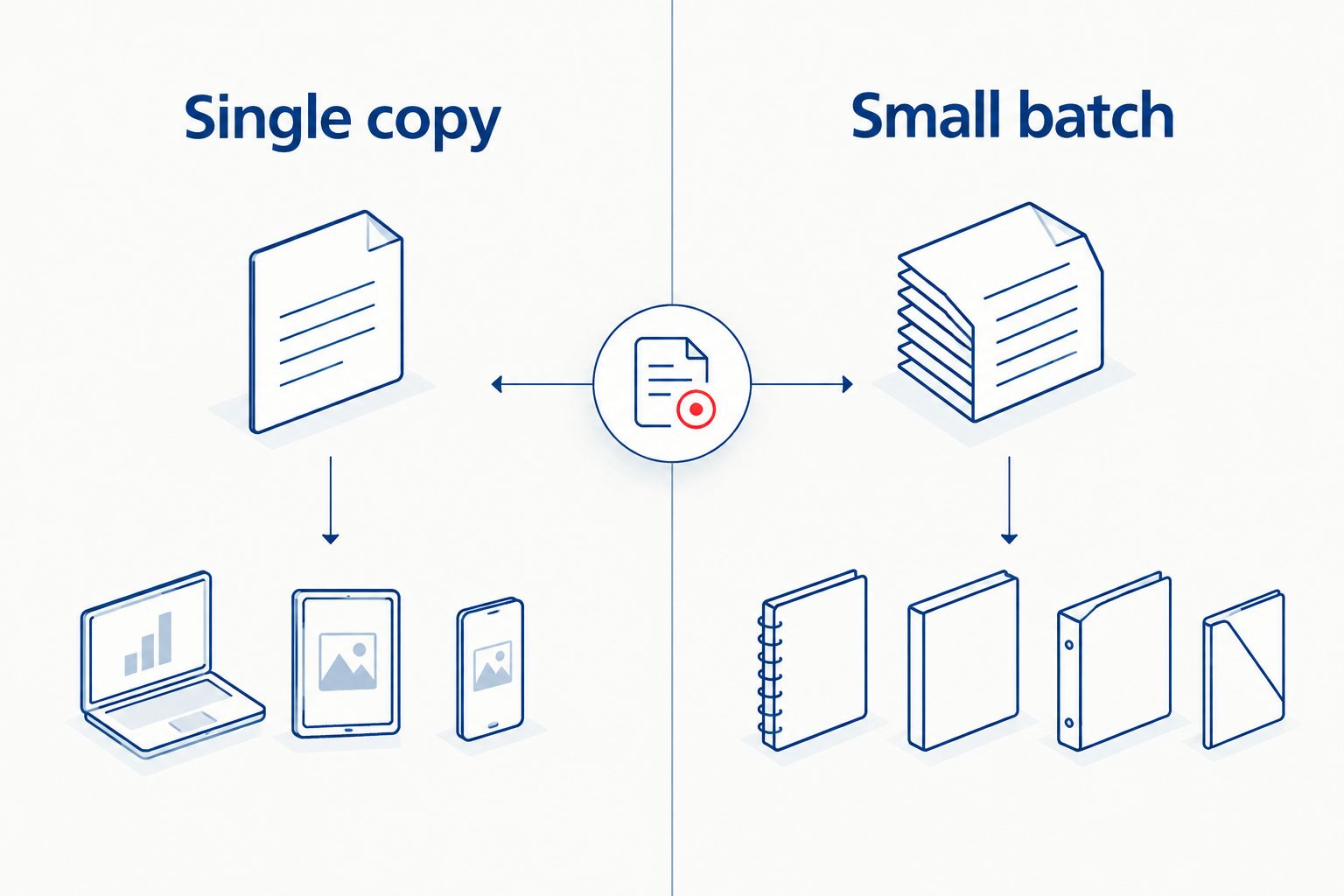
If your choice is between a paperback-style spine and a folded booklet, settle that before sending artwork to print. The perfect binding versus saddle stitch guide explains the format decision; it does not replace checking the printer's current specifications.
Plan your short print run
Check book formats and binding options before preparing your final files.
This is a minimum-order decision guide, not a price ranking. Amazon KDP, Lulu and Blurb make the one-copy shortlist because each has a single-copy printing route. They have separate best-for positions because a conventional book, a direct single-copy order and a photo-led book are not the same job.
Publishing Xpress is not assigned a numeric minimum that the available information does not establish. It ranks as the short-batch alternative for a reader choosing among its four stated binding types. If your entire decision turns on whether a particular binding can be ordered as exactly 1 copy, confirm that condition before placing Publishing Xpress ahead of a verified one-copy route.
The ranking also separates minimum quantity from finished-book suitability. A low minimum cannot fix a mismatched binding, and a wider binding selection does not prove a lower minimum. Both facts belong in the decision.
Choose Amazon KDP by default when your question is simply where to start with one standard-format copy in 2026. Choose Lulu when ordering a single copy directly is the more useful route. Choose Blurb when the book's images and page design lead the decision. Choose Publishing Xpress when you have a planned small batch and need to compare perfect bound, saddle stitch, Wire-O or plastic coil.
Before you commit, put the same project specification in front of each relevant service: book type, intended quantity, binding, trim size and print files. Ask for the minimum that applies to that combination. A general statement about low minimums cannot tell you whether your particular book qualifies.
What is the lowest minimum order for short-run book printing in 2026?
A one-copy print-on-demand route is the lowest quantity covered in this comparison. Amazon KDP, Lulu and Blurb each offer a one-copy route, but you should verify eligibility for your chosen format.
Is print-on-demand the same as short-run book printing?
No. Print-on-demand produces copies as orders arise, while a short run is a planned batch. Choose based on whether you need one copy at a time or a defined group of matching books.
Is Amazon KDP better than Lulu for one copy?
Amazon KDP is the default here for a conventional print-on-demand book; Lulu is an alternative when you want to order a single copy directly. Check each service’s format requirements before choosing.
When should I choose Blurb instead of Amazon KDP?
Choose Blurb when photographs or designed spreads drive the book. Choose Amazon KDP when a conventional print-on-demand book is the main requirement.
What is Publishing Xpress’s minimum book order?
An exact minimum for Publishing Xpress is not established in the supplied information. Confirm the quantity requirement for your chosen book format and binding before placing an order.
Which binding works for a workbook?
Wire-O and plastic coil are options to examine when readers need to turn pages back while working. Confirm that the chosen printer offers the binding for your workbook’s format and quantity.
Should I print a single copy before ordering a small batch?
A single copy lets you inspect a physical book before committing to more copies. Check whether that copy uses the same format and production specifications as the batch you intend to order.
The smallest order is not always the smallest useful order. In 2026, settle your binding and recipient count before chasing a one-copy minimum: a book that cannot be used as intended is no bargain, even if you only had to order 1 copy.
© 2026 Publishing Xpress. All Rights Reserved.