August 6, 2026
Tasting room guides take more physical abuse than almost any printed piece a small business produces — wine, humidity, sticky fingers, and repeated flipping at a pouring station. Custom book printing for wineries has to survive that environment while still looking like it belongs next to a $60 bottle.
A winery doesn't print one book and move on. Tasting notes change with every vintage, the wine club roster grows every quarter, and a harvest festival program gets reprinted before the leaves turn. Custom book printing for wineries means matching binding, paper, and run size to a business that reprints constantly and can't afford a guide that falls apart during the first pour.
Most general print shops quote wineries the same way they'd quote a corporate brochure — big minimums, slow turnaround, laminate that fogs under condensation. That mismatch is the actual problem, not the printing itself.
This guide is for tasting room managers, winery marketing leads, and small-lot producers who need tasting notes, wine club catalogs, pairing guides, or harvest event programs printed in runs of 50 to 2,000 copies — not the 5,000-unit minimums a commercial printer assumes you want.
A guide that snaps shut mid-pour annoys guests and slows staff. Binding that opens flat and stays flat — without a hand holding it down — matters more here than in almost any other booklet category.
A single-varietal tasting flight might need 12 pages. A full wine club catalog with vintage notes, pairing suggestions, and club tiers can run past 80. The binding method has to flex across that range without forcing a redesign.
Standard 60 lb. text paper wrinkles the moment a wine glass sweats on it. Heavier, coated stock resists moisture longer and holds color better under tasting room lighting.
Tasting notes change every harvest, sometimes every release. A printer that demands 500 copies minimum forces wineries to either overprint or run stale content into next season.
Guests compare the printed guide to the bottle in their hand. Color that shifts the label's actual hue reads as sloppy, not artisanal.
Harvest season compresses everything into a few weeks. A guide ordered in September needs to land before the first crush event, not after.
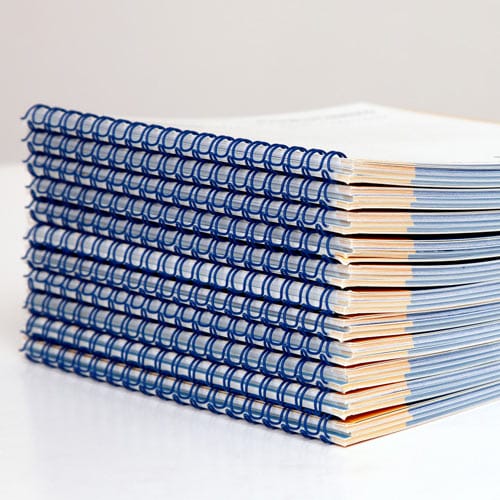
Wire-O binding — the pourer's friend. Wire-O opens 360 degrees and lays completely flat on a tasting counter, which matters more than any other spec on this list. It handles page counts from 8 to about 150 without the mechanism failing, and the exposed spiral survives daily handling better than a glued spine. Verdict: Buy for any guide that stays open at the pour.
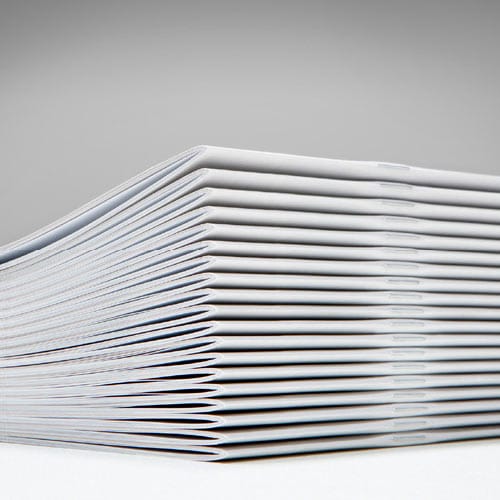
Saddle stitch — the budget pick. Saddle stitch works cleanly up to roughly 60 pages and costs less per copy than any binding method that requires a spine. A seasonal tasting flight guide or a single harvest event program fits this format without looking cheap. Past 60 pages the staples strain and the booklet won't lie flat. Verdict: Buy for thin, frequently-updated guides.
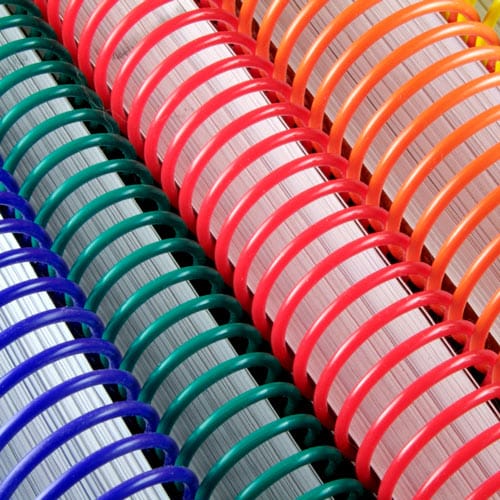
Plastic coil — the tasting notebook pick. Plastic coil bends further than Wire-O without kinking, which suits a guide that gets tossed in a tote bag or mailed to wine club members. It's slightly bulkier on a shelf display than Wire-O but wins on durability for anything mailed. Verdict: Consider for wine club mailers and take-home pairing guides.
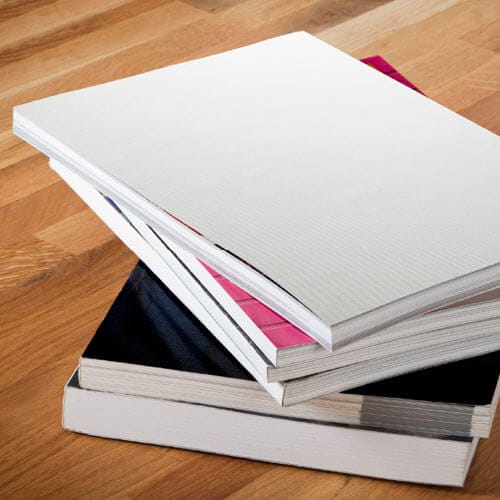
Perfect bound — the wine club catalog pick. Perfect binding gives a squared, bookstore-style spine that reads as premium for a full wine club catalog running 80-plus pages with vintage histories and photography. It costs more per copy at small volumes than Wire-O or saddle stitch, so it earns its place only past that page threshold. Verdict: Consider for annual club catalogs, Skip for anything under 40 pages.
All four formats print with no large minimum order requirement, so a 50-copy tasting flight guide and a 1,500-copy wine club catalog get handled with the same setup — just different run sizes.
Every pick above works better paired with a genre-appropriate approach to layout and cover design — see how the same choosing a book binding type logic applies to any short-run project before locking a format for 2026.
| Binding | Best page range | Lay-flat at counter | Best use case | Verdict |
|---|---|---|---|---|
| Wire-O | 8-150 pages | Yes, 360 degrees | Tasting flight guides at the pour | Buy |
| Saddle stitch | Up to 60 pages | Partial | Seasonal flight cards, event programs | Buy |
| Plastic coil | 8-120 pages | Yes | Wine club mailers, take-home guides | Consider |
| Perfect bound | 80+ pages | No | Annual wine club catalogs | Consider (Skip under 40 pp.) |
The same trade-off shows up outside wineries too — a restaurant menu book faces near-identical lay-flat and spill-resistance demands, and spiral bound menu printing covers the same binding math from the restaurant side.
What’s the best binding for a winery tasting room guide?
Wire-O binding is the best choice for tasting room guides in 2026 because it lays flat at the pouring station and handles daily handling without the spine failing. Saddle stitch works as a cheaper option under 60 pages.
How much does custom book printing for wineries cost?
Cost depends on page count, binding type, and paper stock, with Wire-O and coil running higher per-unit than saddle stitch at low page counts. Get a specific quote based on final page count and run size rather than estimating from a general per-book average.
Is there a minimum order for winery tasting guides?
Publishing Xpress prints with no large minimum order requirement, so a 50-copy seasonal tasting flight run is a normal order, not a special exception. That matters for wineries reprinting notes every harvest.
Can a wine club catalog be printed in color?
Yes, wine club catalogs and tasting guides print in full color for accurate label and vineyard photography reproduction. Color accuracy matters more here than in most booklet categories because guests compare the page to the bottle in hand.
What paper stock holds up best in a tasting room?
A heavier, coated text stock resists moisture and spills far longer than standard uncoated paper or laminated covers. Laminate tends to fog and peel with repeated exposure to condensation from wine glasses.
Should a tasting room guide use perfect binding or Wire-O?
Perfect binding fits full wine club catalogs over 80 pages that need a bookstore-style spine, while Wire-O fits shorter guides that need to lay flat at the counter. Under 40 pages, perfect binding looks flimsy and Wire-O or saddle stitch works better.
How fast can a winery get a tasting guide printed before harvest?
Turnaround depends on run size, binding, and current order volume, so timing a harvest-season order with enough lead time before crush events avoids a rush. Ordering tasting notes as soon as vintage details are finalized keeps the guide ready for the first pour.
The detail most wineries miss isn't the binding — it's the trim size. A guide sized to fit a standard binder or rack next to the register gets picked up and reused across seasons; an oversized one gets set aside and forgotten by the second pour. Match the trim size to where the guide actually lives in the tasting room, not to whatever size a template defaults to.
© 2026 Publishing Xpress. All Rights Reserved.