October 1, 2026
Keto meal prep cookbook printing is the production of branded recipe books that help customers prepare meals, understand portions, and use your recipes at home. For cookbook printing for keto meal prep businesses in 2026, prioritize verified nutrition information, readable recipe pages, and a binding that stays open on the counter.
A keto meal prep cookbook has a different job from a general recipe collection. Your reader needs to connect ingredients, batch yield, portion size, and nutrition information without searching across several pages. A beautiful photograph does not resolve an unclear serving definition.
Publishing Xpress cookbook printing is best for keto meal prep businesses seeking short-run books with a choice of four binding formats. Printing does not replace recipe testing or nutrition review; those responsibilities belong in your publishing plan before production.
Start with the decisions in this guide to book printing for cookbooks and recipe collections, then apply the meal-prep-specific checks below. Your 2026 edition should explain how customers will use the book, not simply reproduce your current menu.
Choose a clear business purpose: a customer onboarding guide, a companion to your meal service, or a standalone recipe collection. That purpose determines what belongs inside. Keep changing menu details out of a book intended to remain useful between editions.
Write a brief in a document you already use. Describe who receives the cookbook, what they should accomplish with it, and how it relates to your meal prep service. You do not need specialized publishing software to settle those questions.
Separate customer recipes from internal kitchen procedures. Customers need household quantities, understandable equipment references, and practical instructions. A production recipe written for staff is not automatically ready for home cooks.
Give the 2026 edition a defined scope. For an onboarding book, emphasize getting started and understanding portions. For a recipe collection, emphasize cooking instructions and finding meals. Avoid mixing a promotional brochure with a detailed operations manual.
Plan an opening explanation that tells readers how to use the book. Include the meaning of recipe labels and where to find batch-preparation instructions. Keep personal background shorter than the information customers need to begin cooking.
Build a recipe spreadsheet before laying out the book. Record ingredients, quantities, preparation methods, finished yield, and serving definition in consistent fields. Use the same measurement system throughout, and explain any exceptions.
Verify nutrition information against the exact recipe you print. A calculation attached to an earlier ingredient list does not validate a revised recipe. Record the calculation source and assumptions so someone else can review them.
Define whether your displayed carbohydrate figure is total carbohydrate or a separately calculated net-carbohydrate figure. If you publish a net figure, explain your calculation method instead of expecting readers to infer it. Have a qualified nutrition professional review dietary claims and calculations where needed.
A substitution changes the recipe, not just the wording. Review its effect on allergens, cooking instructions, yield, and nutrition before presenting it as equivalent. Do not promise that a recipe will produce a particular health outcome.
Make a paper mockup first. Print representative pages, hold them at a kitchen counter, and check whether the reader can follow the instructions without continually turning pages. This simple exercise exposes layout problems before you buy printing.
Plastic coil and Wire-O are the strongest starting choices for a cookbook that needs to stay open during use. Perfect binding suits a collection intended to sit on a shelf, but it does not offer the same hands-free page behavior. Saddle stitch suits a slim starter booklet rather than an expanding recipe library.
Publishing Xpress offers perfect bound, saddle stitch, Wire-O, and plastic coil printing, with black-and-white or color interiors and no large minimum order requirements. Use those options to match the book's purpose; do not let an attractive cover decide the binding.
For your 2026 specification, record the intended use alongside the binding choice. Ask the printer to confirm suitability for your final page count and paper selection before completing the cover.
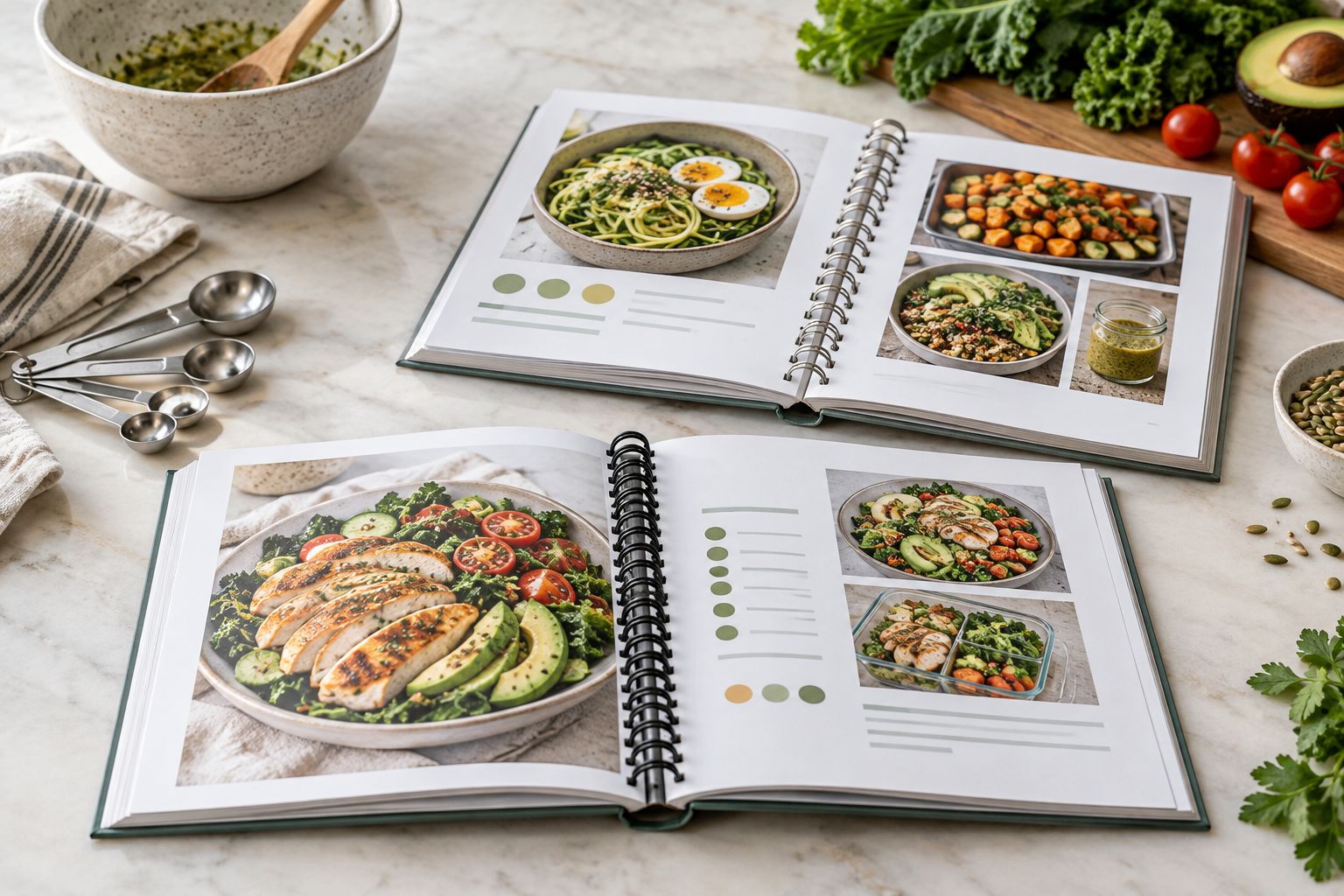
Create a reusable page template before designing the whole cookbook. Start with the longest ingredient list and the most complicated preparation method. A template that only works for your shortest recipe will force awkward fixes later.
Keep the recipe name, serving definition, ingredients, method, and nutrition information visually distinct. Put ingredients in the order readers use them. Separate active cooking instructions from storage and reheating guidance, and validate food-safety advice before publication.
Print 2 sample pages at 100% scale as a layout check. Those are working checks, not printer requirements. Read the smallest text under ordinary kitchen lighting, and check that a reader can distinguish ingredient quantities from serving information.
Avoid shrinking type to squeeze every recipe onto a single page. A clear continuation is better than a crowded page. Keep recipe steps together where practical, and ensure any continuation identifies the recipe it belongs to.
Compare physical samples rather than deciding from a screen. Paper affects how photographs reproduce, how much text shows through from the reverse, and how easily readers write on planning pages. Ask about those needs together.
Color is useful when photographs help readers understand the finished food or a preparation step. Black-and-white suits a text-led guide if the images remain clear without color. Do not use color alone to identify allergens or distinguish recipe categories; keep written labels.
For photographs, aim for 300 pixels per inch at the intended printed size unless the printer specifies otherwise. Check the effective resolution after resizing. Enlarging a small image does not create missing detail.
Do not treat a paper finish as proof of water resistance or wipe-clean performance. Ask for the actual material specification before making that promise to customers. For your 2026 edition, prioritize readable instructions over decorative full-page images that crowd the recipe.
Use your existing word processor or page-layout application to assemble the interior. Set the finished page size before importing the full recipe collection. Changing the size late can alter line breaks, image placement, and page count throughout the book.
Obtain the printer's file requirements for margins, bleed, cover construction, and binding clearance. Do not copy measurements from a different printer or binding format. Export a PDF with fonts embedded, then inspect the exported file rather than relying only on the editable document.
For saddle stitch, plan the total page count in multiples of 4 because folded sheets create four pages. Confirm how the printer counts the cover and any blank pages. For perfect binding, finalize the interior and paper selection before setting the spine width.
Once your specification is ready, Publishing Xpress provides the online printing path. Keep recipe approval separate from file preparation: a technically acceptable PDF can still contain incorrect portions or missing instructions.
Print a desk copy for editorial review before requesting a production proof. Follow recipes from the pages, not from memory. Ask a reader unfamiliar with the project to identify unclear steps and undefined terms.
Approve a physical proof before committing to the distribution run. Check the binding, paper, photographs, small text, page order, and cover. A screen review cannot show how comfortably a cookbook stays open or how a photograph looks on the chosen paper.
Publishing Xpress supports short-run printing without large minimum order requirements. That fits a controlled first edition, but the initial quantity still needs a distribution plan. Count confirmed uses rather than assuming every customer will want a copy.
Set a revision rule for the 2026 edition. Ingredient changes, corrected calculations, and revised food-safety instructions need a documented review before reprinting. Retain the approved PDF and its matching recipe spreadsheet so later edits do not create conflicting versions.
Choose the binding by reader behavior, not by how the book looks closed. These formats solve different problems. None makes an untested recipe or unclear nutrition panel ready for publication.
| Option | Best for | Main advantage | Key limitation |
|---|---|---|---|
| Plastic coil | Everyday meal-prep cooking | Pages open flat and fold back | Requires clearance around punched holes; no conventional printable spine |
| Wire-O | Cookbooks with planning worksheets | Opens flat with facing pages accessible | Exposed metal loops can deform if crushed |
| Perfect binding | Shelf-oriented branded collections | Provides a conventional book spine | Does not stay open like a coil-bound cookbook |
| Saddle stitch | Slim onboarding recipe guides | Simple booklet format | Page count must follow folded-sheet construction |
Choose plastic coil when customers will fold the book back beside their preparation area. Choose Wire-O when facing-page recipes or planning spreads matter. Perfect binding fits a reading-oriented collection; saddle stitch fits a deliberately short introduction.
These choices still require a paper and page-count review. Lay-flat binding does not make pages waterproof, and a conventional spine does not make a book suitable for every recipe layout. Test the complete specification, not just the binding sample.
A nutrition panel is unclear if readers cannot tell whether it describes a portion or the whole batch. Put the serving definition beside the figures, then check it against the recipe yield. Repeat that check after any ingredient or quantity change.
An alternative ingredient needs review before it inherits the original recipe's nutrition information. Keep substitutions separate until you have checked the revised formulation. If you cannot support equivalence, do not present the original panel as applying to both versions.
Temporary menu details date a printed book. Keep the core recipes useful independently of current ordering arrangements, and label content that is specific to an edition. Your cookbook should not require customers to guess which instructions still apply.
A perfect-bound book can suit a recipe collection without being the best choice for hands-free cooking. Test the intended reading position before approving the format. If customers must hold the page open while measuring ingredients, reconsider the binding or layout.
Do not call an ordinary printed cookbook washable, waterproof, or grease-resistant without a supported material specification. Explain care plainly. Binding choice improves page handling; it does not establish resistance to spills or food stains.
What’s the best binding for a keto meal prep cookbook?
Plastic coil is the best starting choice for a keto meal prep cookbook used hands-free on a counter. Wire-O also opens flat; compare physical samples and confirm suitability for your page count.
Can Publishing Xpress print a small batch of branded cookbooks?
Publishing Xpress offers short-run digital printing without large minimum order requirements. It provides perfect bound, saddle stitch, Wire-O, and plastic coil options for businesses and self-publishers.
Should a keto cookbook show total carbs or net carbs?
Clearly identify whichever carbohydrate figure you publish and explain any net-carbohydrate calculation method. Match the figures to the exact ingredients and serving definition, and obtain qualified review where needed.
Is color printing necessary for a meal prep recipe book?
Color printing is not necessary for every meal prep recipe book. Choose it when photographs or instructional images benefit from color, and keep essential labels understandable in black-and-white.
Can I prepare my cookbook in a word processor?
You can prepare a cookbook in a word processor if the exported PDF meets the printer’s requirements. Set the finished page size first, embed fonts, and inspect the exported file before submission.
Do I need a physical proof before printing my cookbook?
Approve a physical proof before committing to your distribution run. It lets you check binding behavior, paper, image reproduction, and readability that a screen cannot demonstrate.
How do I decide how many cookbooks to print?
Base the quantity on confirmed distribution uses, such as customer onboarding, events, or direct book orders. Plan a controlled first edition and document corrections before ordering a reprint.
Make the recipe's serving definition part of your final print approval. Proofreading the ingredient list is not enough: the yield, portion description, and nutrition panel must describe the same recipe.
Before approving your 2026 cookbook, ask a reader to explain a serving using only the printed page. If the answer depends on a staff member's explanation, revise the page. That small check addresses a problem that better paper, color photographs, and a new binding cannot fix.
© 2026 Publishing Xpress. All Rights Reserved.