October 27, 2026
Yes—foil stamping on a short run book order is possible when the printer’s finishing process supports your cover material, artwork, and quantity. It is a separate finishing operation, not an effect you get by choosing a gold color in your cover file. For a 2026 project, confirm the finishing specifications and schedule before approving the cover for production.
A foil title changes more than your cover’s appearance. It introduces another production requirement, and your designer needs that requirement before preparing the final files. Treat foil as part of the original book specification, not a last-minute decoration.
Start with the distinction between foil stamping and embossing on a book cover. Foil transfers a surface finish; embossing creates a raised impression. You can combine them through an appropriate process, but requesting one does not automatically include the other.
Yes. A small quantity does not, by itself, rule out foil stamping. The practical question is whether the proposed finishing method suits the complete book specification—not simply whether the printer handles short runs.
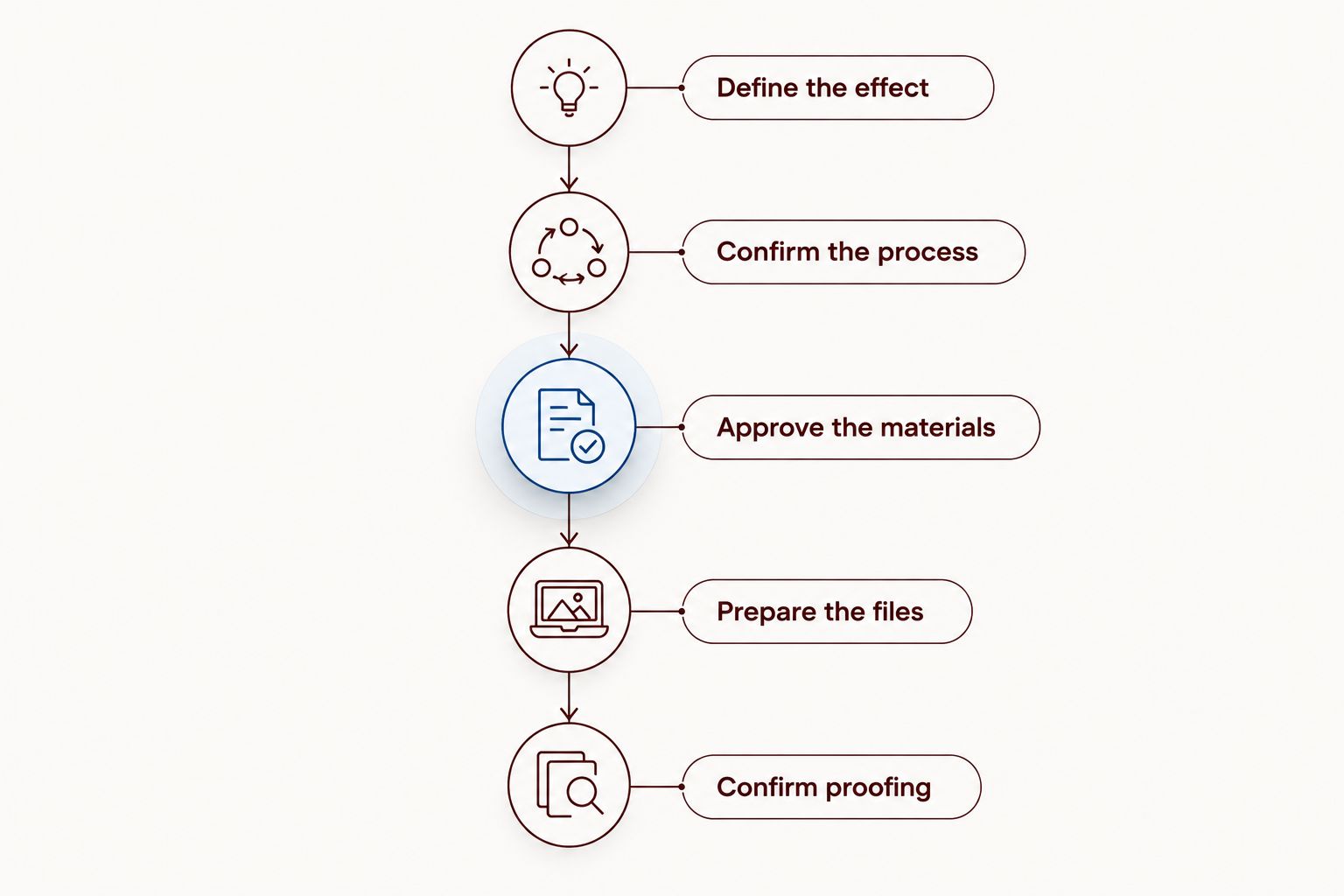
For your 2026 order, use this sequence before releasing the cover:
Do not approve a general book-printing specification while leaving the foil details unresolved. Your approval should identify the finish and its location, not just the cover’s printed colors.
Choose the production method by the effect you need, not by the word metallic. Hot foil, digital foil, and ordinary gold-colored printing are different treatments. They do not produce interchangeable results.
| Treatment | Best for | Main advantage | Main limitation |
|---|---|---|---|
| Traditional hot foil | A defined foil title or ornament | Transfers foil using a heated die and pressure | Requires tooling and process-specific artwork |
| Digital foil | A foil project suited to the chosen digital finishing system | Uses a digital production workflow | Material compatibility and file rules depend on the system |
| Gold-colored process printing | A cover that needs a gold hue rather than reflective foil | Keeps the color within the printed artwork | Does not reproduce metallic foil’s reflection |
Traditional hot foil stamping uses a heated die to transfer foil under pressure. The die carries the design, so changing the stamped artwork is not the same as replacing a page in a print file.
The advantage is a distinct foil element. The limitation is the additional tooling and setup involved. Ask the printer to assess fine lettering, small gaps, and the proposed coverage before your designer commits to the artwork.
Digital foil describes processes that apply foil through digitally controlled production methods. The exact mechanism and preparation requirements vary by system. Do not assume that instructions for hot foil also apply to digital foil.
The advantage is an alternative route to a foil effect. The limitation is dependence on the specific equipment, materials, and artwork requirements. Ask which process is proposed for your 2026 project and request instructions for that process by name.
A gold-colored title printed with ordinary process inks represents a color. It does not have the reflective surface of metallic foil. A digital mockup can make these treatments look deceptively similar.
This option keeps the design within the printed cover artwork, but it gives up the foil effect. Choose gold-colored printing only if the color satisfies the design brief without metallic reflection.
Your copy count matters, but it does not settle every production question. These factors belong in the finishing discussion:
Do not borrow artwork tolerances from an unrelated printer’s template. A specification is useful only when it applies to the process producing your books.
Start with approved production instructions. Your designer should distinguish the foil element from the printed artwork so the production team can identify exactly what receives the finish.
Use this preparation checklist for a 2026 cover:
Do not make the foil element a gold gradient and assume the production team will interpret it correctly. The file needs to identify the finishing area, while the reference communicates the intended appearance.
Also confirm whether printed ink should remain beneath the foil area. That decision belongs to the chosen production process; do not guess or apply a generic knockout rule.
Ask your designer to keep the cover effective without relying entirely on metallic reflection. The title must still read clearly in a flat image, including promotional images that do not capture the physical finish.
Request a printed-color version and a foil-placement reference. Label them clearly so nobody mistakes the visual mockup for the production separation. Keep the approved versions together with the finishing instructions.
A proof is useful only when you know what it proves. A screen image can show spelling, alignment, and the intended foil location, but it cannot demonstrate the changing reflection of a metallic surface as you tilt the book.
Before approving the job, establish the evidence for each decision:
| Decision | What to check | What not to assume |
|---|---|---|
| Artwork placement | Position relative to printed elements, trim, and binding | A metallic-looking mockup proves physical alignment |
| Lettering and detail | Approved artwork meets the finishing process requirements | Every detail visible on screen will reproduce unchanged |
| Surface appearance | An appropriate physical reference, if part of the agreed proofing process | A screen preview demonstrates sheen or texture |
| Final specification | Quantity, binding, material, foil area, and shipping schedule | Approval of the printed cover also approves unspecified finishing |
Ask what remains unverified after proof approval. That question is more useful than asking whether a proof looks good.
For a 2026 event or launch, separate the production schedule from transit time. A ship date is not an arrival date, and a standard printing schedule does not establish a specialty-finishing schedule.
Publishing Xpress short-run book printing is best for authors and organizations ordering at least 25 copies. Its binding options include perfect bound, saddle stitch, wire-o, and plastic coil, so choose the binding around how readers will use the book before finalizing cover decoration.
The minimum is 25 copies. Saddle stitch has a maximum of 80 pages, and Publishing Xpress ships in 4 to 6 days after proof approval. Confirm the agreed schedule for any specialty finishing rather than treating that standard shipping window as a foil-production commitment.
For Publishing Xpress book printing, the practical advantage is a defined small-order minimum and a choice of binding formats. The limitation is that an order below 25 copies does not meet that minimum. Discuss foil as a separate specification before making it essential to the cover design.
Confirm feasibility before printing or binding the books. Finishing equipment requires access to the stamping area, and an assembled book presents different handling constraints from an unbound cover.
Do not order plain finished books on the assumption that foil can be added later. Have the printer establish the production sequence while the cover materials and binding are still being specified.
No. Foil stamping transfers a finish, while embossing creates a raised impression in the material. A foil title is not automatically raised, and an embossed title does not automatically include foil.
If you want both effects, describe both in the specification. Ask how the combined treatment affects artwork preparation and proofing before approving the design.
Specify the quantity of finished copies explicitly. If you want a decorated edition and a plain edition, ask the printer to assess them as distinct production requirements rather than assuming a finishing operation can be split without further planning.
Keep the artwork versions identifiable. Your 2026 order approval should state which cover treatment belongs to which quantity, along with the corresponding proof references.
Can I request foil stamping for a small book order?
Yes, foil stamping is technically possible for a small book order when the finishing process supports the quantity, material, and artwork. Confirm those specifications before approving the cover.
Does choosing gold text in my PDF create foil stamping?
No, gold-colored text in an ordinary print file does not create metallic foil. Foil requires a separately specified finishing process and artwork prepared to the printer’s instructions.
Is digital foil the same as traditional hot foil?
No, digital foil and traditional hot foil use different production methods. Traditional hot foil uses a heated die and pressure; digital foil requirements depend on the finishing system.
Can a screen proof show what metallic foil will look like?
A screen proof can show the intended foil placement, but it cannot reproduce the physical surface’s changing reflection. Ask what physical reference or proofing method forms part of the approval process.
What is the minimum book order at Publishing Xpress?
Publishing Xpress has a minimum print quantity of 25 copies. Discuss specialty finishing separately before treating it as part of your approved book specification.
Will foil stamping automatically make my book title raised?
No, foil stamping does not automatically create a raised title. Specify embossing separately if you want a raised impression as well as foil.
Should I finish my cover design before asking about foil?
Confirm the foil process before finalizing your cover design. The material, artwork separation, detail limits, and placement requirements need to guide the production files.
Review your cover as a flat image before approving the metallic treatment. Foil reflects surrounding light; a promotional image does not necessarily show that effect. Keep the title readable without the shine, then let the foil add the physical detail.
© 2026 Publishing Xpress. All Rights Reserved.