October 30, 2026
Best overall: plastic coil printing for working wedding planners. Best for client presentation books: Wire-O printing. Best for concise ceremony programs: saddle stitch printing. Best for portfolio books: perfect bound printing. Publishing Xpress offers all four custom book printing services; this 2026 guide explains which format fits each wedding project.
A ceremony program and a working planning book solve different problems. Guests need a clear sequence they can follow; your coordination team needs schedules, contacts, and room to make notes while the book stays open.
Choose the binding around how someone uses the book, not just how the cover looks. A glued spine suits a portfolio you hand to prospective clients, but a workbook needs easier access to its writing area. Printing every wedding document in the same format creates unnecessary compromises.
This guide ranks four printing services by their wedding-planning use case rather than treating every book as interchangeable. Publishing Xpress has a minimum order of 25 copies, so plan around a batch of matching books or programs rather than a single personalized copy.
Use these criteria before comparing layouts or approving a print order for your 2026 wedding calendar:
For wedding planners, a useful comparison starts with these practical requirements. Decorative cover choices come later. First establish whether the finished book will support the person holding it.
These are different binding services, not different printing companies. The ranking follows the most useful default for a working wedding planner, then separates the other options by purpose.
| Rank | Printing service | Best for | Standout feature | Key limitation |
|---|---|---|---|---|
| 1 | Plastic coil printing | Working planning books | Pages turn around a flexible continuous coil | Visible coil and punched binding edge |
| 2 | Wire-O printing | Client presentation books | Paired metal loops allow flat opening | Metal loops can bend under pressure |
| 3 | Saddle stitch printing | Ceremony programs | Folded pages secured through the spine | Maximum 80 pages |
| 4 | Perfect bound printing | Portfolio books | Glued spine creates a conventional paperback format | Not the default for hands-free writing |
None of these formats wins every category. The strongest choice is the one whose limitation does not interfere with your book's main job.
Plastic coil printing threads a continuous plastic spiral through holes along the binding edge. Pages turn around the coil, letting you open the book flat or fold it back when desk space is limited.
Plastic coil is the best default for a wedding planning workbook. Use it for reusable planning frameworks: consultation questions, vendor checklists, meeting notes, and blank schedule templates. Keep event-specific information in designated fields rather than building every printed page around one couple.
Best for: Your working planning book, especially when you write in it throughout the planning process.
Before ordering, check the longest worksheet rather than just the cover. Open a printed draft and place your hand where you would write; any cramped field near the binding needs more clearance. Give contact details and timing notes enough room to remain readable after handwritten changes.
Verdict: Buy plastic coil for working planners; skip it when a conventional spine is essential.
Wire-O printing uses paired metal loops through the binding edge. It allows pages to open flat, making it useful when you want clients to view a spread while you discuss its contents.
Choose Wire-O for a presentation book that combines visual ideas with structured decisions. A spread can pair a room concept with discussion notes or place a proposed event sequence beside questions that still need answers. Keep the book focused on the consultation rather than filling it with every internal task.
Best for: Client presentation books used at consultations, venue meetings, and design reviews.
Wire-O and plastic coil both suit books that need to stay open. Choose between them by use: plastic coil is the default here for the working workbook; Wire-O earns its place for a presentation-focused book. Neither binding replaces careful interior spacing.
Verdict: Buy Wire-O for presentation-led consultations; skip it if the book needs a conventional spine.
Plastic coil has a continuous spiral, while Wire-O uses paired metal loops. Saddle stitch secures folded pages through the fold; perfect binding joins the page block to a glued spine. These differences affect how you hold, open, and use the finished book.
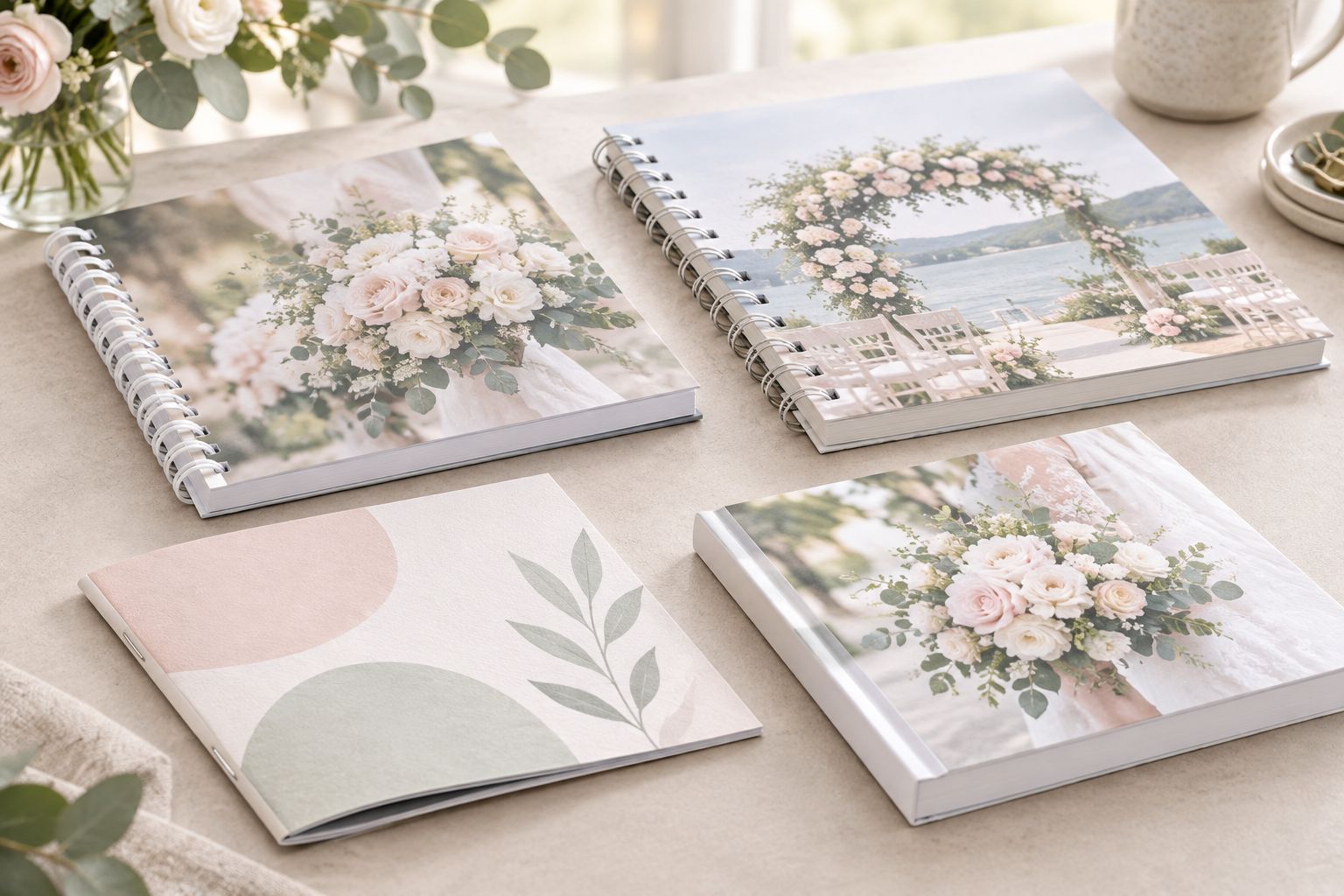
Saddle stitch printing folds sheets together and secures them with staples through the fold. It suits a concise wedding program containing the ceremony order, participant names, readings, and acknowledgments.
Choose saddle stitch when guests need a booklet, not a workbook. Its compact structure keeps a short sequence together without an exposed coil. Publishing Xpress limits saddle stitch books to 80 pages, so check the complete page count before committing to the layout.
Best for: Ceremony programs and short wedding-weekend information booklets.
Folded saddle stitch layouts work in multiples of four pages. Ask how the printer counts the cover, then account for every page, including intentional blanks. Proof names and ceremony order against the approved event document rather than relying on memory.
Do not turn the program into an internal coordination manual. Guests need the information relevant to their experience, not vendor instructions or private contact details.
Verdict: Buy saddle stitch for concise ceremony programs; skip it for books exceeding 80 pages.
Perfect binding joins the interior page block to a cover at a glued spine. The result is a paperback-style book suited to a collection of completed wedding projects, visual work, and explanatory captions.
Choose perfect binding when readers will browse and turn pages rather than write throughout the book. A portfolio can group projects by setting, design approach, or planning challenge, with enough context to explain your role. Keep the strongest work easy to find.
Best for: Wedding planning portfolios and client-facing books of completed work.
Do not place important faces, captions, or details directly against the gutter. Confirm the final page count and paper before preparing the spine artwork; do not estimate the spine from a different book. For portfolio photographs, confirm permission to reproduce the images before submitting the files.
Verdict: Buy perfect binding for portfolios; skip it for writing-heavy planning workbooks.
This ranking prioritizes reader task, opening behavior, page count, binding clearance, quantity, and approval schedule. Plastic coil takes the default slot because the central working-planner task is using and writing in a book; the other bindings win their separate presentation, program, and portfolio categories.
The 2026 recommendations are about fit, not a claim that one binding always has better print quality. Your paper, image files, layout, and proof approval still need attention regardless of the binding you select.
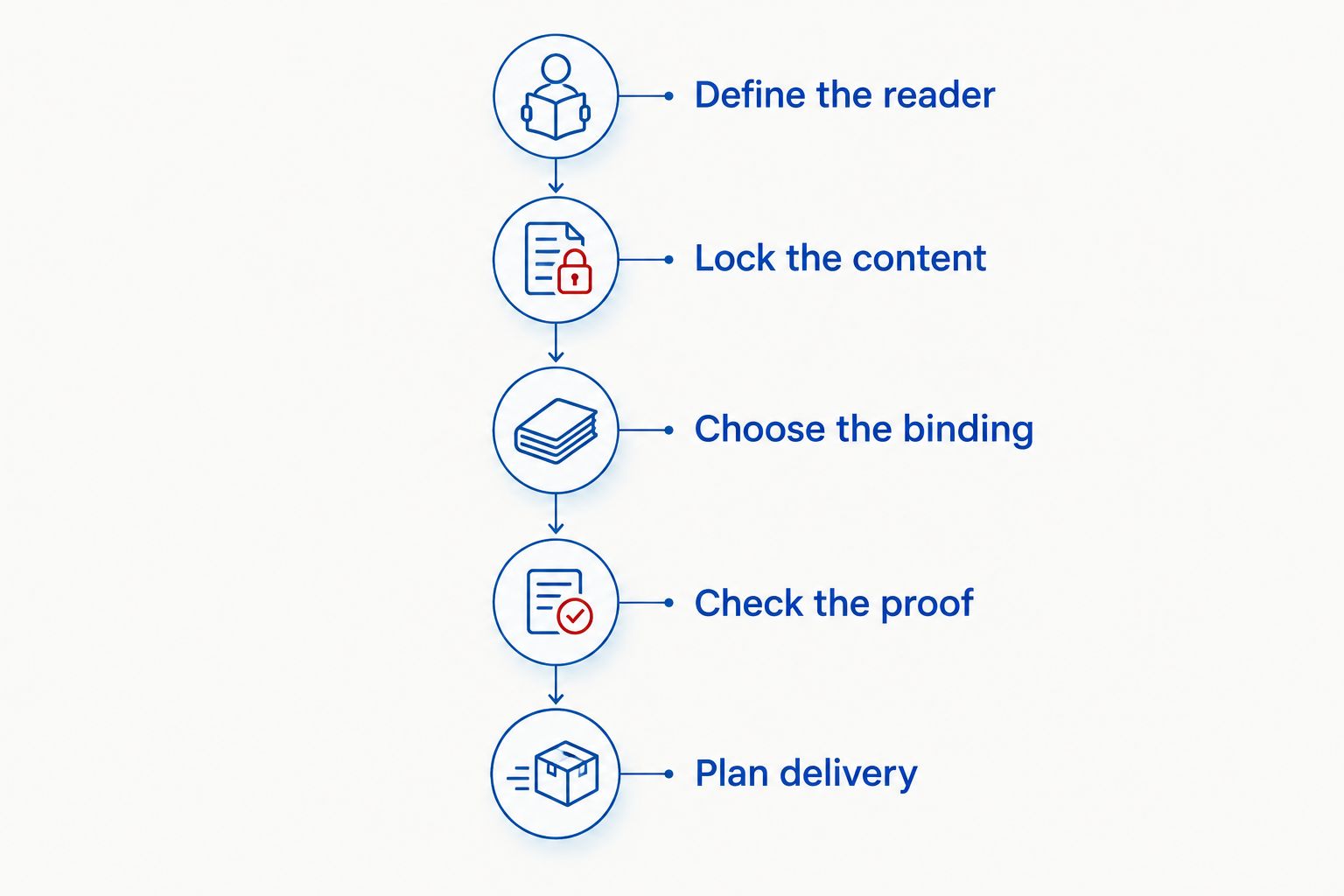
Use this sequence for a 2026 print project. Settle the content and specifications before treating the layout as finished.
Name the person who will use the book: planner, couple, coordination team, or guest. Remove information that does not belong with that audience, especially private contacts from guest-facing programs.
Confirm names, ceremony order, locations, and the approved schedule. For reusable workbooks, separate stable guidance from fields that change with each event.
Match the reader's task to plastic coil, Wire-O, saddle stitch, or perfect binding. Then check page count and binding clearance against that choice.
Review every page, including blanks and the cover. Check small captions, cropped photographs, writing space, and the sequence of sections—not just spelling.
Work backward from when you need the books in hand. Publishing Xpress ships in 4 to 6 days after proof approval; that is not the same as arrival within that window. Allow separately for transit and receiving the order.
Publishing Xpress custom book printing is best for wedding planners who need at least 25 copies with a choice of four bindings. Start with plastic coil for a working planner, then change the binding only when the reader's task calls for it.
Choose Wire-O for a client presentation, saddle stitch for a concise ceremony program, and perfect binding for a portfolio. You do not need one format for every document in your business. You need each book to work properly in the setting where someone uses it.
What’s the best custom book printing option for wedding planners?
Plastic coil is the best default for a working wedding planning book because pages open flat and fold back. Choose Wire-O for presentations, saddle stitch for ceremony programs, or perfect binding for portfolios.
Can I order just one personalized wedding planning book?
Publishing Xpress has a minimum print quantity of 25 copies. Its minimum does not fit a one-copy order; confirm how separately personalized versions are handled before preparing files.
Is Wire-O better than plastic coil for a wedding planner?
Wire-O is the stronger fit for a presentation-focused book in this comparison; plastic coil is the default for a working workbook. Both open flat, but their exposed binding structures differ.
How many pages can a saddle stitch wedding program have?
Publishing Xpress offers saddle stitch books up to 80 pages. Plan the folded layout in multiples of four pages and confirm how covers count before finalizing the document.
How long does wedding book printing take in 2026?
Publishing Xpress ships in 4 to 6 days after proof approval. Allow additional time for preparing files, reviewing corrections, transit, and receiving the order before the event.
Should I use perfect binding for a wedding planning workbook?
Choose plastic coil or Wire-O instead when hands-free opening and writing are the main requirements. Perfect binding is better suited to a portfolio that readers browse.
What should I check before approving a wedding program proof?
Check names, ceremony order, readings, acknowledgments, page sequence, and any location information. Compare the proof with the approved event details, then inspect the cover and intentional blank pages.
Keep your reusable planning book separate from the final event schedule. A bound workbook cannot make a printed contact number or timing change current after production. Before each wedding, check the working book against the approved event details and identify which document your team should treat as final.
For your 2026 projects, make that version decision before proof approval—not while distributing books at the venue.
© 2026 Publishing Xpress. All Rights Reserved.