October 12, 2026
The minimum order quantity for custom notebook printing is the smallest quantity your printer accepts for your specific notebook design; there is no single minimum that applies to every printer and binding. For a 2026 order, confirm the minimum for your finished size, page count, binding, and artwork before committing to production. Also ask whether the minimum applies to the whole order or separately to each cover and interior version.
The applicable minimum is the printer’s confirmed minimum for the notebook you actually want to produce. A general short-run printing statement does not establish the quantity accepted for every combination of cover, interior, and binding.
If you are planning gifts or workshop materials, start with the intended use. The guide to custom notebook printing for corporate gifts and events covers a closely related project category.
Use these steps to get an answer you can act on:
Do not treat an example quantity in a design guide as an order requirement. Likewise, a minimum page count is not a minimum number of copies: one describes the construction of the notebook, while the other describes the size of your order.
A minimum order requirement decides whether a project fits your actual need. Your goal is not simply to find the lowest minimum; it is to get a usable notebook in a quantity you can distribute or sell.
For a 2026 workshop, count the people receiving notebooks and identify any additional copies you need for instructors or records. For a retail project, separate confirmed demand from notebooks you hope to sell later. That distinction keeps the order tied to a purpose rather than an arbitrary bulk quantity.
Do not order extra copies just to satisfy a requirement you have not confirmed. First establish the specification, then ask for the accepted quantity. If the answer does not fit your project, discuss a different binding or a simpler version before redesigning everything.
Your total order and your quantity per design answer different questions. A group of notebooks with identical files is not the same specification as a group with different covers or different interior pages.
Explain the artwork structure before asking for the minimum. Otherwise, you and the printer can be discussing different jobs without realizing it.
| Notebook setup | Best for | Practical advantage | Limitation to address | Minimum-order question |
|---|---|---|---|---|
| Shared cover and interior | A single event or organization | Keeps the artwork consistent | Does not distinguish groups or recipients | What is the minimum for this identical design? |
| Different covers, shared interior | Departments or themed collections | Changes the outside without rewriting the inside | Requires separate cover files | Does each cover have its own minimum? |
| Shared cover, different interiors | Workshops with different exercises | Matches the content to each audience | Requires separate interior files | Does each interior version have its own minimum? |
| Individual personalization | Named gifts or assigned notebooks | Identifies the intended recipient | Requires accurate recipient information and file preparation | Is personalization supported, and how is the minimum applied? |
The table is a planning comparison, not a promise that every printer supports every setup. Confirm the version rules before combining quantities. Do not assume different cover designs count toward the same minimum.
Keep a version list with matching filenames. If you change an interior after requesting the order details, identify that change explicitly so the accepted specification stays clear.
A notebook needs to work while someone writes in it. The binding affects how the pages open, where you place the writing area, and how the finished notebook feels in use.
Publishing Xpress offers 4 binding options for its printing services: perfect bound, saddle stitch, Wire-O, and plastic coil. Confirm which construction fits your notebook’s page count and intended use rather than assuming all four suit the same design.
| Binding | Best for | Advantage | Drawback |
|---|---|---|---|
| Plastic coil | Writing notebooks and frequently handled workbooks | Pages turn around the coil and fold back | The exposed coil occupies space at the binding edge |
| Wire-O | Desk notebooks and structured journals | Opens flat and allows pages to fold back | The exposed metal loops can bend if mishandled |
| Saddle stitch | Thin workshop notebooks | A simple stapled construction | Folded-sheet construction limits thickness and constrains page count |
| Perfect bound | Book-style guided journals | Gives the document a glued spine | Does not open as freely as coil or Wire-O |
For a notebook used primarily for writing, start by evaluating plastic coil or Wire-O. Compare how each handles your page layout, not just its appearance. Perfect binding serves a different purpose when a book-style presentation matters more than easy page movement.
Saddle-stitched interiors use folded sheets, so their page count normally works in multiples of 4 pages. One physical leaf has 2 page faces: its front and back. Use those distinctions when describing your notebook, and follow the printer’s instructions for counting the cover.
Those numbers describe document construction, not minimum order quantities. A page-count rule does not tell you how many finished notebooks you must purchase.
The useful question is not why one printer’s headline minimum differs from another’s. Ask which parts of your specification are covered by the minimum you receive.
For your 2026 notebook request, check these factors:
These are specification checks, not a claim that every factor increases the minimum. Get the printer’s answer for your actual combination and keep that answer with the project files.
Write a short production brief before opening an ordering form. A clear brief gives the printer enough information to distinguish a straightforward repeat design from a project with several versions.
Describe who will write in the notebook and where. A desk journal, a classroom exercise book, and a notebook carried between meetings need different layout decisions.
Keep the description practical. Explain whether pages must fold back, whether the notebook includes printed exercises, and whether recipients need room for long handwritten answers.
Separate the cover from the interior according to the printer’s submission instructions. Keep page size consistent, include intended blank pages, and leave writing content clear of the binding area.
Do not substitute a screen preview for a file check. View the interior at its intended physical size and print a sample page locally to judge line spacing and room for handwriting.
Record each cover and interior combination in plain language. Match every version to its files, and identify any recipient-specific changes.
Avoid describing the job as identical if only the interior is shared. A different cover is still a different artwork version that needs to be explained.
Ask for the smallest accepted order for the specification you have supplied. Include a separate question about whether distinct versions can be combined toward that minimum.
Then check the response against your production brief. A minimum confirmed for one binding should not be carried over to another without checking.
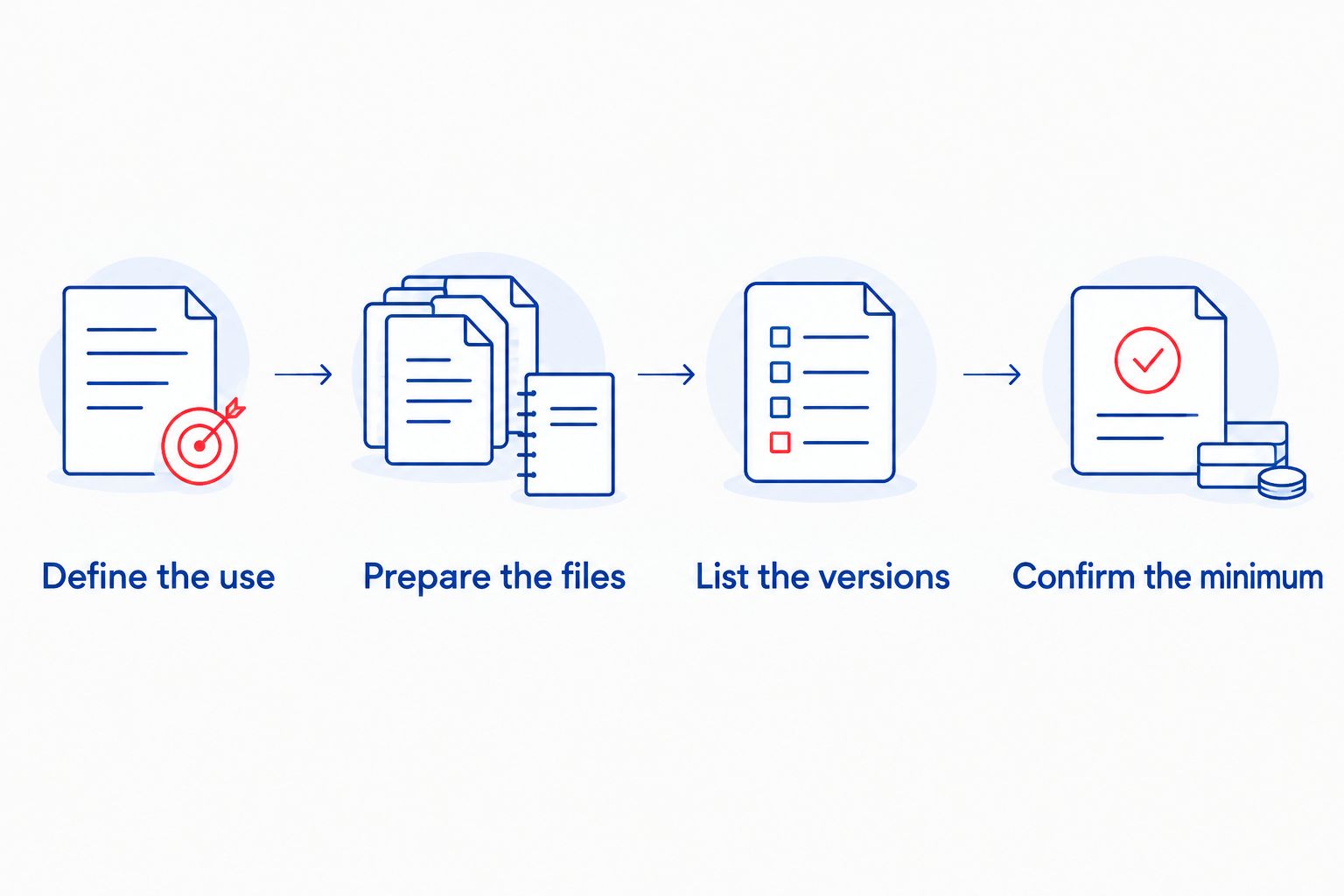
A good request also gives your needed delivery date and destination without assuming a production or shipping schedule. For a 2026 event, ask whether the complete schedule includes file review, production, and delivery; an accepted quantity alone does not establish that the notebooks will arrive when needed.
Publishing Xpress is a fit for self-publishers, nonprofits, and organizations seeking short-run digital printing without large minimum order requirements. That service model is relevant when you need printed materials for a defined audience rather than a large speculative order.
The advantage is the stated focus on short runs. The limit is that this general positioning does not replace confirmation of your particular notebook construction, artwork versions, and accepted quantity.
When discussing notebook printing with Publishing Xpress, bring the production brief rather than only a logo. Ask these questions together:
For 2026 purchasing, keep the confirmed quantity and specification in the same written record. That gives you a clear reference if you change the design before ordering.
Check your notebook printing options
Match your page count, binding, artwork versions, and intended quantity before ordering.
A single-copy notebook order requires explicit confirmation from the printer for your chosen specification. Short-run printing does not, by itself, promise that every notebook design is accepted as a single-copy job.
If your purpose is to test the design, explain that you want to inspect a physical example before committing to the full project. Ask what proofing process applies rather than assuming a sample uses the same ordering rules.
Each cover needs its own quantity confirmation unless the printer explicitly accepts the versions together. Shared interior pages do not automatically establish a shared order minimum.
Send the cover list with your request. Include the quantity intended for each version so the answer addresses the complete project.
The minimum page count describes the notebook’s construction; the minimum order quantity describes the number of finished copies. They are separate requirements.
For example, saddle-stitched interiors normally use multiples of 4 pages because sheets are folded. That construction rule provides no answer about the number of notebooks accepted in an order.
What’s the minimum order quantity for custom notebook printing?
The minimum is the smallest quantity your printer accepts for your exact notebook specification. Confirm the binding, page count, artwork versions, and quantity per version before ordering.
Can I print a single custom notebook?
A single-copy order needs confirmation from the printer for the notebook you want. Do not treat a general short-run printing statement as a promise that every specification accepts a single copy.
Does Publishing Xpress require large print orders?
Publishing Xpress offers short-run digital printing without large minimum order requirements. Confirm the accepted quantity for your notebook’s binding, page count, and artwork versions.
Can different covers count toward the same notebook minimum?
Different covers count together only if the printer confirms that ordering arrangement. List every cover version and the quantity you need for each.
Is coil binding better than perfect binding for a writing notebook?
Plastic coil is the better starting point when folding pages back and writing near the binding are priorities. Perfect binding gives a book-style spine but does not open as freely.
Do blank pages count toward my notebook’s page count?
Intentional blank pages are part of the notebook interior and should be included in the page count. Follow the printer’s separate instructions for counting the cover.
How many pages does one sheet add to a notebook?
One physical leaf has 2 page faces, front and back; a sheet folded for saddle stitching forms 4 pages. Confirm how the printer wants you to report the interior page count.
Order around the writing experience, not just the minimum. Before approving the notebook, try writing on a full-size sample page and check the space next to the binding.
A low-quantity order still needs a usable layout. Fix cramped writing areas and unclear prompts before production, then confirm the minimum for the final files—not the earlier draft.
© 2026 Publishing Xpress. All Rights Reserved.