August 7, 2026
Textbook printing for schools and educational publishers in 2026 comes down to one tradeoff: binding that survives a semester of backpacks and desks versus a budget that doesn't assume a 500-copy warehouse order. Get the binding and run size wrong and you're either reprinting mid-term or sitting on boxes of an edition that's already outdated.
Educational publishing runs on annual revisions. A district updates a science curriculum, a professor tweaks a lab manual, a homeschool co-op needs 30 copies of a workbook before September — none of that looks like a traditional 5,000-copy textbook print run. Ordering the wrong binding or committing to a minimum built for retail bookstores is the most common way schools and small educational publishers overspend on textbook printing in 2026.
The fix is matching binding to how the book gets used, not to what looks like a "real" textbook. A spiral workbook that lies flat on a desk during a test beats a perfect-bound edition that won't stay open. A short run printed twice a year beats a big offset order that locks you into last year's content.
This guide is for curriculum directors, textbook publishers, homeschool co-op leads, university departments printing course packs, and instructors self-publishing lab manuals or workbooks for their own classes. If you're ordering anywhere from 10 to 2,000 copies of a document students will write in, flip through, or carry daily, this applies to you. Publishing Xpress's guide to book printing for curriculum guides covers the same territory in more depth if you're building a multi-title series.
A textbook gets opened hundreds of times between August and May. Perfect binding holds up fine for a 150-page reference text that mostly sits on a shelf, but a workbook that gets crammed into a backpack daily needs a mechanical binding — coil or Wire-O — that won't crack at the spine by October.
Students write in workbooks and lab manuals while they're open on a desk. If the book won't stay flat without a hand holding it down, that's friction every single class period. Wire-O and plastic coil both open to 180 degrees; perfect binding and saddle stitch do not.
A 40-student pilot program doesn't need a 500-copy minimum. Textbook printing for schools should scale down to classroom size without a per-unit cost penalty that makes short runs pointless.
Science and history curricula lean on diagrams and photos that lose meaning in poor black-and-white reproduction. Decide up front whether the interior needs color — it changes both cost and paper stock choice.
A textbook that arrives in October is a textbook that missed the first quarter. Build in turnaround time against your semester start date, not against when the manuscript happens to be finished.
Standard 60 lb. text stock feels thin under repeated handling. Heavier stock — or a laminated cover for workbooks that travel — holds up noticeably better across a full school year.
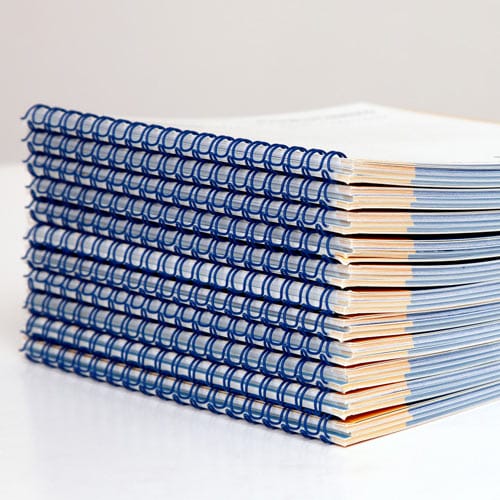
Wire-O binding — the lay-flat workhorse. Pages open to a full 180 degrees and the wire spine resists cracking under daily use, which matters for anything a student writes in during class. It's the strongest fit for lab manuals, teacher editions, and training-style course materials, and Publishing Xpress's page on training course materials breaks down setup specifics. Buy for any workbook or manual over 40 pages that needs to stay flat.
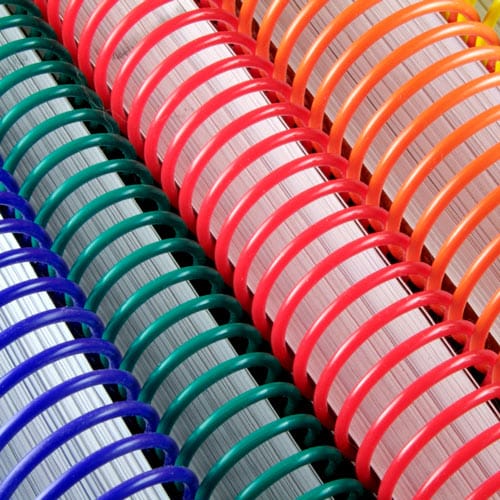
Plastic coil / spiral binding — the flexible favorite. Coil binding costs less than Wire-O in most short runs and still lays flat, making it the default for student workbooks and study guides under 200 pages. The workbook binding options guide compares coil against Wire-O directly if page count is borderline. Buy for standard workbooks and study guides.
Perfect binding — the safe pick for full textbooks. A squared spine and printed title look like a real textbook, which matters when the book leaves the classroom and goes home or into a library. It holds up fine for reference-style texts over 120 pages that get read more than written in. Buy for full-length textbooks and teacher reference editions.
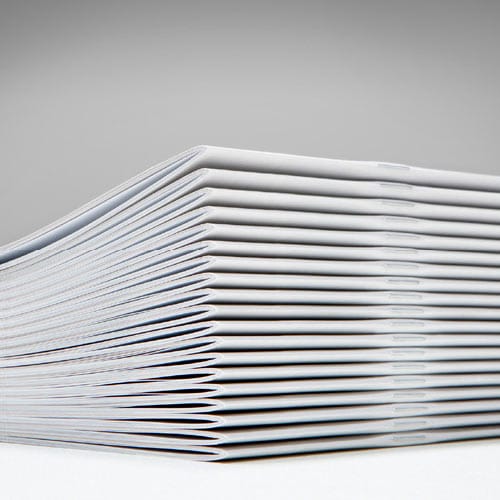
Saddle stitch — the budget pick for thin supplements. Cheapest option per copy, fastest to produce, and fine for a 20-40 page unit supplement or study packet. Push it past 60 pages and the folded spine starts to bulge and split. Consider for short supplements only.
Print-on-demand — the wildcard for pilot curriculum. When a curriculum is still being tested with one classroom or one district pilot, print-on-demand lets you order 10-50 copies without locking in a final layout. Consider for pilot programs; Wait if the curriculum content is still likely to change before next semester.
| Binding | Best For | Lay-Flat | Typical Page Range | Verdict |
|---|---|---|---|---|
| Wire-O | Lab manuals, teacher editions | Yes | 40-300 pages | Buy |
| Plastic coil | Student workbooks, study guides | Yes | 30-200 pages | Buy |
| Perfect bound | Full textbooks, reference texts | No | 120+ pages | Buy |
| Saddle stitch | Unit supplements, packets | No | 8-60 pages | Consider |
| Print-on-demand | Pilot curriculum runs | Varies | Any | Consider |
What’s the best binding for a school textbook?
Perfect binding is the best fit for full-length textbooks over 120 pages because the squared spine holds up on a shelf and looks like a standard textbook. Workbooks that students write in are better served by Wire-O or coil binding, which lay flat on a desk.
Is spiral binding or Wire-O better for workbooks?
Both lay flat, but Wire-O holds up better under repeated daily use because the wire spine resists cracking, while plastic coil costs less in short runs. For a standard classroom workbook under 200 pages, coil is usually the more affordable pick.
How many pages before perfect binding makes sense for a textbook?
Perfect binding starts making sense around 120 pages, since thinner books don’t hold a glued spine well. Below that page count, saddle stitch or a mechanical binding like coil is a better fit.
What’s the minimum order for textbook printing in 2026?
Minimums vary by printer, but short-run digital printing lets schools order as few as 10-30 copies without a large-minimum penalty. That flexibility matters most for pilot programs and single-classroom curricula.
Can you print textbooks in black-and-white to save cost?
Yes, and it’s the standard choice for text-heavy curricula without diagrams or photos. Color printing makes sense specifically when diagrams, maps, or photos carry meaning that black-and-white would lose.
How long does textbook printing take before a semester starts?
Turnaround depends on binding type and run size, but ordering with enough lead time before a semester start date is the single biggest factor in avoiding a late delivery. Build in buffer time against your actual first day of class, not the manuscript deadline.
Is print-on-demand good for small curriculum runs?
Print-on-demand works well for pilot programs testing a curriculum with one classroom or district before a wider rollout. It lets you order 10-50 copies without committing to a final layout that might still change.
Most school districts and educational publishers overspend on textbook printing in 2026 by treating curriculum like it's permanent. It isn't. Standards get revised, editions get corrected, pilot programs get scrapped after one semester. Ordering exactly what you need for the current term — even if that means reordering every six months — costs less over a school year than warehousing a big run of a book that's one revision away from obsolete.
© 2026 Publishing Xpress. All Rights Reserved.