August 6, 2026
Lab manuals get flipped open a hundred times a semester and shoved into backpacks between classes — most binding types don't survive that treatment. Spiral bound lab manual printing, which really means plastic coil or Wire-O binding, is built for exactly this kind of abuse, and picking the wrong option means reprinting mid-semester.
A lab manual isn't a novel. It sits open on a bench next to a Bunsen burner, gets annotated in pencil, and has to lie flat without a hand holding it down while a student's other hand is busy with a beaker. Saddle stitch and perfect binding are built for reading. Coil and Wire-O are built for working documents that need to survive a full academic year in 2026 without falling apart.
Getting the file setup right matters as much as the binding choice — margins, punch clearance, and page order all shift once a manual goes into a coil. The mechanics of setting up a spiral bound book for printing determine whether pages line up or the coil tears through the margin on page one.
This guide is for science teachers, curriculum coordinators, homeschool co-ops, university TA offices, and nonprofit STEM programs ordering lab manuals or curriculum workbooks in runs of roughly 30 to 500 copies. If your content changes every semester or every school year, and your students need the manual open flat next to equipment, you're the buyer this comparison is built for.
A manual that springs shut mid-experiment forces students to hold it open with one hand instead of two hands on the equipment. Coil and Wire-O both open a full 360 degrees; saddle stitch and perfect binding do not, and that's the entire reason this comparison exists.
A thin 24-page weekly handout and a 200-page full-semester manual need different coil diameters. Order the wrong diameter and the coil either binds too loose to hold pages in order or too tight to open flat — check page count before you order, not after.
Lab environments mean water, chemicals, and heavy pencil erasing. A 24 lb. or 28 lb. text stock holds up to repeated erasing better than standard 20 lb. copy paper, and a coated cover resists the occasional splash that a plain paper cover won't.
Curricula get revised every year. Short-run digital printing without a large minimum order means a department can print 50 copies this fall and adjust the file for spring without eating the cost of an offset print run built for thousands of copies.
Diagrams, safety charts, and periodic tables need color; procedure text doesn't. A manual printed in black-and-white with select color inserts keeps cost down while still making the safety page legible.
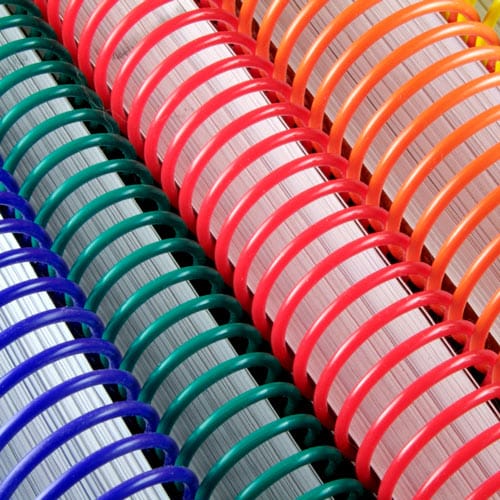
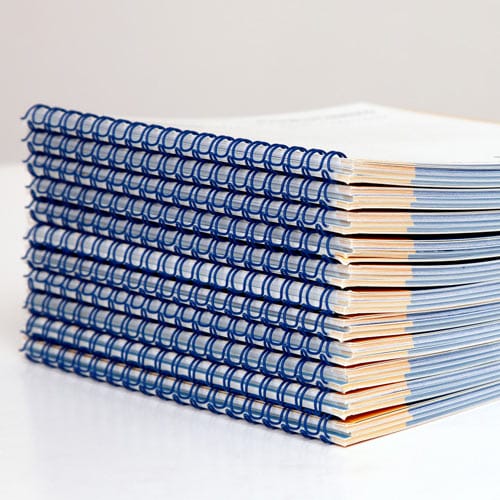
Plastic Coil Binding — the default pick. Coil binding opens fully flat, resists crushing better than most people expect, and typically handles manuals up to roughly 1.5 inches thick before you need to split the document into two volumes. It's the binding best spiral bound printing for training manuals already points to for exactly this reason — training manuals and lab manuals face the same bench-top abuse. Buy.
Wire-O Binding — the durability upgrade. Wire-O uses a double-loop wire instead of a plastic spiral, and it holds shape better than coil after a full year of students opening and closing the same manual. It costs a bit more per copy but pays that back if the manual gets reused across multiple semesters instead of reprinted each term. The full breakdown of coil vs Wire-O binding covers which one wins for repeated handling versus one-and-done runs. Consider.
Saddle Stitch — looks cheap, fails by midterm. Stapled booklets are the least expensive option per copy, but the spine cracks and pages start detaching once a manual passes about 60 pages and gets opened daily. Fine for a single weekly handout; wrong for a full-semester manual. Skip for anything beyond a short packet.
Perfect Bound — the wrong tool for this job. Glued spines look like a finished book, but perfect binding won't lie flat without cracking the spine, and a cracked spine means loose pages inside a month. Save perfect binding for the curriculum textbook that stays on a shelf, not the manual that lives open on a bench. Skip.
| Binding | Lies flat? | Best page range | Durability for daily use | Verdict |
|---|---|---|---|---|
| Plastic Coil | Yes, 360 degrees | Up to ~1.5" thick | High | Buy |
| Wire-O | Yes, 360 degrees | Up to ~1.5" thick | Highest | Consider |
| Saddle Stitch | No | Under 60 pages | Low past a semester | Skip |
| Perfect Bound | No | Any, but not flat | Cracks with flat use | Skip |
“If a lab manual can’t lie flat next to a beaker, the binding is wrong.”
What’s the best binding for a lab manual that needs to lie flat?
Plastic coil binding is the best choice for a lab manual that needs to lie flat — it opens a full 360 degrees and holds up to daily use in 2026 lab environments. Wire-O is a durability upgrade if the manual gets reused across multiple semesters.
Is Wire-O better than plastic coil for lab manuals?
Wire-O holds its shape better than plastic coil after repeated opening and closing over a full year, making it the better pick for manuals reused semester after semester. Plastic coil costs less and is the right call for a manual that gets reprinted each term.
Can you use saddle stitch binding for a science curriculum booklet?
Saddle stitch works for short weekly handouts under about 60 pages but fails on longer lab manuals because the spine cracks under daily flipping. Reserve saddle stitch for single-topic packets, not full-semester manuals.
How many pages can a coil-bound lab manual have?
A coil-bound manual typically handles up to roughly 1.5 inches of paper thickness before it needs to split into two volumes. Beyond that, the coil diameter gets unwieldy and the manual becomes harder to hold open one-handed.
Do lab manuals need color printing?
Only the pages with diagrams, safety charts, or periodic tables need color — the rest of a lab manual is procedure text that prints fine in black-and-white. Mixing color inserts with black-and-white body pages keeps the per-copy cost down.
What paper stock holds up best for lab manual printing?
A 24 lb. or 28 lb. text stock survives repeated pencil erasing and occasional spills better than standard 20 lb. copy paper. A coated cover adds extra resistance against the splashes that happen near lab equipment.
Can you reprint a spiral bound curriculum guide every year?
Yes — short-run digital printing without a large minimum order lets a department reprint a coil or Wire-O manual every year as the curriculum changes. That flexibility is the main reason short-run printing beats an offset run for annually revised material.
What’s the difference between coil binding and comb binding?
Coil binding uses a continuous plastic spiral that resists crushing, while comb binding uses flat plastic teeth that pop open under repeated flexing. They can look similar in a photo, but coil holds up to the daily open-close cycle a comb binding won’t survive.
Most science departments order lab manuals the same way they'd order a textbook — one big run at the start of the year. The department that gets this right instead orders a smaller batch, runs it for one term, and adjusts the file before the next print run. That's the whole point of skipping a large minimum order: the manual gets better every semester instead of sitting wrong for a full year because nobody wanted to eat the cost of a second print run.
© 2026 Publishing Xpress. All Rights Reserved.