October 14, 2026
Yes—short run book printing is worth it for a first-time author in 2026 when your manuscript is finished and you have a clear use for the copies. The trade-off is that you pay for a batch before every book has a reader, and you take responsibility for storage and distribution. Choose a short run for signed copies, events, gifts, or confirmed orders; choose print on demand when you want books produced as individual orders arrive.
Short-run printing earns its place when having physical copies serves a specific purpose. A launch table, a family-history project, or a workshop gives those books a destination. Printing a batch simply because finishing a manuscript feels exciting does not.
Your first decision is how readers will receive the book—not which printing method sounds most professional. The book printing options for short print runs guide is a useful next step once you know whether you need copies in hand or order-by-order production.
| Printing approach | Best for | Main advantage | Main drawback |
|---|---|---|---|
| Short-run digital printing | Authors with planned events, direct orders, or private distribution | You receive a batch to inspect, sign, and distribute | You handle unused copies and fulfillment |
| Print on demand | Authors seeking production tied to individual orders | You do not need to hold a batch for each reader order | Order fulfillment depends on the chosen provider and service |
| Larger production run | Authors with established demand and a settled edition | You produce the planned quantity together | More copies commit you to the same files and require more storage |
For a first book, match the batch to an actual distribution plan—not your hoped-for audience. A small order does not prove demand, but it limits how many copies you commit to before you learn from readers.
Your first printed edition combines several decisions: editing, page layout, cover preparation, binding, and distribution. Printing fewer copies does not remove those tasks. It limits the quantity affected if you later revise the book.
For a 2026 debut, separate finishing the book from ordering the book. You can be ready to share your manuscript without being ready to approve a production file. That distinction prevents an avoidable problem: discovering an unfinished contents page or awkward margin after the whole batch arrives.
A first print run also needs a definition of success. A memoir printed for relatives succeeds when it reaches those relatives; a book intended for direct sales needs a plan for reaching buyers. Neither goal requires pretending that every debut must start with a large audience.
Short-run printing fits events where you want books available to hand to readers. You can inspect them beforehand, add signatures or dedications, and organize the copies you intend to bring.
The drawback is responsibility. You transport the books, handle transactions, and bring any remaining copies home. Confirm the event arrangements before deciding how many books belong in the batch.
Choose a short run when the event gives your copies a practical destination. Attendance alone is not a book-order commitment.
A family history, personal memoir, or commemorative book does not need a public sales channel to justify printing. Its value comes from putting a finished object into the hands of intended readers.
Make a recipient list before ordering. Include the people who have requested copies and the copies you deliberately want to retain; keep speculative recipients separate. That makes the quantity a decision rather than a guess.
Private editions still deserve careful proofreading. A limited audience does not make missing captions, incorrect names, or unreadable photographs less noticeable.
A short run also fits authors who already know where copies will go. Confirmed requests provide a firmer basis for a batch than expressions of interest, social reactions, or general encouragement.
Keep your fulfillment promises separate from your printing assumptions. Before telling readers when their books will arrive, confirm the production and delivery arrangements with the printer.
Print for commitments you can document. Do not turn every interested reader into an assumed buyer.
Print on demand fits a book whose orders arrive individually rather than through a planned batch. Its defining benefit is production tied to demand, not a requirement to predict your entire readership before publishing.
Check what the selected service actually handles. Printing, retailer listings, distribution, and customer fulfillment are separate functions, and their inclusion depends on the service you choose. Do not assume that ordering printed books automatically places your title in stores.
If chapters are still moving, illustrations are placeholders, or the cover dimensions are undecided, pause the production order. Short-run printing is not a substitute for completing the book.
You can use draft pages for editorial review without calling them a final edition. Fix structural problems first, then review the designed pages. Otherwise, layout work and proof corrections get repeated whenever the manuscript changes.
An author with committed distribution and an approved edition has a different decision from an author testing a debut. A larger run belongs in the discussion when the intended quantity is supported by actual needs.
For a first-time author in 2026, the useful comparison is not small versus ambitious. It is a manageable commitment versus copies with no assigned destination. Do not increase your batch to make the launch feel bigger.
The same printing method can suit one debut and create unnecessary work for another. Evaluate these factors before choosing your quantity:
For your 2026 printing decision, write down the answers rather than keeping them in your head. An unresolved factor is a task to complete, not a reason to order extra copies.
Binding changes how readers handle the finished book. Start with what they will do: read continuously, write answers, consult instructions, or browse a short publication.
Publishing Xpress offers 4 binding options for its short-run digital printing: perfect bound, saddle stitch, wire-o, and plastic coil. That provides a practical choice for self-publishers, but the options are not interchangeable; your page count, layout, and intended use still need to fit the selected binding.
| Binding | Best for | Practical advantage | Limitation to consider |
|---|---|---|---|
| Perfect bound | Novels, memoirs, and continuous reading | Creates a glued spine and paperback format | Does not offer the same flat-opening behavior as coil or wire-o |
| Saddle stitch | Short booklets and compact publications | Secures folded sheets through the fold | Page count follows folded-sheet requirements |
| Wire-o | Workbooks and reference material | Opens flat for writing or consultation | Exposed wire changes the handling and shelf appearance |
| Plastic coil | Activity books and hands-on guides | Allows pages to turn around the coil | The punched edge needs space clear of text and artwork |
A saddle-stitched sheet contributes 4 pages, so finished page counts work in multiples of 4 pages. For wire-o or plastic coil, keep essential content outside the punched binding area. For perfect binding, plan enough inside margin for comfortable reading near the spine.
Use the guide to choosing a book binding type before finalizing your layout. Changing binding after designing every page can mean revisiting margins and the cover.
Publishing Xpress is a fit for first-time authors seeking short-run digital book printing. The benefit is access to small-batch production and different bindings; the limitation is that printed copies still need your distribution plan.
Follow this sequence before approving your 2026 edition. Each step resolves a decision that otherwise gets pushed into production.
A proof checks the edition you are approving, not the readership you hope to reach. Treat file approval and audience planning as separate jobs; both need to be complete.
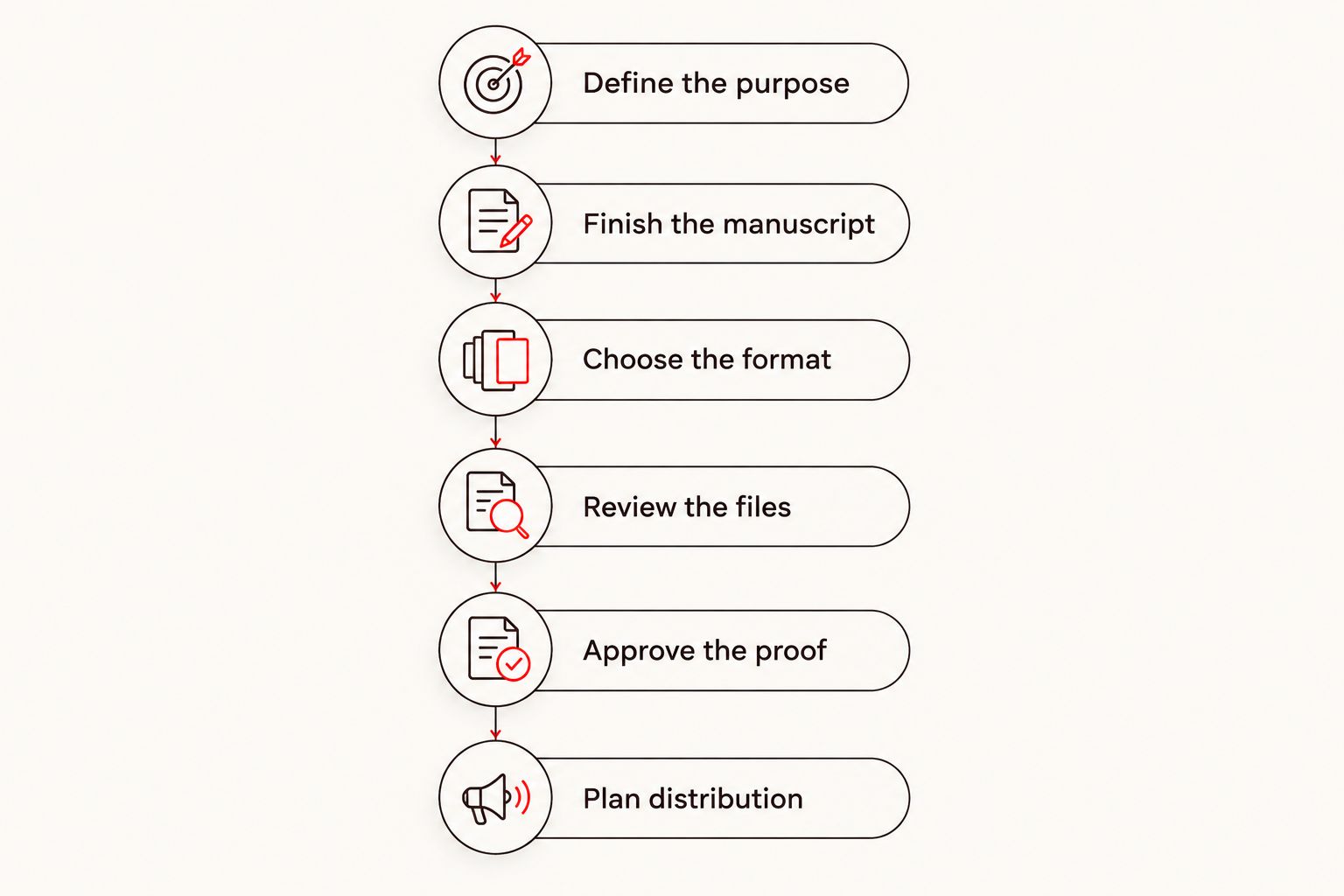
A short run limits how many copies contain the current edition, leaving later batches open to corrections. It does not excuse known mistakes. Approve a book you are comfortable giving to readers now.
Keep a revision log after distribution. Record the page, issue, and proposed correction, then update the source file rather than making isolated fixes in unrelated copies.
Printing produces the physical book; publication planning and distribution require their own decisions. Confirm the scope of any service before assuming it includes editing, sales channels, or delivery to individual readers.
For a 2026 launch, assign a person and a process to each task. A box of finished books is a production result, not a complete sales plan.
Is short run book printing worth it if I have no audience yet?
Short-run printing is worth it without an established audience when you have a defined use for the copies, such as gifts or private distribution. For speculative sales alone, establish a distribution plan before ordering a batch.
Is short-run printing better than print on demand for my first book?
Short-run printing is better suited to planned batches, while print on demand suits production tied to individual orders. Choose based on how readers will receive the book and whether you want to manage copies yourself.
How many copies should a first-time author print?
Base your first quantity on confirmed requests, named recipients, and deliberate event or reference needs. Keep hoped-for sales separate from copies with an assigned destination.
Can Publishing Xpress print a small batch of my first book?
Publishing Xpress provides short-run digital book printing without large minimum order requirements. Confirm the requirements for your selected binding and finished files before placing an order.
Should I choose perfect binding for my first novel?
Perfect binding suits novels because it creates a glued spine and paperback format. Confirm that your page count and layout meet the printer’s requirements before preparing the final cover.
Do I need to check a proof before approving a short run?
Check a proof before approving your short run so you can resolve file and layout problems before batch production. Ask the printer which proof options are offered and inspect the cover as well as the interior.
Can I correct my book after the first batch is printed?
You can correct the files for a later batch, but already printed copies retain the original content. Save the approved edition and keep a revision log so changes remain traceable.
Before you order, make a list titled Where these books will go. Every intended copy should belong to a real purpose: a request, a recipient, an event allocation, or a copy you intentionally keep.
If the list is mostly hope, wait. If the list describes a finished book reaching intended readers, a short run is a sensible first step.
© 2026 Publishing Xpress. All Rights Reserved.