November 20, 2026
Zine printing costs depend on your page count, finished size, paper, color, binding, and print quantity; get a quote for your exact specifications before setting your 2026 budget. Check whether the quoted total includes delivery and any applicable tax, then separate printing expenses from design, packaging, and mailing to readers.
Your zine's cost is the total for a defined print job, not a reliable category-wide average. A text-led issue and a photography issue need different production specifications, so a headline figure without those details is not a useful budget.
For a usable estimate, contact the printing team with your finished size, page count, quantity, interior color requirements, paper preferences, binding, and delivery destination. Ask for an itemized quote so you can distinguish production from other expenses.
Use this breakdown when reviewing a 2026 quote:
| Budget component | What to confirm | Why it belongs in your budget |
|---|---|---|
| Interior printing | Page count, color treatment, and interior paper | Defines the content being reproduced |
| Cover | Cover paper, printing, and any selected finish | Keeps cover specifications separate from interior specifications |
| Binding | Binding method and suitability for the finished document | Determines how pages are assembled and handled |
| Delivery | Destination and delivery service | Distinguishes the printing total from the delivered total |
| Applicable tax | Whether the quote includes it | Prevents comparing a tax-inclusive total with a tax-exclusive total |
| Separate project expenses | Design, editing, packaging, and reader fulfillment | Shows the full project commitment beyond printing |
Do not assume every component appears as a separate charge. The purpose of this checklist is to confirm what the total includes, not to predict a printer's billing structure.
A lower cost per copy does not automatically make a zine run more affordable. You still have to fund the complete order, store the copies, and distribute them.
Start with the money you can commit to the issue. Then decide which physical features are essential to the reading experience and which are optional. That order keeps a specification upgrade from quietly becoming a budget problem.
Your distribution plan matters, too. Copies for contributors, reviewers, and your own archive use part of the print run even when you do not sell them. Keep those allocations visible before deciding how many copies you expect to sell.
These specifications define the job a printer quotes. Keep them consistent when comparing printers, and change them deliberately when comparing versions of your own zine.
The best comparison changes a single specification while holding the others fixed. If you change size, page count, paper, and quantity together, you lose the ability to identify which decision changed the quote.
Start with the way readers will handle the issue, then confirm that the binding suits its page count and paper. Saddle stitch and perfect binding create different physical objects; neither wins every zine project.
| Binding option | Best for | Practical advantage | Trade-off to check |
|---|---|---|---|
| Saddle stitch | Short, booklet-style zines | Folded pages fastened through the fold suit a compact issue | Page-count limits and paper thickness restrict suitability |
| Perfect binding | Thicker, paperback-style zines | Glued pages and a wraparound cover create a defined spine | It does not open flat like a loose stack of pages; gutter space needs attention |
These are format recommendations, not a claim that either binding always has the lower quote. Compare the actual job specifications before deciding.
Publishing Xpress zine printing supports saddle stitch books up to 80 pages. Treat that as a maximum, not a reason to fill every available page or a guarantee that every paper choice suits the same thickness.
Saddle stitch uses folded sheets, so booklet pagination works in multiples of four. Include intentional blank pages in the layout and ask the printer how to report the cover in the page count. Finalize pagination before approving the production file.
Perfect binding suits a zine you want readers to handle as a paperback-style publication. Confirm the required document thickness and paper combination before building a cover with spine artwork.
Do not estimate the spine from page count alone. Paper thickness contributes to the finished spine width, and the cover file must match the approved production specifications. Keep important text away from the binding edge inside the issue.
For your 2026 issue, prepare a short specification sheet before requesting estimates. You do not need printing jargon. You need a consistent description of the document.
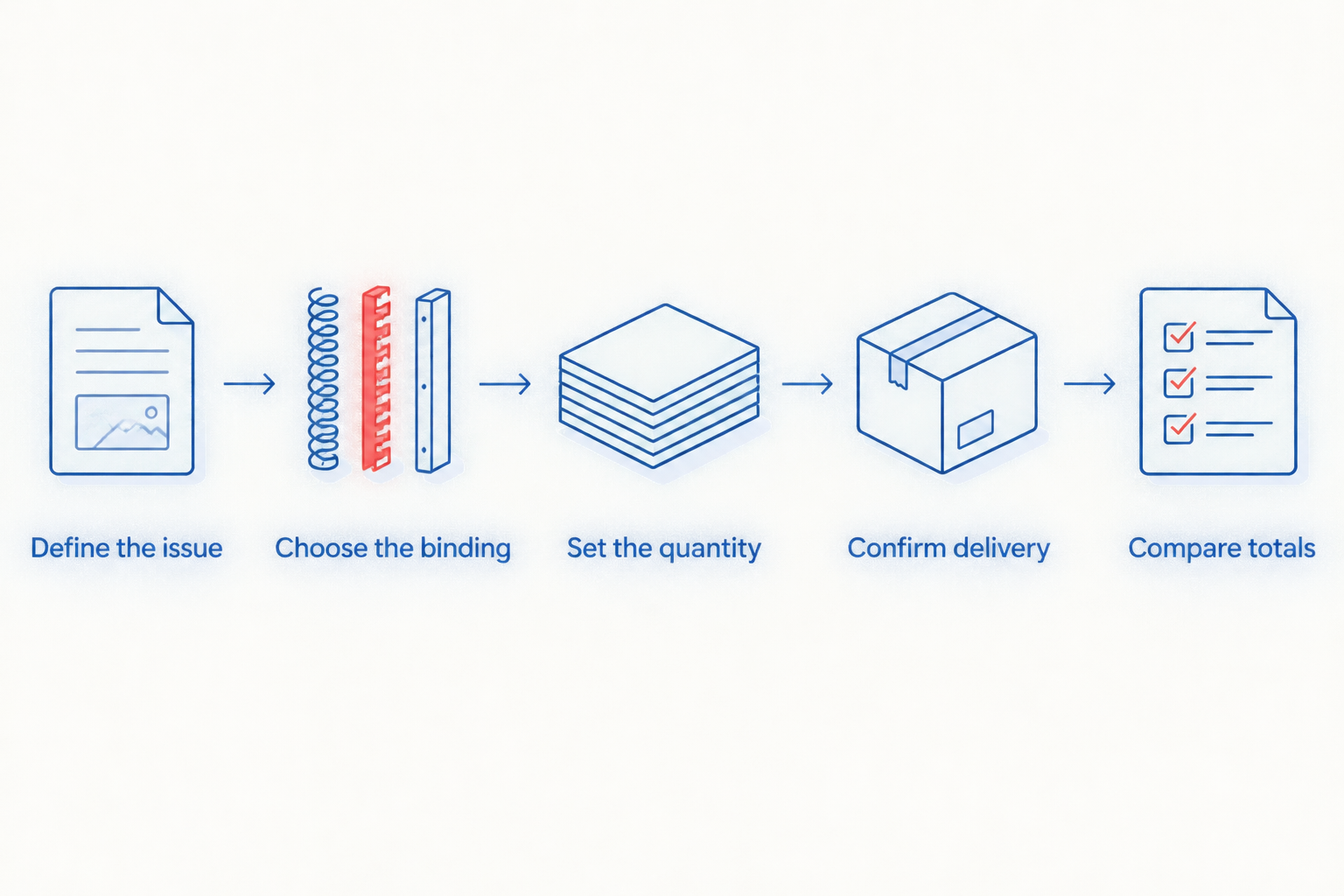
Save that specification sheet with the quote. If you later add content or switch paper, update the sheet and request confirmation of the revised total before approving production.
Protect the features that carry the content; simplify the features that do not. A photography issue needs a different set of priorities from a text-led collection of interviews or poems.
Review your issue in this order:
For a recurring 2026 zine, preserve the approved specifications after the issue is complete. A consistent production brief makes later comparisons clearer because you can identify what changed between issues.
Avoid making a last-minute design change solely to chase an unconfirmed saving. Get the revised quote first. Otherwise, you risk spending time on a redesign that does not solve your budget problem.
25 copies is the minimum print quantity at Publishing Xpress. That makes the service a fit for creators planning a batch, not a single-copy project.
Publishing Xpress is best for zine creators who need a print run of at least 25 copies. The limitation is equally clear: your project must support that minimum order, even if you intend to distribute fewer copies immediately.
Build a copy-allocation list before placing the order. Separate copies for readers, contributors, promotion, and your archive so the print quantity reflects an actual plan rather than a round-number guess.
80 pages is the maximum saddle stitch book length at Publishing Xpress. Confirm that your chosen paper and finished format suit the project before treating that limit as your final specification.
If the manuscript exceeds the binding's limit, edit the issue or discuss another binding. Do not reduce text to an uncomfortable size merely to keep a preferred assembly method.
4 to 6 days after proof approval is when Publishing Xpress ships orders. That is a shipping milestone, not a statement that the package arrives within the same period.
For a 2026 fair, launch, or subscriber mailing, plan backward from the date you need the copies. Leave room for file preparation, proof review, corrections, and transit before making a delivery promise to readers.
How much does zine printing cost in 2026?
Zine printing requires a quote based on quantity, page count, finished size, paper, color, and binding. Compare the complete delivered total and confirm whether applicable tax is included before setting your budget.
Is saddle stitch always cheaper than perfect binding for a zine?
Do not assume saddle stitch is always cheaper than perfect binding. Request quotes for suitable specifications and compare complete totals; the binding must also fit the document’s thickness and intended use.
Can I print a zine with a color cover and black-and-white pages?
Specify the cover and interior color requirements separately when requesting your quote. Ask the printer to confirm the proposed combination before preparing the final files.
Does a zine printing quote include shipping?
Confirm shipping directly in the quote rather than assuming it is included. Provide the delivery destination so you can compare delivered totals rather than production totals alone.
Should I order extra zines to lower my cost per copy?
Order extra copies only when the complete order fits your budget and distribution plan. A lower per-copy result does not remove the need to fund, store, and distribute the additional copies.
Do blank pages count when I prepare a zine for printing?
Include intentional blank pages in your document’s pagination and confirm the printer’s page-count convention. For saddle stitch, the folded-sheet structure requires pagination in multiples of four.
Should I approve the proof before checking the final specifications?
Check the final specifications before approving the proof. Verify page order, intentional blanks, cover placement, image cropping, and the binding requirements against the approved quote.
Work out your budget per sellable copy, not just per printed copy. Contributor copies, review copies, and archive copies remain part of your production expense even though you do not sell them.
Keep those allocations in your planning sheet. Dividing the complete project expense by the copies you actually intend to sell gives you a clearer basis for deciding whether the issue is financially workable.
© 2026 Publishing Xpress. All Rights Reserved.