October 22, 2026
The cost to print a children’s picture book depends on your book’s finished size, page count, color, paper, binding, and order quantity; get a quote for those exact specifications before setting your budget in 2026. Keep illustration, editing, and layout separate from printing, and confirm whether delivery and applicable taxes are included in the total.
Your printing budget should match the book you intend to put in a reader’s hands. A quote for a different size, paper, or binding does not tell you what your finished picture book will cost.
For a first project, start with the production decisions in this guide to self-publishing a children’s picture book. Then request comparable quotes rather than redesigning your book around an unrelated estimate.
Choose the book specifications first, then compare the total order cost. That keeps an attractive per-copy figure from distracting you from delivery charges, design work, or more copies than you need.
A useful printing estimate is a quote for a defined job, not a category-wide average. For your 2026 budget, ask for an itemized total covering the finished books and identify any separate charges before comparing suppliers.
Publishing Xpress sets a minimum order of 25 copies, limits saddle stitch books to 80 pages, and ships in 4 to 6 days after proof approval. Those production facts help you check whether the service fits your project; your selected specifications determine the quote.
Use this breakdown to separate printing from the rest of publishing:
| Budget component | What to establish | What to check |
|---|---|---|
| Interior printing | Finished size, page count, color, and paper | Whether every quote uses identical specifications |
| Cover production | Cover file, stock, and finish | Whether the cover is included in the quoted total |
| Binding | Saddle stitch, perfect binding, plastic coil, or Wire-O | Whether the format suits your page count and reading experience |
| Quantity | The number of finished copies you need | Total order cost as well as cost per copy |
| Proofing and changes | Proof process and final file approval | Whether revisions or additional proofs carry separate charges |
| Delivery and taxes | Destination and applicable charges | Whether these appear in the final total |
| Creative preparation | Illustration, editing, and layout | Which expenses sit outside the printing quote |
Printing cost per copy equals the printing total divided by the number of copies ordered. Delivered cost per copy uses the total including delivery and applicable taxes instead. Keep those calculations distinct when reviewing estimates.
Saddle stitch uses staples along the fold to hold the book together. It suits a short illustrated story when you want a booklet format rather than a glued paperback spine.
The advantage is a straightforward format for a short book. The limitation is capacity: the maximum offered here is 80 pages, and paper choice still needs to suit the finished booklet.
Ask how the printer counts the cover and interior pages before submitting your files. Do not assume that your design application’s page total matches the quote form’s counting method.
Recommendation: compare saddle stitch for a short picture book, but confirm page count and paper compatibility first.
Perfect binding attaches the interior pages to a wraparound cover with adhesive. It gives your picture book a paperback format with a defined spine when the book’s thickness supports it.
The benefit is that paperback presentation. The trade-off is the gutter: artwork and text near the binding need space, and you should not design a spread on the assumption that it will open completely flat.
Ask the printer whether your page count and paper create a suitable book block before finalizing the cover. Spine dimensions depend on the actual interior specifications, not just the cover artwork.
For a closer comparison, read perfect binding vs. saddle stitch. Choose perfect binding for the intended reading experience, not because it sounds more finished.
Plastic coil binding threads a continuous coil through holes along the binding edge. It is useful when your illustrated book includes drawing, tracing, or other activities that readers complete on an open page.
The benefit is practical page handling and a lay-flat format. The compromise is an exposed binding edge with punched holes, which requires extra attention to the placement of text and artwork.
Do not position a character’s face, instructions, or an activity’s answer area inside the punched margin. Request the printer’s binding clearance before laying out those elements.
Recommendation: consider plastic coil for an illustrated activity book; do not choose it solely to change the quote.
Wire-O uses paired wire loops through holes along the binding edge. Like plastic coil, it supports pages that lie flat, making it relevant to an illustrated workbook or guided learning book.
Its advantage is the open-page format. Its limitations include the exposed wire and the space needed for punched holes; it does not create the continuous paperback spine of perfect binding.
Confirm the binding margin before approving the layout. A usable workbook needs enough room for both the binding and the reader’s activity.
Recommendation: compare Wire-O when working on the page matters more than a conventional storybook format.
Binding changes how a picture book opens, how artwork sits near the center, and how the cover is constructed. Use the reading experience to narrow your choices before requesting a 2026 estimate.
| Binding | Best for | Main advantage | Main limitation |
|---|---|---|---|
| Saddle stitch | Short picture books | Folded booklet construction | Maximum of 80 pages here; no flat paperback spine |
| Perfect binding | Paperback picture books | Glued spine and wraparound cover | Requires suitable book thickness and gutter planning |
| Plastic coil | Illustrated activity books | Pages lie flat for hands-on use | Punched margin and exposed coil |
| Wire-O | Illustrated workbooks | Lay-flat reading and writing | Punched margin and exposed wire loops |
Do not treat this table as a cost ranking. Request quotes for compatible bindings using the same interior specifications. Otherwise, you are comparing different books rather than different production choices.
These specifications define the production job. Change them deliberately, and ask for a revised quote rather than assuming a particular saving.
Do not remove a feature that carries the story just to simplify the estimate. If color is essential to understanding an illustration, preserve it and investigate other specifications instead.
A clear quote request prevents assumptions about your files and finished book. Follow this sequence for your 2026 project before approving production.
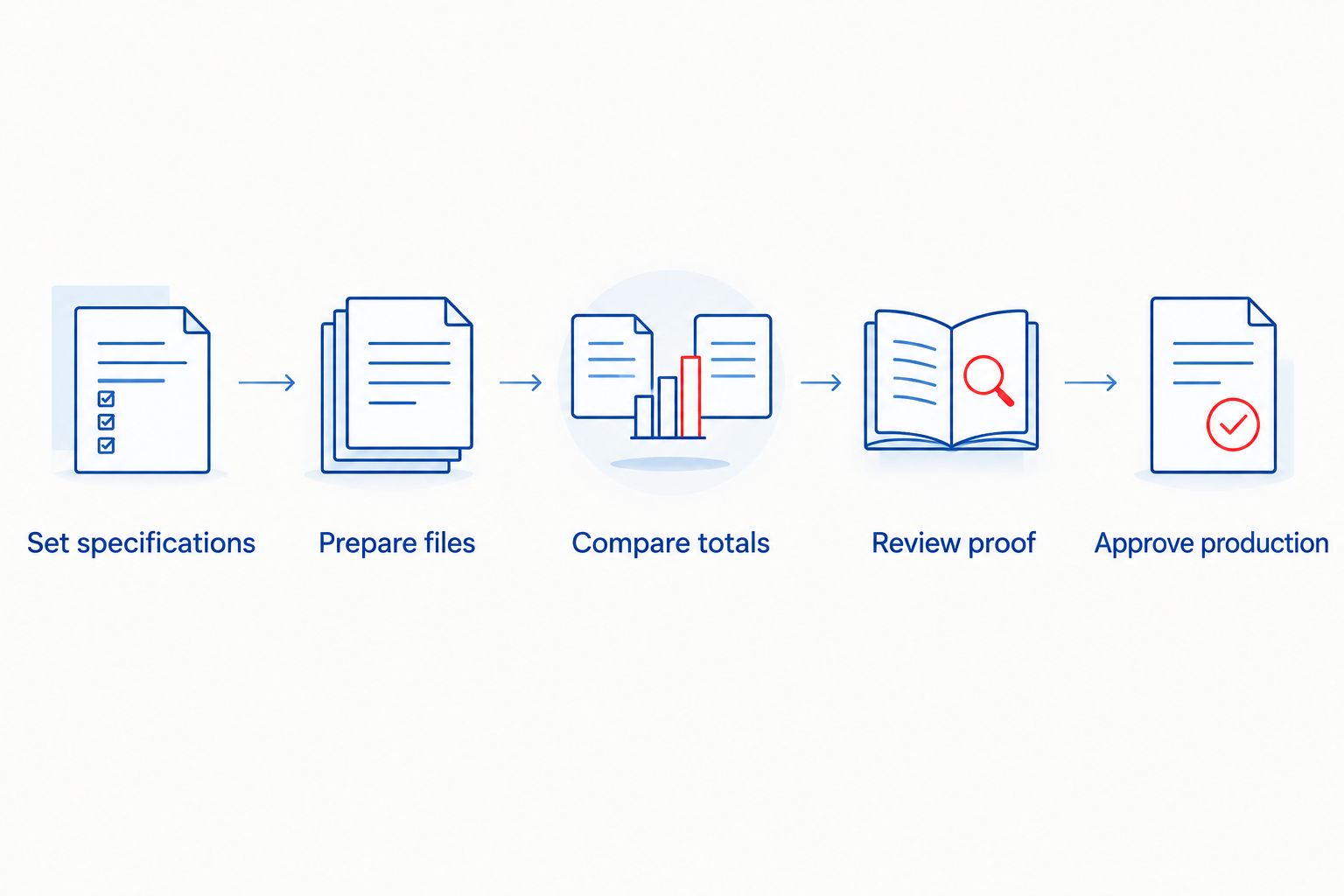
A quote request should also explain how readers will use the book. A read-aloud story and an illustrated workbook place different demands on the binding even when their page counts match.
Publishing Xpress is best for self-publishers who need short-run children’s picture book printing starting at 25 copies. The minimum also sets a clear boundary: this service is not a single-copy order option.
Illustration, editing, and layout belong in your publishing budget, but they are separate from producing the physical copies unless your agreement explicitly includes them. Keep each expense visible so a printing quote does not become your assumed total project cost.
Also plan what happens after the books arrive. Storage, packaging, and sending copies to readers are separate tasks from manufacturing your order.
Before committing to a 2026 launch budget, write down:
Compare printing quotes with printing quotes, not with full publishing packages. Different scopes make totals misleading even when both proposals describe a finished book.
Order more only when the revised quote and your distribution plan justify the larger commitment. A lower per-copy figure does not automatically make a larger order the better decision.
Start with copies assigned to a clear purpose: direct sales, school visits, gifts, review copies, or an event. Keep copies intended for sale separate from copies you plan to give away.
Then compare the full order totals. If the larger run leaves you with books you cannot distribute or store, the lower unit cost has not solved your budget problem.
Yes: test specification changes individually and review the effect on both the quote and the reading experience. Start with unnecessary blank pages, an unsuitable format, or an order quantity that exceeds your actual needs.
Preserve readable text, clear artwork, and adequate margins. Cutting those essentials creates a weaker book rather than a better production plan.
Ask for alternate quotes with each change identified. That gives you a useful basis for choosing between versions without guessing which specification caused the difference.
How much does it cost to print a children’s picture book in 2026?
Get a quote based on the book’s size, page count, color, paper, binding, and quantity. Compare the total order cost and confirm whether delivery and applicable taxes are included.
What is the minimum order for a children’s picture book?
Publishing Xpress requires a minimum order of 25 copies for children’s picture book printing. Use that minimum when deciding whether a short-run order fits your project.
How many pages can a saddle stitch picture book have?
The maximum offered for saddle stitch books is 80 pages. Confirm the page-count method and paper compatibility before finalizing your files.
Is saddle stitch cheaper than perfect binding for a picture book?
Compare quotes for your actual specifications rather than assuming a cost ranking. Saddle stitch and perfect binding also differ in construction, page-count suitability, and gutter requirements.
Does a printing quote include children’s book illustrations?
Treat illustration as a separate publishing expense unless the agreement explicitly includes it. Check the scope for editing, layout, cover preparation, and printing individually.
Should I compare printing cost per copy or the total order cost?
Compare both, but use the total order cost to judge your budget commitment. Check delivery and applicable taxes separately so every estimate covers the same scope.
What should I check before approving a picture book proof?
Check page order, spelling, image cropping, text readability, and binding clearance. Confirm that the approved files match the size, color, and page count in your order.
Make a folded paper dummy before locking the layout. You do not need finished illustrations to check where the story opens, where each page turn lands, and whether the ending falls in the right place.
Read it aloud while turning the pages. Fix the pacing before approving the print files; a technically correct PDF still needs to work as a physical picture book.
© 2026 Publishing Xpress. All Rights Reserved.