October 27, 2026
The cost to print 500 copies of a book in 2026 requires a quote based on your finished page count, size, paper, color, and binding—quantity alone does not establish a reliable total. Check whether that quote includes shipping, taxes, proofing, and any file preparation, because the printing subtotal is not necessarily your complete project budget. The practical next step is to finalize a book specification, then compare quotes for exactly the same book.
A usable total comes from a specification-based quote for 500 finished books. A text-only paperback and an illustrated workbook are different printing jobs, even when you order the same quantity. Comparing their totals without accounting for those differences tells you little.
You can start a book printing inquiry with Publishing Xpress, but decide what you want printed before comparing estimates. Use this breakdown to keep the scope clear.
| Budget component | What to specify or confirm | Why it belongs in your comparison |
|---|---|---|
| Interior printing | Final page count, black-and-white or color, paper | Defines the pages being produced |
| Cover | Cover stock, printing, and finish | Keeps cover specifications consistent |
| Binding | Perfect bound, saddle stitch, plastic coil, or Wire-O | Determines construction and how pages open |
| Proofing | Proof format and approval process | Establishes what you review before production |
| File preparation | Who supplies print-ready files and handles corrections | Separates printing from preparation work |
| Delivery and taxes | Destination, shipping method, applicable taxes | Establishes the complete order total |
Ask each printer to identify what is included rather than assuming every line carries a separate charge. An item included in one estimate and excluded from another still needs to be accounted for.
For your 2026 printing budget, the useful comparison is the total for the book you actually intend to distribute. A lower estimate for different paper, fewer pages, or a different binding is not a lower estimate for the same job.
Ordering 500 copies also means committing to physical inventory. Before approving production, confirm where the books will go, who will receive them, and whether the content is final enough to print in that quantity. Saving on an unsuitable format does not solve your publishing problem.
These specifications define the printing job. Keep them unchanged when comparing printers, then request separate alternatives if you want to explore changes.
Do not change several specifications at once when investigating your options. Ask what happens when one variable changes, and keep a written record of the revised specification beside each estimate.
Choose binding by how readers will use the book, then compare estimates within that format. A novel needs comfortable sequential reading; a training workbook needs accessible writing space. Neither requirement disappears because you order 500 copies.
The distinction between perfect binding and saddle stitch is especially relevant when your project sits between a paperback book and a shorter booklet.
| Binding | Best for | Main advantage | Main limitation |
|---|---|---|---|
| Perfect bound | Novels, memoirs, and reading-focused paperbacks | Glued spine and a conventional paperback format | Does not naturally lie completely flat |
| Saddle stitch | Short booklets, zines, and event programs | Folded pages secured through the center | Publishing Xpress limits this format to 80 pages |
| Plastic coil | Workbooks, planners, and hands-on manuals | Pages lie flat and turn around the coil | Punched edge requires space clear of content |
| Wire-O | Cookbooks, portfolios, and reference books | Pages lie flat for open-book use | Exposed wire can bend if mishandled |
Perfect binding joins the page block with adhesive inside a wraparound cover. It suits books readers hold and read from beginning to end, including novels and personal histories.
The trade-off is the opening behavior. Choose perfect binding for a paperback format, not because you expect hands-free, flat-open pages. Confirm that your page count and paper combination suit the printer's binding requirements before finalizing the cover.
Saddle stitching secures folded sheets through the center. It fits shorter publications such as poetry booklets, programs, and zines, but it is not an alternative for every paperback.
Publishing Xpress offers saddle stitch books up to 80 pages. If your finished file exceeds that limit, quote another binding instead of squeezing the text into an unreadable layout.
Plastic coil runs through holes along the binding edge. Readers can open the book flat or fold pages back, which makes the format practical for exercises, recipes, and reference instructions.
The punched edge needs a clear margin. Keep answer spaces, diagrams, and text away from that area, and review the layout for usability rather than appearance alone.
Wire-O uses a double-loop wire binding to hold punched pages. It suits books that stay open beside a task, including cookbooks and reference manuals.
The wire remains exposed. Protect the binding during handling and distribution, and confirm the required punching clearance before preparing the final interior file.
For a 2026 order, send every printer the same written brief and the same file version. A comparable quote starts with a comparable request. Use this sequence before treating any estimate as your final budget.
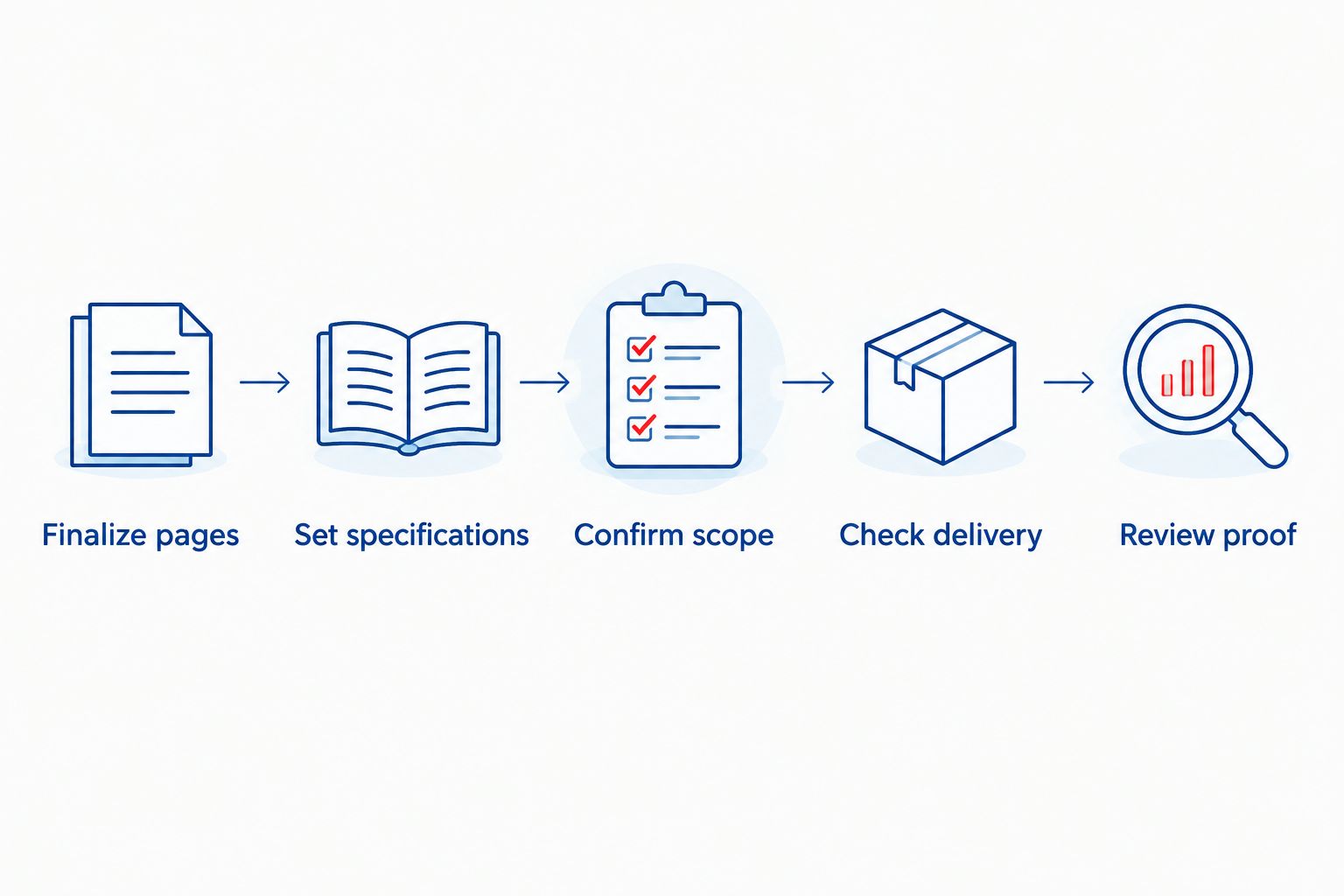
Save the quote beside the files it describes. If your interior changes after quoting, ask whether the revision changes the specification before approving production; do not assume a revised layout leaves the estimate unchanged.
Choose the size your content needs before trying to reduce the printing total. Text, photographs, diagrams, and writing exercises place different demands on a page. A smaller book is not automatically a better production choice if it forces additional pages or cramped typography.
For image-led projects, comparing photo book sizes and formats belongs alongside layout planning: page proportions determine how photographs fit and where cropping occurs. Review representative spreads before committing the entire book to a format.
Apply the same discipline to color. A text-focused book can communicate without a color interior, while an art book or illustrated instructional book needs a closer review of what the images must convey.
Before changing a color interior to black-and-white, inspect:
Remove unnecessary color, not necessary information. If you request an alternative specification, inspect a representative conversion rather than assuming the original design will remain equally clear.
Printing produces physical books; it does not describe every task needed to publish and distribute them. Keep editing, interior formatting, cover design, and distribution work distinct from the manufacturing quote unless those services are explicitly included.
For a 2026 budget, record both the printing total and the complete project total. Divide the relevant total by 500 copies to understand its per-copy allocation, but label which total you used. A manufacturing-only calculation and a complete-project calculation answer different questions.
Delivery also deserves its own check. Confirm whether the estimate covers shipment to your destination, then plan separately for any later shipments from you to readers or event organizers. Receiving a batch of books is not the same task as distributing that batch.
Finally, name the costs that remain unconfirmed before committing. A clearly identified exclusion is easier to manage than an assumed inclusion. Do not treat an incomplete estimate as a finished budget.
500 copies is a distribution decision as well as a printing quantity. Match the order to preorders, event needs, organizational use, or a sales plan you can explain. Do not increase a run solely to pursue a different per-copy figure without considering the additional inventory.
Publishing Xpress book printing has a 25-copy minimum, so a 500-copy order is not required to meet its minimum. That flexibility suits a project with a smaller confirmed audience; the limitation is that a smaller batch still needs its own specification-based quote.
Publishing Xpress is a fit for self-publishers who need short-run book printing in quantities of at least 25 copies. It is not the right fit for an order below that minimum. Choose the quantity around your actual distribution needs, then compare the complete commitment.
Publishing Xpress states a production window of 4 to 6 business days after proof approval. That clock does not start when you begin writing, request an estimate, or first upload an unfinished manuscript.
For your 2026 schedule, allow separate time for file preparation, proof review, production, and shipping transit. Give the printer your required arrival date rather than treating the production window as a delivery promise.
A rushed proof review risks sending an overlooked error into every copy. Read the entire proof, check cover placement and page order, and confirm that diagrams and writing areas remain clear near the binding.
What’s the cost to print 500 copies of a book in 2026?
The cost to print 500 copies of a book requires a quote for the finished page count, size, paper, color, and binding. Confirm shipping, taxes, proofing, and file preparation before treating the quote as your complete budget.
How do I calculate printing cost per copy for 500 books?
Divide the quoted printing total by 500 copies to calculate the printing allocation per book. If you include delivery or other project expenses, label that calculation separately so you do not confuse manufacturing cost with the complete project budget.
Is perfect binding better than spiral binding for my book?
Perfect binding suits reading-focused paperbacks, while plastic coil spiral binding suits books that need to lie flat or fold back. Choose around reader use, then request a quote for the appropriate format.
Can I saddle stitch a long book?
80 pages is the maximum Publishing Xpress offers for saddle stitch books. Quote another binding if your finished book exceeds that limit.
Do I have to order 500 copies to use a short-run printer?
25 copies is the minimum order at Publishing Xpress. Choose your quantity around distribution needs rather than assuming a short-run order must contain 500 books.
Does the production time include shipping to my address?
The stated 4 to 6 business days begins after proof approval and describes production, not transit to your address. Confirm shipping time separately against your required arrival date.
What should I send a printer to get an accurate quote?
Send the finished page count, trim size, interior color, paper and cover requirements, binding choice, quantity, destination, and required arrival date. Identify whether your files are print-ready and ask which services the estimate includes.
Do not cut pages by shrinking everything until the book becomes difficult to read. Review unnecessary blank space, repeated material, and layout inconsistencies first, then check a printed sample of representative pages at the intended finished size.
Your best final check is practical: can readers comfortably read the text, see the images, and use the book as intended? Approve the specification that passes that test before committing to 500 copies.
© 2026 Publishing Xpress. All Rights Reserved.