October 23, 2026
In 2026, getting an ISBN for a self-published book means choosing between buying identifiers from your national ISBN agency and using an eligible publishing platform’s supplied identifier; check the provider’s current terms before choosing. Your country, publishing plans, and number of separately published formats determine what you need. Barcode preparation, book production, and distribution are separate services—not benefits automatically included with an ISBN.
Choose your publishing route before choosing your ISBN source. An identifier tied to a platform comes with different conditions from one registered to your own publishing name. That difference matters when you want to print elsewhere or distribute the same edition through additional channels.
Start with how to get an ISBN for your self-published book if you need the registration steps. Here, the decision is narrower: which route fits your book, what belongs in the same budget, and which purchases you should keep separate.
For a US self-publisher, Bowker’s current purchasing options are the starting point for an independently registered ISBN. A publishing platform’s supplied identifier is a different route, not necessarily an interchangeable substitute. Compare the registration terms alongside the financial commitment.
The International ISBN Agency identifies Bowker as the US registration agency. Its ISBN Users’ Manual explains the underlying assignment rules: identifiers distinguish publications by publisher, edition, and product form. Those rules—not the size of your print order—determine how many identifiers your project needs.
| ISBN route | Best for | Main advantage | Main limitation |
|---|---|---|---|
| Direct registration through your national agency | Authors establishing their own publishing identity | You register under your publishing name and manage the assignment | You handle registration and publication metadata |
| Eligible platform-supplied ISBN | Authors publishing within that platform’s supported workflow | ISBN assignment forms part of the platform’s process | Use and publisher-of-record conditions depend on the platform |
| No ISBN for a private project | Authors printing books solely for private circulation | Avoids unnecessary registration when no sales channel requires it | Does not meet channels that require an ISBN |
For your 2026 publishing budget, compare like with like. An identifier by itself is not the same service as an identifier bundled with barcode artwork, file preparation, or distribution assistance. Ask what each item does before accepting the bundle.
Register through the agency responsible for the country where your publishing operation is based. For US publishers, that means Bowker. Do not choose another country’s agency simply because its registration arrangements look more attractive.
The advantage is control over your registered publishing identity and publication records. The trade-off is responsibility: you must assign identifiers correctly and keep the associated information accurate. Choose direct registration when you intend to publish under your own imprint across compatible printing and distribution services.
Read the platform’s ISBN terms before you finish your cover. Establish who appears as the publisher of record, where the identifier can be used, and what happens if you later move the edition elsewhere.
The advantage is a simpler assignment process inside the platform. The limitation is the platform’s rules. Do not assume that a supplied identifier can travel with your files to an unrelated service.
A privately circulated family history, workshop book, or organization-only publication does not automatically need an ISBN merely because it is printed and bound. The intended recipient or sales channel determines whether an identifier is required.
This route avoids registration work that serves no practical purpose. Its limitation is distribution: if your plans change, a retailer or distributor can require an ISBN before accepting the book. Decide from your actual release plan, not from the appearance of other books.
Your manuscript’s length does not determine the number of ISBNs you need. Publishing decisions do. For a 2026 release, check these factors before selecting a registration option:
Write down only the titles and formats you actually plan to release. A speculative catalog is not a useful purchasing plan. If more books are firmly scheduled, compare agency purchasing options against that schedule rather than treating every future idea as a committed publication.
You need 1 ISBN for each separately published edition and product form that requires an ISBN—not 1 for every copy. A current ISBN contains 13 digits. Those digits identify the publication, not an individual unit from the print run.
| Publishing situation | ISBN treatment | What to check |
|---|---|---|
| Unchanged paperback reprint | Retain the existing ISBN | Publisher, edition, and product form remain unchanged |
| Separately published ebook | Assign a distinct ISBN where required | Platform requirements and separately available digital formats |
| Substantially revised edition | Assign a new ISBN | Whether the content changes constitute a new edition |
| A different book in a series | Assign a different ISBN | Each title needs its own publication record |
| Private circulation only | An ISBN is not automatically necessary | Requirements of the intended recipients or channels |
Suppose you print 25 copies of an unchanged paperback edition. You do not assign 25 ISBNs. Increasing the quantity later does not, by itself, create a new edition.
Digital publishing needs a separate check. Some ebook platforms use their own identifiers and do not require an ISBN. If you assign ISBNs to digital versions, follow the International ISBN Agency’s rules for separately available formats rather than assuming every digital file shares an identifier.
An ISBN does not produce your book, protect your manuscript, or secure bookstore placement. Treat it as a publication identifier with associated metadata. Keep the following work visible in your publishing plan.
An ISBN is a number; a barcode is its machine-readable representation. Buying or receiving the identifier does not mean a print-ready barcode has already been placed correctly on your cover.
Check whether your chosen workflow supplies barcode artwork or adds it during cover preparation. Avoid buying the same service twice. A valid number still needs readable reproduction when a retailer requires a barcode.
An ISBN does not register copyright. In the United States, copyright protection and Copyright Office registration are separate from ISBN assignment.
Do not use an ISBN confirmation as evidence that you completed copyright registration. Keep those records in separate folders and verify each process independently.
Your print order has its own specifications, proof approval, production schedule, and shipping arrangements. Registering an ISBN does not reserve production time or approve your files.
Publishing Xpress book printing fits self-publishers who need a short run of at least 25 copies. That minimum makes the service unsuitable for an author seeking just a single printed copy. Publishing Xpress ships in 4 to 6 days after proof approval; shipping time to your destination is separate from that production milestone.
Use Publishing Xpress for the printing side of your project, and keep ISBN registration on its own checklist. Resolve identifier placement before approving the cover proof so the printed book matches its publication record.
An ISBN does not guarantee that a bookstore will stock your book. Retailers and distributors have their own acceptance, ordering, and account requirements.
Registration also does not replace a complete book listing. Your title, contributor names, publisher, format, and edition details still need to match across the records you submit.
Use this sequence for your 2026 release. The order prevents you from finalizing a cover around an identifier that does not fit your publishing route.
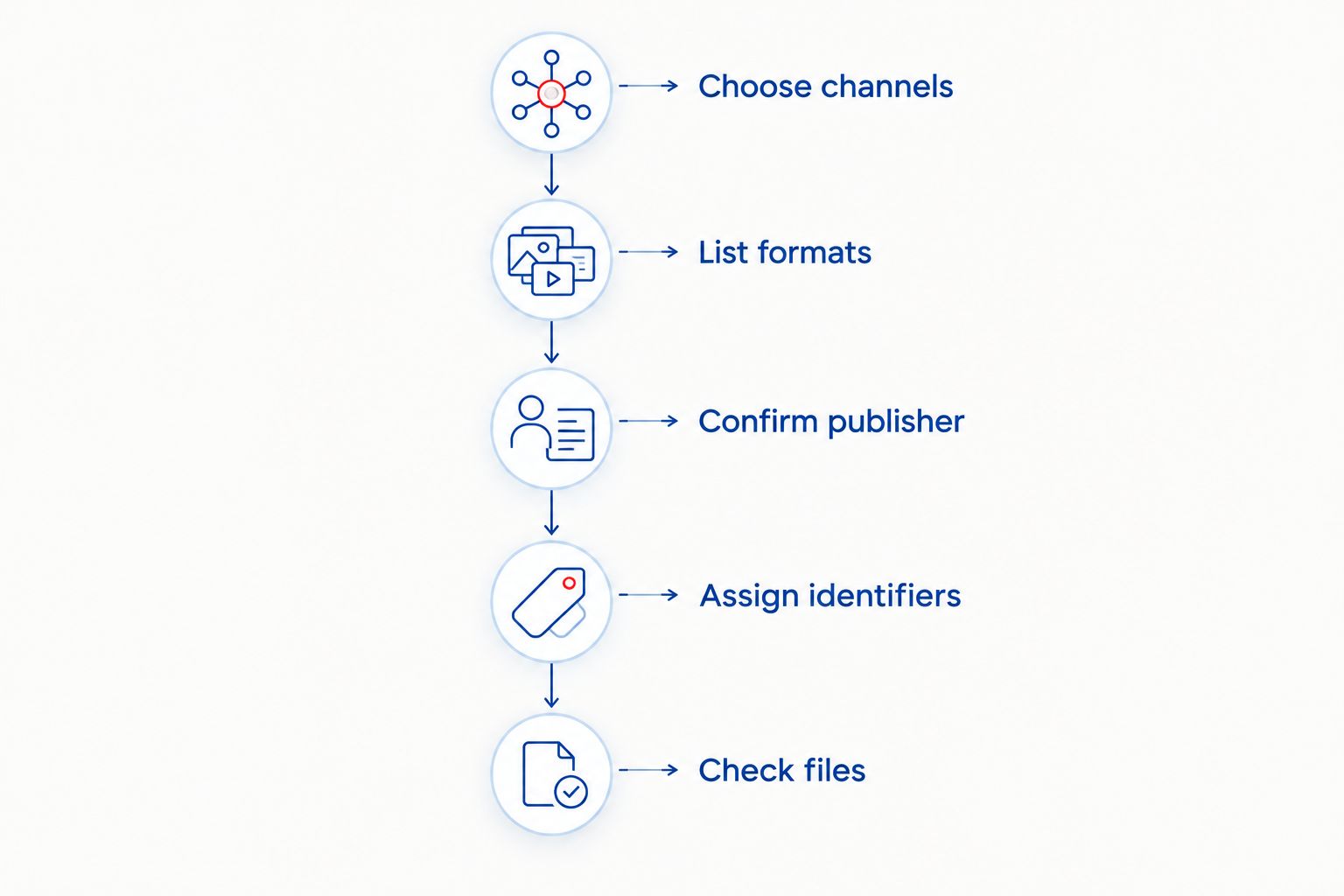
Keep a simple publication record for each edition. Include the assigned ISBN, exact title, publishing name, format, and the files approved for that version. This gives you a reference when updating a listing or placing an unchanged reprint.
Before approval, compare the human-readable ISBN with the number encoded in the barcode. Matching the cover to the copyright page is not enough if the barcode represents a different edition. Ask your designer or production provider to verify the encoded number as well as its appearance.
1 ISBN stays with an unchanged edition and product form across reprints. A larger print quantity does not create a new publication. Changing printers alone does not require a new ISBN when the publisher and edition remain the same and the identifier’s terms permit its use.
Keep that distinction clear when planning inventory. Reordering books is a production decision; releasing a substantially revised edition is a publishing decision with different identifier requirements.
1 ISBN cannot identify both a paperback and a separately published ebook. They are different product forms. Check whether your ebook channel requires an ISBN before assigning one, because some platforms identify ebooks through their own systems.
Do not copy the paperback’s barcode onto an ebook listing as a shortcut. Maintain a separate record for each published format so readers and ordering systems identify the correct version.
Where should I check how much it costs to get an ISBN in the US?
Check Bowker’s current ISBN purchasing options for US publishers. Compare identifier registration separately from barcode preparation and other publishing services.
Is buying my own ISBN better than using a platform’s ISBN?
Buying directly is the better fit when you want your own registered publishing identity across compatible services. A platform-supplied ISBN suits a release within that platform’s terms, so check publisher-of-record and reuse restrictions first.
Does an ISBN expire if I do not publish immediately?
An ISBN does not expire. Once assigned to a publication, it cannot be reassigned to a different book, even if the original publication goes out of print.
Does getting an ISBN protect my book’s copyright?
Getting an ISBN does not register copyright or establish copyright protection. ISBN assignment identifies a publication; US copyright registration is handled separately through the Copyright Office.
Do I need an ISBN for a book I only give to family?
A book circulated privately among family members does not automatically need an ISBN. Check requirements if you later decide to offer the edition through retailers or distributors.
Do I need a different ISBN for every printed copy?
You do not need a different ISBN for every printed copy. Copies of the same unchanged edition and product form share the assigned identifier.
Does an ISBN automatically get my book into bookstores?
An ISBN does not guarantee bookstore placement. Retailers and distributors still apply their own acceptance and ordering requirements.
An assigned ISBN cannot be recycled for your next book—even when the original title goes out of print. Treat the assignment as permanent, not as an identifier you can move between projects.
For your 2026 release, settle the edition and format before assignment, then check the record against the final files. That small administrative step keeps the identifier attached to the book you actually intend to publish.
© 2026 Publishing Xpress. All Rights Reserved.