October 26, 2026
Getting an ISBN for a book has no universal waiting period: the timing depends on your national ISBN agency, your application route, and whether you already have an unused number to assign. For a 2026 release, confirm your agency’s current processing instructions before setting your deadline. Receiving the number does not mean your book’s metadata, barcode, retailer listing, or print files are ready.
Plan around a verified ISBN assignment, not an assumed approval date. A cover designer needs the correct identifier before finishing the barcode area, and your book’s publishing details must agree across your files and distribution records.
Start with the guide to getting an ISBN for your self-published book. Then separate the administrative task of obtaining the number from the production task of getting finished books into your hands.
Your first step is to identify which stage you actually need to complete. Obtaining numbers from an agency is different from assigning an unused number you already hold, and neither task guarantees that a bookstore can immediately find your title.
For U.S. publishers planning a 2026 release, Bowker is the official ISBN agency. Publishers based elsewhere should use the agency responsible for their country; the country where you intend to sell the book does not, by itself, determine your application route.
| ISBN route | Best for | What determines readiness | Advantage | Limitation |
|---|---|---|---|---|
| Apply through your national agency | Publishers obtaining their own identifiers | The agency’s application and processing requirements | Establishes an agency-based route for your publishing operation | Requires you to complete the applicable registration steps |
| Assign an unused ISBN you already hold | Publishers with an existing allocation | Correct assignment to the intended edition and format | Avoids a new allocation application | You still need accurate title metadata |
| Use a publishing platform’s supplied ISBN | Authors choosing that platform’s publishing arrangement | The platform’s eligibility rules and setup process | Keeps identifier setup within that publishing workflow | Publisher attribution and use restrictions require review |
Do not treat these routes as interchangeable. Before choosing one, decide who should appear as the publisher and where you intend to distribute that edition.
Best for: authors establishing their own publishing identity. Use the International ISBN Agency’s agency directory to identify the correct organization, then follow that organization’s current application instructions.
Check whether you must register a publisher account, submit supporting information, or complete an approval stage. Use the agency’s stated processing guidance for your launch schedule rather than an estimate from another author’s experience.
Best for: publishers with unused numbers in an existing allocation. You do not need to request a new allocation simply because you are publishing another title, provided you have a suitable unused number available in your account.
Assign it deliberately. Record the title, contributor names, publisher or imprint, edition, and product format so you do not accidentally use the same number for different publications.
Best for: authors whose distribution plan fits the platform’s terms. Read the identifier conditions before accepting the supplied number, including the publisher name attached to it and any restrictions on using it elsewhere.
A convenient setup does not remove those conditions. If you expect to move the edition between services, settle the ISBN arrangement before producing the final cover.
Prepare your publishing details before starting the application. For a 2026 publishing schedule, keep these decisions in a single project record that your editor, designer, and publishing administrator can reference.
You can edit your manuscript while completing the administrative steps. The important dependency is the final identifier: do not approve files containing a provisional or borrowed ISBN.
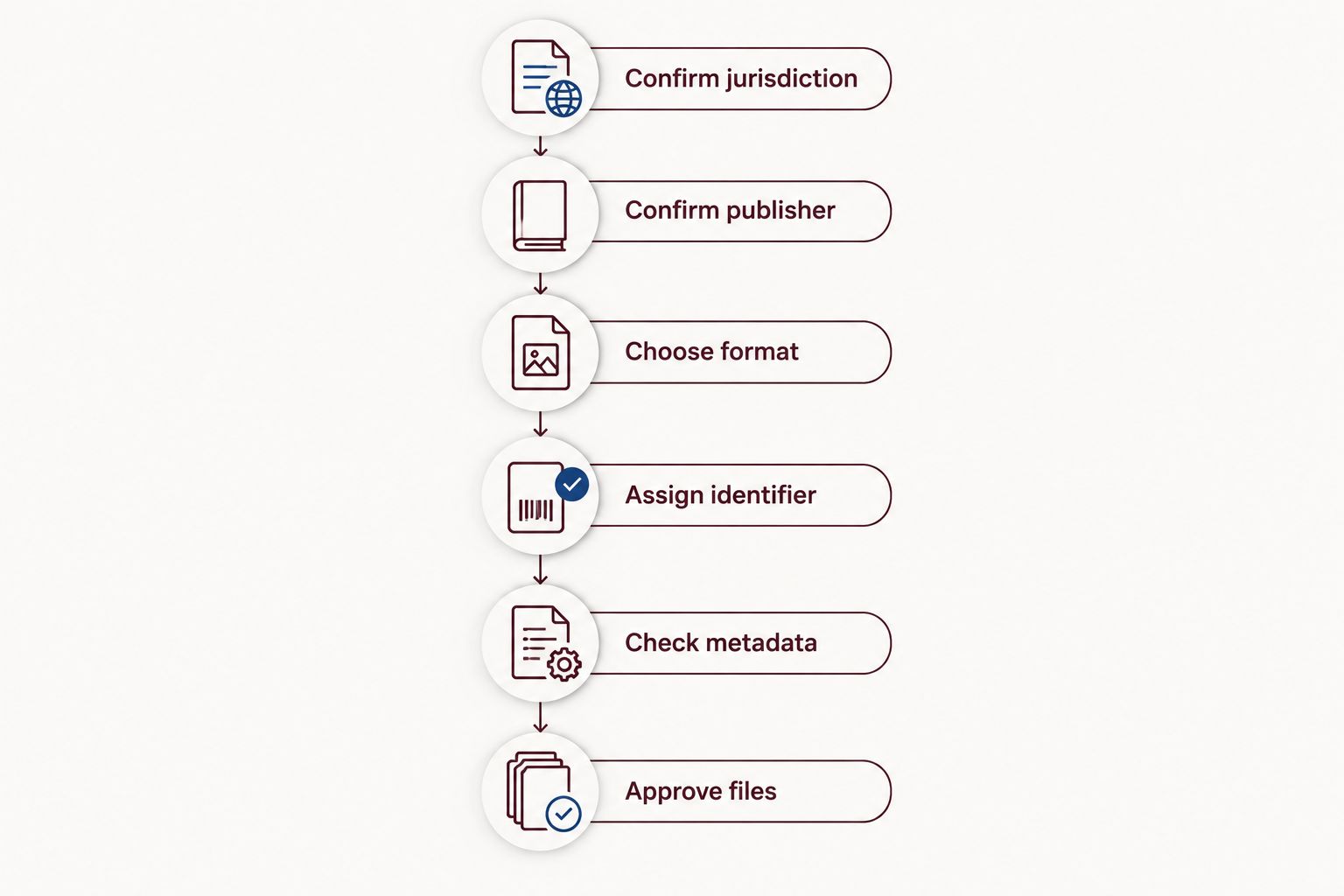
Keep the title and subtitle consistent with the wording you intend to publish. Record contributor names in their intended published form, and distinguish the author name from the publisher or imprint name.
Also identify the language, edition, and physical or digital format. Your agency or publishing service determines which fields are required at each stage, so use its instructions rather than assuming every application asks for identical information.
Continue editing, proofreading, interior formatting, and cover development. Ask your designer to leave the identifier and barcode areas unfinished until the correct details are confirmed.
Keep a clear distinction between a working PDF and an approved production PDF. A finished-looking cover is not ready for printing if it still contains a placeholder barcode or an identifier belonging to another edition.
The useful question is not simply how fast another author received a number. It is which dependencies apply to your publishing project.
Ask for the deadline attached to your actual task. An agency’s assignment guidance does not describe how long a distributor takes to process your title, and a printer’s production schedule does not describe either administrative process.
No. An ISBN identifies a publication; it does not create distribution or guarantee retailer acceptance. You still need the appropriate sales or distribution arrangement, accurate publishing information, and finished files.
The International ISBN Agency’s ISBN Users’ Manual is the reference for identifier scope and assignment principles. For a 2026 launch, use that guidance alongside the current requirements of your chosen agency and distribution services.
A number can be assigned before a retailer has processed the corresponding title record. Check the status inside your distribution service rather than using possession of an ISBN as proof that the book is discoverable.
If you are planning an event, confirm the sales arrangements separately. Physical copies, an online product page, and bookstore ordering are different outcomes with different dependencies.
An ISBN is a 13-digit identifier; a barcode is a machine-readable representation used on the printed book. Copying the number into a document does not automatically produce a suitable barcode graphic.
Check that the barcode encodes the ISBN assigned to that specific edition. Then inspect the actual exported cover PDF, not just the editable design file, before approving it.
Obtaining an ISBN does not register your copyright or establish that you have permission to reproduce material. Copyright administration and permissions require their own review.
Treat these as separate checklist items. A valid identifier does not resolve rights questions involving photographs, illustrations, quotations, or other contributed material.
You can print a book without an ISBN when your intended use and sales arrangements do not require one. Private family histories, internal manuals, and books distributed directly within an organization do not automatically need a retail identifier simply to exist in print.
Check your intended channel before deciding. If a retailer or distributor requires an ISBN, obtain and assign it before approving the edition’s production files.
For authors planning a 2026 print run, Publishing Xpress is best for self-publishers who need short-run book printing of at least 25 copies. That minimum supports a batch of books for direct distribution, but it does not fit a project requiring fewer than 25 copies.
Publishing Xpress ships in 4 to 6 days after proof approval. That schedule starts after approval, not when you begin an ISBN application, and it is not a promise that books will arrive within the same interval.
Keep the stages separate when preparing a Publishing Xpress book-printing order: confirm the identifier if your channel requires it, finish the files, review the proof, and then approve production. Arrange the ISBN through the appropriate agency or publishing route rather than treating printing and identifier assignment as the same service.
Get the correct ISBN before finalizing any print files that display it. You do not need to wait until every paragraph is polished to start investigating your agency’s requirements.
For your 2026 launch plan, work backward from the date you need finished copies. Include agency processing, metadata preparation, cover completion, proof review, production, and transit as distinct tasks rather than combining them into a single turnaround estimate.
Check the nature of the change against the International ISBN Agency’s assignment guidance. A different product format or a substantially revised edition requires separate consideration; a routine reprint of the same edition does not automatically become a new publication.
Do not solve a title, format, or edition mismatch by simply editing the digits on the cover. Confirm the correct assignment first, then update every affected file and publishing record together.
How long does it take to get an ISBN in the United States?
The processing time depends on your Bowker application route and account status; use Bowker’s current guidance for your application. Receiving an ISBN and having a retailer process your book are separate milestones.
Can I get an ISBN before my book is finished?
Yes, you can obtain an ISBN before completing the manuscript. Confirm the intended publisher, edition, and format before assigning it, then check the information again before printing.
Does each paperback edition need its own ISBN?
Each distinct paperback edition needs an appropriate ISBN assignment. Reprinting the same unchanged edition does not, by itself, require a new ISBN.
Can I use the same ISBN for a paperback and an ebook?
No, a paperback and an ebook are different product formats and should not share an ISBN. Follow the International ISBN Agency’s guidance and your distribution service’s requirements for digital editions.
Do I need an ISBN to print books for my family?
Not simply to produce private family copies. If you later plan retail distribution, check the intended channel’s identifier requirements before preparing that edition.
Does receiving an ISBN mean my book is on sale?
No, receiving an ISBN does not publish a sales listing or establish distribution. Complete the relevant retailer or distributor setup and confirm the title’s status separately.
Does an ISBN protect my book’s copyright?
No, an ISBN is a publication identifier, not copyright registration. Handle copyright registration and permissions separately from ISBN assignment.
Check the barcode against the copyright-page ISBN character by character. Both can look correct while referring to different editions, especially when you reuse an older book’s layout.
Make that comparison in the final exported PDFs. Correcting a mismatch before proof approval is a file update; discovering it in finished books means the error has already reached the printed edition.
© 2026 Publishing Xpress. All Rights Reserved.