August 10, 2026
Choosing greeting card printing for small businesses in 2026 comes down to four things: stock weight, envelope match, minimum order size, and turnaround around your busiest mailing weeks.
A greeting card is one of the few pieces of print marketing a customer keeps on their desk instead of tossing. For a small business, that's real estate you don't get from an email blast or a social post. But the wrong stock weight, a mismatched envelope, or a print run sized for a corporation instead of a five-person shop turns a nice gesture into a wasted order.
The category is also more crowded than it looks. "Greeting card" covers flat cards, folded cards, postcard hybrids, and referral cards dressed up as thank-yous — each with different costs, minimums, and use cases. Getting this right once means you're not re-learning the specs every holiday season.
This guide is for small business owners, solo practitioners, and office managers who send client thank-yous, holiday greetings, or referral cards on a schedule — not the occasional single card, but a running need for 100 to a few thousand pieces at a time. If you're printing one card for a personal event, a big-box print shop app is faster. If you're printing for a client list, a nonprofit donor base, or a referral network, the criteria below actually matter.
Greeting card printing for small businesses only pays off when the run size, paper, and envelope match how you actually mail — not how a template assumes you'll mail.
Anything under 80 lb. cover stock feels like a flyer, not a card, and clients notice the difference in about two seconds. Aim for 100 lb. to 130 lb. cover stock with a matte or uncoated finish if you want customers to write on the inside — glossy stock looks premium but resists ink from pens.
A2 (4.25" x 5.5") and A7 (5.25" x 7.25") are the two envelope sizes that cover almost every small business greeting card. Order the card and envelope together, or confirm the exact folded dimension before you approve a proof — a card that's an eighth of an inch too big for its envelope is the single most common reprint request in this category.
A small business doesn't need 5,000 holiday cards printed at once — it needs 250 now and the ability to reorder 250 more in March without re-uploading files. Publishing Xpress runs a 100-copy minimum on greeting card printing and lets you reorder in increments of 1, which matters more than the per-unit price once you've sent your first batch.
Full CMYK color makes sense for anything a client sees — holiday cards, thank-yous, referral cards with your logo. Two-color printing is fine for internal notes or bulk mailers where the design is simple text on colored stock. Don't pay for four-color process on a card nobody outside your office will open.
November and December are the two months every small business print order competes for the same press time. Get your card design finalized and files submitted by early November if you want holiday cards in hand before the second week of December — turnaround windows stretch as the season peaks, same as they did in 2025 and every year before it.
Flat cards skip the fold and the crease, which means faster production and a lower per-unit cost on short runs. One spec that matters: flat cards ship on the same 100 lb. to 130 lb. stock as folded cards, so quality doesn't drop just because the format is simpler. At a 100-copy minimum, this is the pick for a quick thank-you batch you need turned around in days, not weeks. Verdict: Buy for volume mailings where speed beats formality.
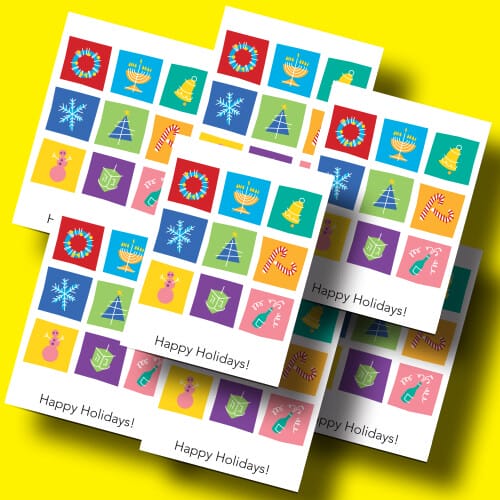
Folded cards read as more formal and are the default for holiday greetings and client appreciation mailings. The card folds to A2 or A7 dimensions and pairs with a matching envelope ordered at the same time, which removes the sizing guesswork entirely. Verdict: Buy for anything client-facing where presentation carries weight.
Skipping the envelope entirely turns a greeting card into a mailable postcard, which cuts both material cost and mailing weight on large sends. This format borrows the same production logic covered in postcard printing for other short-run mailings — full bleed color on one side, message and address on the other. Verdict: Consider if you're mailing to a list larger than a few hundred and want to cut per-piece cost.
A referral thank-you card that includes a matching contact card inside performs better than a card alone, since the recipient has something to pass along. This pairs naturally with business card printing ordered in the same batch so the stock and finish match. Verdict: Consider for referral-driven businesses — real estate, consultants, service providers — where the card is doing double duty as a lead-gen tool.
| Format | Minimum Order | Envelope Included | Best For | Verdict |
|---|---|---|---|---|
| Flat Greeting Cards | 100 | Optional | Fast, high-volume thank-yous | Buy |
| Folded Greeting Cards | 100 | Yes (A2/A7) | Formal client and holiday mailings | Buy |
| Postcard-Style Cards | 100 | No | Large mailing lists, lower postage weight | Consider |
| Referral Cards + Business Cards | 100 | Optional | Referral-driven service businesses | Consider |
What’s the best greeting card printing for small businesses in 2026?
Folded cards on 100 lb. to 130 lb. cover stock with a matching A2 or A7 envelope is the standard choice for client-facing greeting cards in 2026. Flat cards work better for fast, high-volume thank-you runs where formality matters less.
How much does greeting card printing cost for a small business?
Cost depends on quantity, stock weight, and whether envelopes are included, so check current pricing directly on the order page for an exact quote. A 100-copy minimum order is the standard starting point for short-run greeting card printing.
What’s the minimum order for greeting card printing?
Publishing Xpress runs a 100-copy minimum on greeting card printing, with reorders available in increments of 1. That means you don’t have to commit to thousands of cards just to get a short run printed.
Is postcard printing better than greeting cards for business mailings?
Postcard-style cards cut cost and mailing weight on large lists since there’s no envelope to buy or seal. Traditional folded greeting cards still read as more formal for client thank-yous and holiday mailings.
What paper weight should I use for business greeting cards?
100 lb. to 130 lb. cover stock is the standard range for greeting card printing in 2026. Anything under 80 lb. feels thin and closer to flyer stock than card stock.
When should I order holiday greeting cards for my business?
Submit files by early November to get holiday cards printed and delivered before mid-December, since turnaround windows stretch during the peak season. Ordering earlier also gives you room to reorder if your first batch runs out.
Can I reorder greeting cards in small batches?
Yes — reorders can be placed in increments of 1 once your initial print run is set up, so you’re not stuck buying another 500 cards just to restock. This matters most for businesses sending cards on a rolling basis rather than one seasonal batch.
The detail that trips up most small businesses isn't the card design — it's the envelope. Order the envelope in the same batch as the card, on the same stock family, and confirm the folded dimension before approving a proof. A card that's a hair too big for its envelope is the most common reprint request in this category, and it's completely avoidable if you check sizing once before you hit approve.
© 2026 Publishing Xpress. All Rights Reserved.