October 19, 2026
Yes, a 100-page booklet can be saddle stitched when the paper thickness and the printer’s equipment allow it, but page count alone does not establish whether your booklet will bind well. The main caveats are bulk at the fold, secure staple closure, and creep—the outward movement of inner pages before trimming. Confirm the complete paper-and-cover specification before designing around saddle stitching.
Yes, but only after the printer approves the actual stock, cover, and finished size. Saddle stitching nests folded sheets together and fastens them through the fold. A page count that works on thin paper does not automatically work on thicker stock.
For your 2026 project, start with the physical construction rather than a generic maximum. The saddle stitch binding guide explains the format’s uses and limits; your printer must still confirm your particular specification.
Use this comparison to decide which construction deserves a closer look:
| Binding | Best for | Main advantage | Main drawback | Decision for a 100-page project |
|---|---|---|---|---|
| Saddle stitch | Programs and magazine-style booklets | Stapled fold without a glued spine | Nested sheets create bulk and creep | Use only after a stock-specific check |
| Perfect binding | Reports and books read from beginning to end | Glued, squared spine | Does not naturally stay completely flat | Check minimum spine thickness and adjust the cover |
| Plastic coil | Workbooks and reference manuals | Pages lie flat and fold back | Punched edge needs extra clear space | Consider when writing and hands-free use matter |
| Wire-O | Presentation books and desk references | Pages lie flat with a double-loop wire binding | Exposed wire can deform if crushed | Consider when an open spread matters most |
None of these choices removes the need for a file check. Changing the binding changes how you prepare the cover, inside margins, or both.
An approved page count is not the same as an approved booklet. A thick nested stack can resist closing, while artwork placed close to the outside edge can lose space during trimming. Those are construction problems, not proofreading problems.
For a 2026 print order, settle the binding before you finalize page furniture such as running heads, page numbers, and outer borders. Otherwise, you risk revising a finished layout after the printer checks the paper.
Publishing Xpress is best suited to self-publishers and organizations seeking short-run digital printing with a choice of binding styles. That choice is useful here: the goal is a readable finished document, not saddle stitching at any cost.
Saddle stitching works by nesting folded sheets, so every additional sheet adds material around the center fold. The outside sheets wrap around everything inside them. That is why the thickness of the assembled booklet matters more than the page count viewed on a screen.
A conventional folded sheet creates 4 pages. A 100-page booklet therefore represents 25 folded sheets when that count includes every page in the assembled booklet. If your count excludes a separate cover, the printer needs to account for that cover too.
The practical advantage is a familiar booklet format without a glued spine. The limitation is the growing nested stack: a booklet that looks reasonable as a PDF can feel bulky when folded.
Ask for a construction check using the intended materials. Keep saddle stitch only if the printer confirms that the stack can be folded, stitched, and trimmed satisfactorily. Do not treat that confirmation as permission to change the paper later without another check.
Perfect binding attaches the pages to a cover with adhesive along the spine rather than nesting the whole document through a single fold. It is a useful alternative when you want a book-style result and do not need pages to fold back.
The advantage is the squared spine and familiar reading format. The drawback is opening behavior: perfect-bound pages do not naturally lie completely flat, so a workbook user has a different experience than with coil binding.
Page count does not establish the final spine width. Paper thickness and the printer’s binding requirements determine whether the book block is suitable and how wide the cover spine must be.
Choose perfect binding for a reading-focused document only after the printer confirms the book block. Replace the saddle-stitch cover layout with the correct perfect-bound cover template; do not simply add a spine panel by eye.
Plastic coil and Wire-O bind punched pages along an edge. Both deserve consideration when your reader needs to write, follow instructions, or consult a spread while doing something else.
Their main advantage is flat opening. Their trade-off is the punched binding area, which needs space that a saddle-stitched layout does not reserve in the same way.
Plastic coil is best for a workbook that needs to fold back during use. Wire-O is best for a presentation or reference document where flat spreads matter; its exposed wire needs protection from crushing during handling.
Choose either format for its reading function, not merely to avoid a saddle-stitch limit. Confirm the binding edge and required clear area before exporting the final PDF. Text that looked comfortably placed beside a fold can sit too close to punched holes after a binding change.
There is no useful universal answer based on page count alone. These factors determine whether your 100-page specification is practical:
These factors also explain why switching to a thinner stock is not a decision to make in isolation. You still need paper that suits your text, images, and handling requirements.
For a 2026 booklet, approve the complete combination. A binding decision remains valid only for the specification the printer checked.
Send a clear production brief before polishing the final files. You want the printer to assess the actual booklet, not an incomplete description that leaves the cover or paper undecided.
A digital proof helps you check content and placement. It does not let you feel how the folded stack closes or how a reader turns the pages.
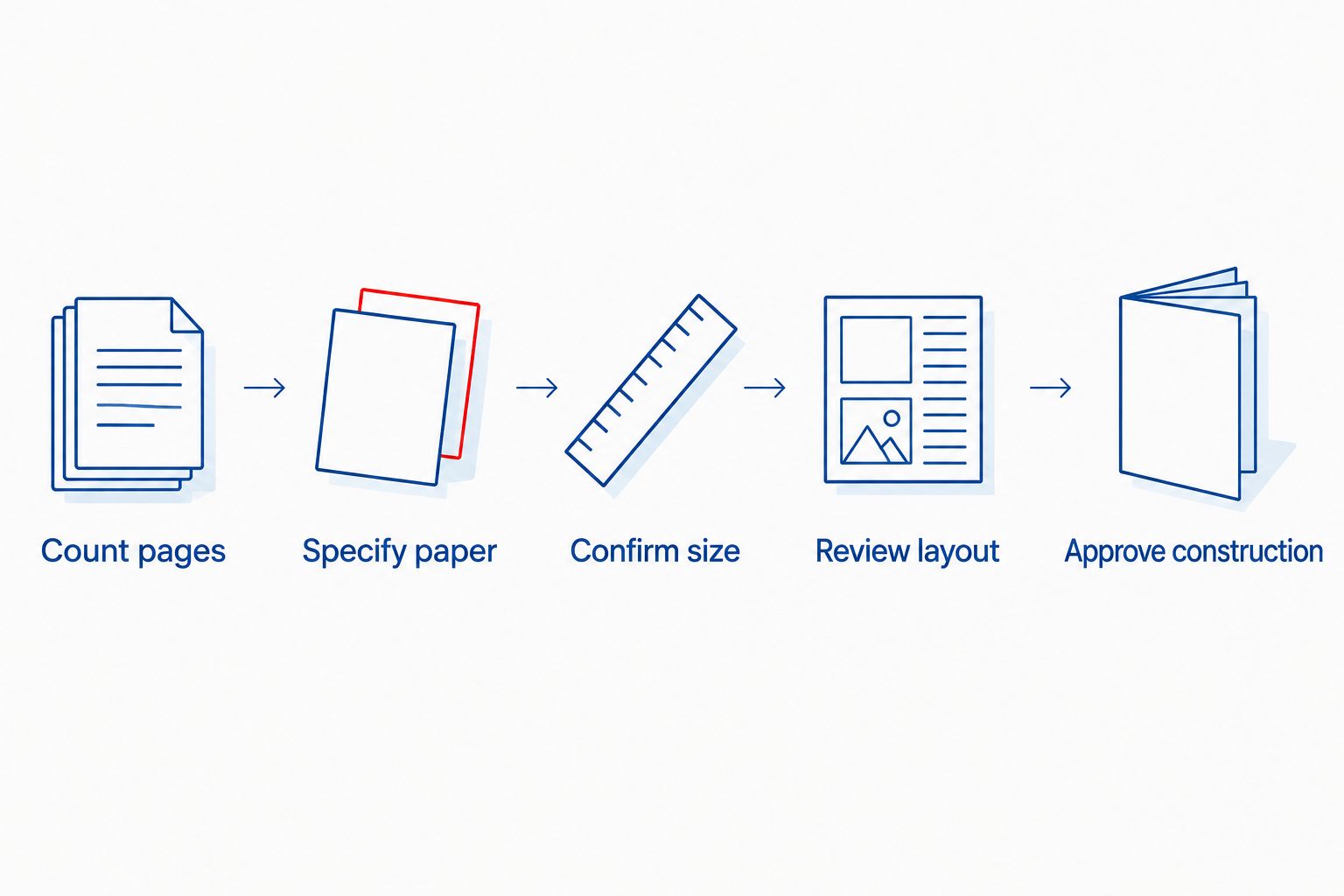
Publishing Xpress offers saddle stitch, perfect bound, Wire-O, and plastic coil printing. For this decision, the useful next step is to confirm which construction fits your particular document—not to assume that every binding accepts every paper combination.
100 pages already meets the multiple-of-four requirement for conventional saddle stitching. Each folded sheet contributes 4 pages, including any blank sides. That arithmetic establishes the page structure, not whether the finished stack is thin enough to stitch.
Be precise about covers. If you mean 100 interior pages plus a separate cover, describe it that way rather than calling the entire job a 100-page booklet.
A 100-page saddle-stitched booklet is not guaranteed to stay flat simply because it opens at a folded spine. Paper stiffness and stack thickness affect how strongly it springs closed. Test the intended construction rather than judging it from a thinner booklet.
For a workbook or instruction manual in your 2026 project list, plastic coil or Wire-O is the more direct choice when staying open is the priority. Both require you to reserve space along the punched edge.
A 100-page booklet should lose pages only when the edit improves the document or resolves a confirmed production problem. Remove repetition and unnecessary blanks before reducing type size or crowding the margins. Readability is not an acceptable sacrifice for keeping a preferred binding.
If all the material is necessary, change the construction instead. Splitting the content into separate booklets is another option, but only when readers can use each part independently without awkward cross-references.
Can you saddle stitch a 100 page booklet in 2026?
Yes, a 100-page booklet can be saddle stitched when its combined paper thickness and cover are within the printer’s equipment limits. Confirm the actual specification before approving the layout or order.
Is 100 pages too thick for saddle stitching?
100 pages is not enough information to determine thickness. Interior paper caliper, cover construction, and the printer’s folding and stitching limits decide whether the booklet is suitable.
Do blank pages count in a saddle-stitched booklet?
Yes, blank pages count because they occupy physical sides of the folded sheets. Include them in the production count even when you leave them unnumbered.
Should I send single pages or booklet spreads to the printer?
Follow the printer’s file instructions; do not impose booklet spreads unless requested. Confirm page order, cover handling, and creep compensation before preparing the final PDF.
Is perfect binding better than saddle stitching for a long booklet?
Perfect binding is better suited to a book-style reading experience when the book block meets the printer’s thickness requirements. Saddle stitching remains an option only when the folded stack is suitable, while perfect binding does not naturally stay completely flat.
Which binding should I use for a workbook that stays open?
Plastic coil or Wire-O is the more direct choice for a workbook that needs to stay open. Both need clear space along the punched edge, so revise a saddle-stitch layout before changing the binding.
Does Publishing Xpress provide alternatives to saddle stitching?
Publishing Xpress provides perfect bound, Wire-O, and plastic coil printing as well as saddle stitching. Choose the format around how readers will use the document, then confirm the paper and file requirements.
A blank paper mockup can answer a question your finished PDF cannot: does this booklet behave well in your hands? Ask for a folded construction sample using the intended interior and cover stocks, then check closure, page turning, and the space near the trimmed edge.
For your 2026 order, make that physical check before treating saddle stitching as settled. A mathematically correct page count is only the beginning; the finished booklet has to work for its reader.
© 2026 Publishing Xpress. All Rights Reserved.