November 20, 2026
Yes, you can print a comic book without a bulk minimum by choosing a print-on-demand service that accepts single-copy orders for your format. In 2026, the main caveat is that a single-copy option does not guarantee your preferred binding, paper, or size, so confirm those details before preparing your files.
Your first printed comic does not have to become a box of unwanted inventory. But choosing the smallest order without checking the finished format leaves an important question unanswered: will the book actually suit your artwork?
Start with the purpose. A personal keepsake, an artwork check, and a convention order need different buying decisions, even when they use the same comic file. This guide to print-on-demand comic book printing for indie creators explains that route in more detail.
Choose the order size your project needs, then confirm that the printer can produce the comic you designed. Do not change your story merely to fit the first ordering screen you find.
Yes. In practical terms, “no minimum order” means you can purchase a single finished copy rather than commit to a larger batch. It does not mean every printer accepts that quantity, or that every binding is eligible.
For your 2026 comic project, distinguish between these routes before comparing printing specifications:
| Printing route | Best for | Main advantage | Main limitation |
|---|---|---|---|
| Single-copy print-on-demand | A personal copy or initial printed check | You do not commit to a batch | Confirm that the exact comic format accepts single-copy orders |
| Short-run printing | Creators distributing a batch themselves | You receive copies together for planned use | You must meet the printer's minimum and manage the copies |
A single-copy service answers the quantity question. A suitable comic printer also needs to answer questions about artwork reproduction, page arrangement, binding, and proof approval. Treat those as separate checks rather than assuming one answer covers everything.
You also need to distinguish printing from distribution. Ordering a comic for yourself is not the same as arranging for future readers to order it individually. Ask which transaction the service supports before building your publishing plan around it.
Single-copy printing is the best fit when you genuinely need only one finished comic. That includes a gift, a personal archive copy, or a printed version you want to examine before deciding what comes next.
The advantage is straightforward: you avoid ordering copies without a use for them. The trade-off is that you must work within the chosen service's production specifications rather than assume every comic configuration qualifies.
Check the following before uploading artwork:
An individual copy is useful for judging lettering size and page flow. However, a copy from one printer is not a production proof for another printer. Different paper, equipment, and binding mean you still need to review the final supplier's proof process.
Keep that distinction clear. Use a personal test copy to improve the comic, not to approve a different printer's production.
Publishing Xpress comic book printing is best for creators who need at least 25 copies to distribute themselves. Its minimum print quantity is 25 copies, so it is not the right fit for a single-copy purchase.
That minimum gives you a clear decision point. Choose a batch only when you have a practical use for the copies, such as reader orders, contributor copies, a class project, or an event table.
The benefit is having copies ready to hand to readers. The responsibility is yours, too: you need somewhere to keep them and a plan for distributing them. Printing a batch does not establish demand.
Write down the intended recipients before selecting the quantity. Separate committed readers from people who have simply expressed interest, and avoid treating a social-media reaction as an order.
If your requirements are unclear, contact Publishing Xpress with the finished size, page count, preferred binding, and intended quantity. Resolve those specifications before making final cover or interior adjustments.
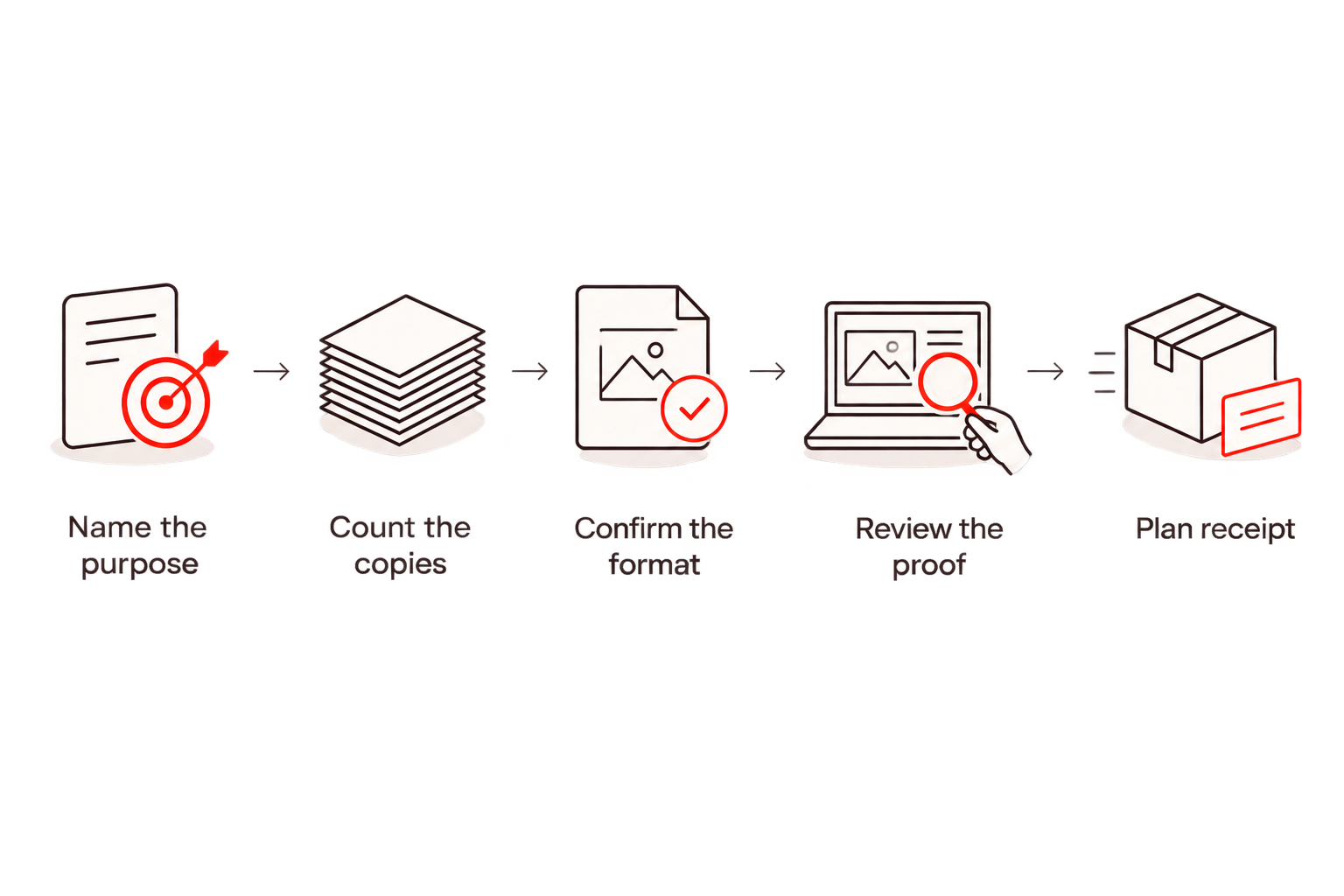
Use the following sequence to separate your actual requirements from features that merely sound useful. For a 2026 release, the right starting point is still the reader and the finished comic—not the ordering method.
Decide whether you need a personal copy, an artwork check, or copies for distribution. Write that purpose at the top of your project notes so it guides the rest of the order.
A private copy does not need a sales plan. A batch intended for readers does, even if your plan is simply to hand copies to a defined group. This distinction prevents you from buying inventory when your real goal is to see your artwork on paper.
Count copies that have a named purpose. Include the people receiving the comic and any copies you deliberately want to retain, rather than adding extras without a reason.
If your total falls below a supplier's minimum, choose between a single-copy route and postponing the batch. Do not assume the printer will waive its minimum because the project is small or personally meaningful.
Check the finished dimensions, page count, color requirements, paper, and binding together. A quantity option is useful only if the finished comic also meets your needs.
Keep the specification identical when evaluating different printers. Otherwise, you are comparing different books rather than different ways to print the same book. Pay particular attention to any setting that changes automatically after you select a binding.
Ask what you will review before production and what approval authorizes. Do not assume that placing an order includes a separately shipped physical proof.
Read every page of the proof, including credits, blank pages, and the cover. Check the comic as a sequence, not just as a collection of attractive individual images. A missing page or misplaced reveal changes the reading experience even when the artwork prints clearly.
Work backward from the date you need the copies in hand. Leave room for file corrections, proof review, production, and shipping transit rather than treating them as a single step.
For an event, receiving the books is the relevant milestone. Submitting the files is not. Confirm the schedule before announcing when readers will receive their copies.
A minimum belongs to a particular service and production setup. “Digital printing,” “short run,” and “print-on-demand” are not interchangeable promises about the smallest order you can place.
These factors explain why you need to check the exact configuration:
These are reasons to ask precise questions, not reasons to accept an unsuitable order. A printer with a minimum is not automatically a poor choice; it is simply the wrong choice when that minimum exceeds your needs.
For your 2026 comparison, record the minimum beside the exact specifications it applies to. A general statement on a service page is less useful than confirmation for your actual comic.
Saddle stitch does not, by itself, mean a printer accepts single-copy orders. It describes the binding: folded sheets secured with staples through the fold.
Publishing Xpress offers Saddle Stitch Printing with a maximum of 80 pages. That page limit is separate from its minimum quantity of 25 copies; meeting one requirement does not remove the other.
Saddle stitch suits shorter comics that use a folded, stapled format. Its limitation is capacity: it is not the route for a comic that exceeds the printer's supported page count.
Confirm how the printer counts the cover and interior before finalizing the document. Also confirm the required page arrangement rather than rearranging your PDF into printer spreads on your own.
Do not cut essential story pages merely to preserve a binding choice. If the complete comic exceeds the supported limit, ask about a suitable binding for the full work instead.
A small quantity still needs a print-ready file. Ordering fewer copies does not protect speech balloons from trimming or restore detail that is missing from the exported artwork.
Check these items before submission:
Zoom in to inspect lettering, then view pages at their intended printed size. Both checks matter: close inspection reveals export problems, while actual-size viewing shows whether readers can comfortably follow the dialogue.
Keep a clearly named final file. After making a correction, export again and recheck the result so an earlier version does not become the approved version.
Publishing Xpress ships in 4 to 6 days after proof approval. That is a shipping milestone, not a promise that the comic reaches your address within that same period.
For a 2026 event order, allow separately for artwork preparation, proof corrections, approval, and transit. Ask how the shipping schedule applies to your order before committing to an event deadline.
The most useful question is not merely when printing starts. Ask when the books need to leave production to reach you before your event, then plan proof approval around that requirement.
Can I print just one copy of my comic book?
Yes, you can print a single comic through a print-on-demand service that accepts single-copy orders for your chosen format. Confirm the binding, size, paper, and page requirements before preparing the final file.
Does Publishing Xpress print comics without a minimum order?
No. Publishing Xpress has a minimum print quantity of 25 copies, so it suits a planned batch rather than a single-copy purchase.
Is print-on-demand better than short-run printing for my first comic?
Print-on-demand is the better fit when you need only an individual copy and the service supports your format. Short-run printing fits a planned batch, but you must meet the printer’s minimum and manage distribution.
Can I use a single-copy comic as a proof for another printer?
A single-copy comic from another printer is not a production proof for your final supplier. Use it to check readability and page flow, then follow the final printer’s proof process.
How many pages can a saddle stitch comic have at Publishing Xpress?
80 pages is the maximum for saddle stitch books at Publishing Xpress. Confirm how your cover and interior count toward that limit before finalizing the files.
Will my comic arrive 4 to 6 days after proof approval?
Publishing Xpress ships in 4 to 6 days after proof approval; that does not establish the arrival date. Account for shipping transit separately when planning an event or reader delivery.
Check your most important page turn before approving anything. A reveal designed for the next page loses its effect if an omitted blank or changed opening sequence moves it onto the facing page.
Make a simple folded paper mockup and mark where each scene starts. It will not tell you how the finished color looks, but it will show whether the story unfolds in the order you intended. Solve the reading experience before committing to the print quantity.
© 2026 Publishing Xpress. All Rights Reserved.