September 25, 2026
BookBaby combines book printing with publishing services, making it a practical choice if you want both in one place. If your files are ready and you mainly need a small print run, that broader scope is not always the best fit. The best BookBaby alternative in 2026 is Publishing Xpress for short-run custom printing; choose IngramSpark when bookstore distribution is the priority.
These services solve different parts of self-publishing. A printer produces copies you can distribute yourself. A print-on-demand platform produces copies as orders come in. A distribution service helps make a book available through sales channels. BookBaby spans more than one of those jobs, so comparing providers by name alone can lead you to buy the wrong service.
Before you choose a BookBaby alternative in 2026, decide who will receive the printed copies. If you need books for an event, a class, or direct sales, compare print formats and order requirements. If readers need to order through retailers, put distribution first. You can use more than one provider when those jobs call for different approaches.
| Service | Best for | Standout feature | Ordering model | How it differs from BookBaby |
|---|---|---|---|---|
| BookBaby | Authors seeking printing and publishing services together | Services beyond physical printing | Select the services your project needs | The benchmark for a broader publishing-service approach |
| Publishing Xpress | Small batches of books and other printed materials | Perfect bound, saddle stitch, wire-o, and plastic coil binding | Short-run digital printing | Start with the printed piece rather than a broader publishing plan |
| Amazon KDP | Authors prioritizing Amazon sales | Print-on-demand tied to an Amazon listing | Copies produced as orders come in | Starts with a marketplace listing rather than a batch you plan to distribute |
| IngramSpark | Authors prioritizing bookstore access | Book distribution through Ingram's network | Print-on-demand and distribution | Puts retailer reach at the center of the decision |
| Blurb | Authors making photo-led books | Tools and formats oriented toward visual books | Project-based book creation and printing | Focuses more closely on visual presentation |
| Lulu | Authors seeking another print-on-demand route | Print-on-demand book production | Copies produced as orders come in | Offers a different path for producing and selling books |
Use this table to narrow the job, not to skip a project-specific comparison. Binding, trim size, paper, file preparation, and sales channels all affect whether a service fits your book. Check each provider's current specifications before you commit files to print.
Publishing Xpress provides printing and publishing services for authors and businesses producing books, magazines, and marketing materials. Its short-run digital printing is a direct fit when you need physical copies for an event, an organization, or sales you handle yourself. The stated binding choices are perfect bound, saddle stitch, wire-o, and plastic coil.
Publishing Xpress is the BookBaby alternative for authors who have a plan for their printed copies and want to choose the physical format first. A novel, workbook, and event booklet do not need the same binding. Matching the binding to how readers will use the pages is more useful than choosing a provider solely because it offers a long list of publishing services.
Where Publishing Xpress shines
Where Publishing Xpress falls short
Best for: Authors, nonprofits, and organizations ordering short-run books or booklets for their own audiences. Verdict: Choose when the physical print job is the immediate need.
| Decision | Publishing Xpress | BookBaby |
|---|---|---|
| Main reason to consider it | Short-run printing across books and other documents | Printing alongside publishing services |
| Binding decision | Four stated options: perfect bound, saddle stitch, wire-o, plastic coil | Confirm the format available for your project |
| Sales plan | Plan what you will do with your printed batch | Evaluate the publishing services you need alongside printing |
A useful first step is to write down the format, quantity, and destination of your copies. That brief makes the BookBaby comparison concrete: you can assess a print order against a broader service arrangement without treating them as interchangeable.
Amazon KDP connects book files to an Amazon listing and uses print-on-demand production for print orders. Choose it when Amazon is where you expect readers to find the book and you do not want to organize a batch before those orders arrive. It answers a different question from a short-run printer: how an Amazon customer can order a copy.
Where Amazon KDP shines
Where Amazon KDP falls short
Best for: Authors whose primary sales channel is Amazon. Verdict: Choose for an Amazon-first release; skip it as your sole plan when your main task is selecting a custom binding for a batch.
| Decision | Amazon KDP | BookBaby |
|---|---|---|
| Primary workflow | Publish for orders through Amazon | Evaluate printing and publishing services together |
| Production approach | Print on demand | Select services for the book project |
| Key preparation task | Check listing details and print files | Define which publishing tasks you want handled |
A common mistake in 2026 is to compare a print-on-demand listing with a box of books as though one replaces the other. If you need copies at a signing or for an organization, make a separate plan for those copies even if readers can also order the book online.
IngramSpark is a self-publishing platform with print-on-demand production and access to Ingram's distribution network. Its clearest role in this comparison is retailer reach. Choose it when making a book available to bookstores matters more than receiving a short-run batch in a particular binding.
Where IngramSpark shines
Where IngramSpark falls short
Best for: Authors who need a bookstore-distribution route. Verdict: Choose for retailer access; pair it with a separate print decision if you also need copies for yourself.
| Decision | IngramSpark | BookBaby |
|---|---|---|
| Central use case | Print-on-demand with distribution | Printing and publishing services |
| Bookstore question | Make the title available through a distribution network | Check which distribution service fits your plan |
| Copies you handle yourself | Plan a separate order if needed | Specify whether you need printed copies as part of the project |
Be precise about what success means. A book being available to order and a bookstore putting it on a shelf are different outcomes. In 2026, build your launch plan around the outcome you can actually arrange, not the one a distribution listing merely permits.
Blurb focuses on creating and printing visual books, making it relevant for photography and other image-heavy projects. It belongs on a BookBaby alternatives list when the page design and printed presentation are central to the work. Compare the finished format your project needs, not just the fact that both providers print books.
Where Blurb shines
Where Blurb falls short
Best for: Photographers and authors making image-led books. Verdict: Choose when visual presentation drives the project; skip when your main concern is a functional workbook binding.
| Decision | Blurb | BookBaby |
|---|---|---|
| Project emphasis | Visual-book creation | Broader printing and publishing services |
| First format question | How should images appear on the page? | Which publishing and printing tasks do you need? |
| Fit to confirm | Finished book format | Services and format for your project |
Lulu offers book printing and print-on-demand services. It is a sensible comparison if you want copies produced in response to orders rather than making a short-run batch your starting point. Check its current formats and sales options against the exact book you intend to publish.
Where Lulu shines
Where Lulu falls short
Best for: Authors comparing print-on-demand production options. Verdict: Choose if its current format and ordering route match your plan; hold until you have checked both.
| Decision | Lulu | BookBaby |
|---|---|---|
| Production question | Can print-on-demand meet your needs? | Which printing and publishing services do you need? |
| Format question | Does the current catalog fit your book? | Does the proposed project fit your book? |
| Sales question | Where will readers place orders? | Which services support your intended sales plan? |
The strongest reason to switch is a mismatch between the job and the service, not a claim that BookBaby is a poor choice. An author with finished files and a mailing list for a direct-sale batch needs a print plan. An author pursuing bookstore orders needs a distribution plan. Those are distinct decisions, even when one company offers help with both.
In 2026, sort your needs in this order:
This sequence prevents a costly planning error: deciding how to publish before deciding what the finished object must do. A plastic-coil workbook and a bookstore-distributed novel can both be books, but they demand different first questions. Settle the destination and format before you compare providers.
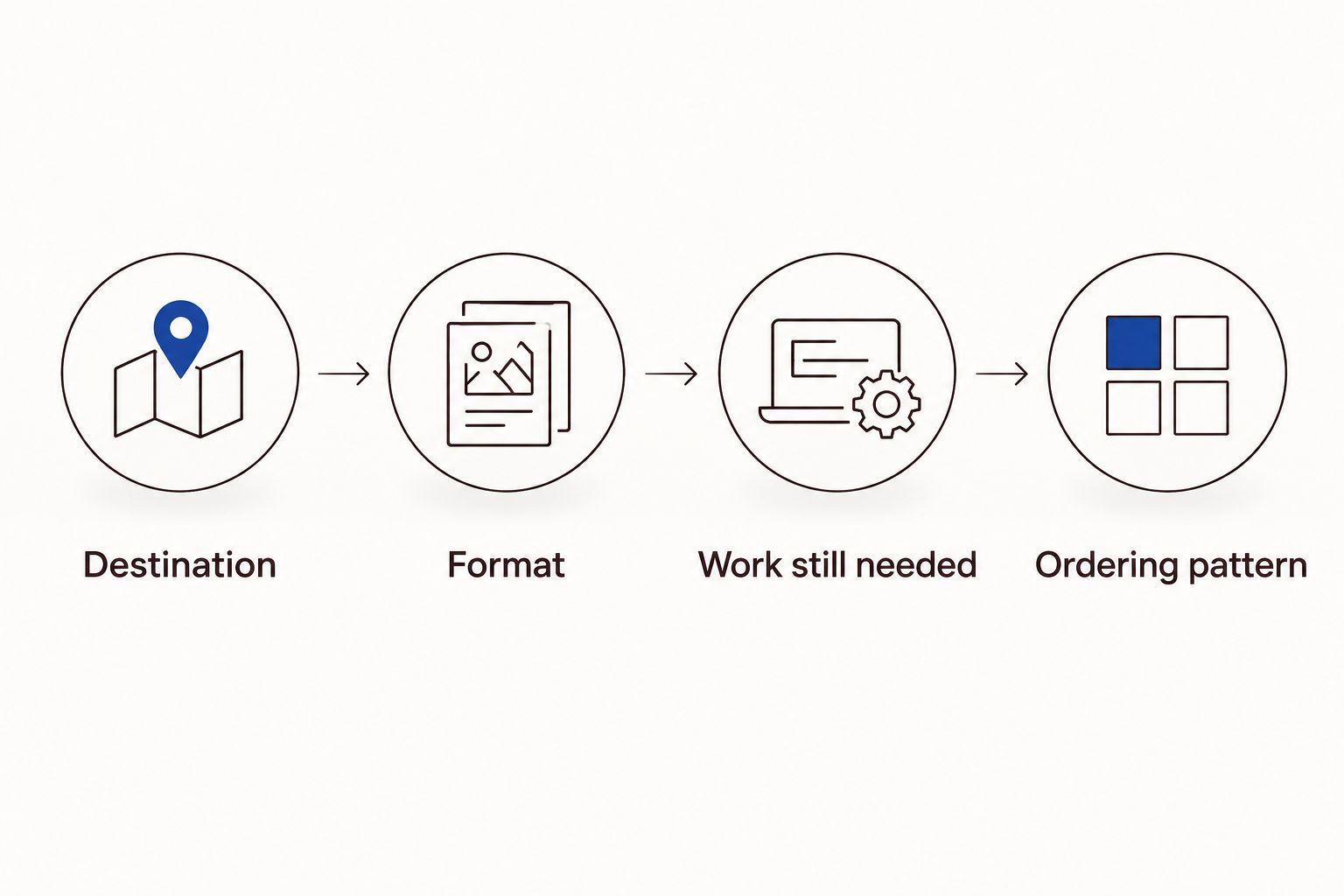
Once you know those answers, request or review specifications for the exact project rather than comparing generic service descriptions. Check trim size, binding, paper, file requirements, and how the copies reach their readers. Keep production and distribution as separate lines in your plan; doing so makes each provider's role clear.
Plan your print project
Match your book or booklet to a short-run print format.
Stay with BookBaby if its mix of printing and publishing services matches the work you need done and its available format fits your book. Switching providers simply because another one specializes in a single step creates extra coordination if you still need help with the other steps. Compare the full scope of your project, not only the printing step.
The right call in 2026 is especially straightforward when you want one provider to address multiple publishing tasks: keep BookBaby under consideration and define those tasks clearly before choosing. If, instead, your manuscript and files are ready and your immediate need is a small batch in a specified binding, put a short-run printing comparison first. Neither route replaces the need to proof your files.
What is the best BookBaby alternative in 2026 for a small print run?
Publishing Xpress is the best fit here for a short-run order when you need books or booklets in one of its stated binding options. Choose the format and plan where the finished copies will go before placing an order.
Is Amazon KDP better than BookBaby for self-publishing?
Amazon KDP is the clearer choice when an Amazon-first print-on-demand listing is your main goal. BookBaby remains relevant if you want to compare printing alongside other publishing services.
Which BookBaby alternative is best for bookstore distribution?
IngramSpark is the strongest fit on this list when bookstore distribution is the deciding requirement. Availability through a network does not guarantee that a bookstore will carry the book.
Can I use a short-run printer and a print-on-demand platform for the same book?
Yes, you can plan a short-run batch and a separate print-on-demand edition. Check each provider’s format and file specifications so the versions are prepared correctly.
What should I compare before moving away from BookBaby?
Compare the destination of your copies, the required binding, the work left to do, and whether you need a batch or print-on-demand production. Those decisions reveal which service solves your immediate problem.
Is Blurb a good BookBaby alternative for a text-only book?
Blurb is more compelling for an image-led project than for a straightforward text manuscript. For text-only work, compare the print format and publishing tasks you actually need.
Does print-on-demand replace short-run book printing?
No, print-on-demand and short-run printing serve different ordering plans. Print-on-demand produces copies as orders arrive; a short run gives you a defined batch to distribute yourself.
A distribution listing and a printed book in your hands are different deliverables. For a 2026 launch, write down who needs each copy before you choose a provider. That single decision tells you whether to start with Publishing Xpress for a short-run print job, IngramSpark for bookstore distribution, or an Amazon KDP listing for Amazon-first sales.
© 2026 Publishing Xpress. All Rights Reserved.