September 21, 2026
Publishing Xpress wins best short run book printing for local history books in 2026 for historical societies, genealogists, and small nonprofit archives that need perfect binding, saddle stitch, wire-o, or plastic coil without a punishing minimum order. IngramSpark wins for authors who want their finished book stocked in real bookstores and public libraries. Blurb wins for photo-heavy pictorial histories where reproduction quality matters more than binding flexibility. Lulu wins for a single proof copy before committing to a full print run. Amazon KDP wins for authors who only plan to sell online and don't need physical distribution to local shops or historical museums.
A local history book is a different animal from a novel. It's usually photo-dense, often funded by a historical society or library friends group, and sold in quantities that would embarrass a traditional publisher — 40 copies for a town centennial, 150 for a county archive fundraiser. Most big-box print-on-demand services are built for genre fiction with plain text interiors, not scanned newspaper clippings and archival photographs that need real halftone reproduction.
Getting the binding wrong is expensive to fix after the fact. A 150-page pictorial history bound with saddle stitch won't lie flat and the spine will crack under repeated handling at a museum gift counter. Choosing the wrong short run printer means paying twice: once for a print run nobody can use, and again for a reprint.
| Service | Best for | Standout feature | Key limitation |
|---|---|---|---|
| Publishing Xpress | Historical societies and family archives needing low minimums | Four binding options: perfect bound, saddle stitch, wire-o, plastic coil | No built-in national bookstore distribution network |
| IngramSpark | Books that need library and bookstore shelf presence | Feeds into Ingram's wholesale distribution catalog | Slower setup than a direct short-run printer |
| Blurb | Photo-heavy pictorial local histories | Built around photo book layout tools | Fewer binding formats for archival text-heavy projects |
| Lulu | A single proof copy before a full order | True single-copy print-on-demand | Not built for coordinating a bulk historical society order |
| Amazon KDP | Online-only sellers with no local retail plan | Free setup, direct listing on Amazon | No presence in local bookstores, museum shops, or libraries |
Publishing Xpress prints books, booklets, and catalogs in black-and-white or color with four binding options and no large minimum order requirement, which is exactly the constraint most local history projects run into. A county historical society printing 75 copies of a centennial book gets the same attention as an author ordering 500.
The format flexibility matters for local history specifically: a text-heavy oral history project works fine as perfect bound, while a scrapbook-style photo compilation often does better wire-o bound so it lies flat on a table during a reading event. Genealogy and family history books frequently need that flat-lay handling for side-by-side photo comparisons.
Publishing Xpress pros:
Publishing Xpress cons:
Publishing Xpress pricing: check current binding and page-count options on the site — costs vary by trim size, binding, and page count.
Best for: historical societies and family history authors printing under a few hundred copies who need archival-friendly binding.
Verdict: Buy.
Get a quote for your local history book
Compare binding options for photo-heavy or text-heavy local history projects.
IngramSpark is a print-on-demand platform tied to Ingram's wholesale distribution network, which is the standard route for authors who want a book stocked outside a single museum gift shop. A local history title that a county library system wants to carry benefits from this reach in a way a direct short-run print job doesn't.
The tradeoff is setup complexity. IngramSpark requires more upfront file prep — ISBN assignment, metadata, discount and returns settings — before a book is even printable, which slows down a project tied to a fixed anniversary date.
IngramSpark pros:
IngramSpark cons:
Best for: local history books that need to reach shelves beyond the town where the story happened.
Verdict: Buy if distribution matters more than speed.
Blurb built its platform around photo books, which fits a local history project that's mostly captioned photographs — old Main Street storefronts, historical parade images, restored building before-and-afters. The layout tools are designed for that kind of page, not dense archival text.
The binding and format menu is narrower than a general short-run printer, so a text-heavy oral history compilation is a worse fit here than a picture-forward retrospective.
Blurb pros:
Blurb cons:
Best for: pictorial local histories built mostly from photographs and short captions.
Verdict: Buy for photo-first projects, skip for text-heavy manuscripts.
Lulu's single-copy print-on-demand model is useful for the step nobody wants to skip: checking a proof before a historical society commits to 150 copies for a launch event. Ordering one physical copy to check photo reproduction and spine width before the real order goes out saves an expensive reprint.
It's a weaker fit once the project moves from proofing to bulk fulfillment, since Lulu isn't built around coordinating one large coordinated order the way a short-run printer is.
Lulu pros:
Lulu cons:
Best for: checking a proof copy before placing a full local history print order.
Verdict: Buy for proofing only.
Amazon KDP is free to set up and lists a book directly for sale on Amazon, which works when the entire distribution plan is online sales with no local museum shop, no library sale table, and no historical society meeting where copies change hands in person.
That's a real limitation for most local history projects, which sell heavily through in-person channels — town anniversary events, historical society meetings, county fair booths. KDP puts nothing on those tables.
Amazon KDP pros:
Amazon KDP cons:
Best for: authors who genuinely plan to sell online only.
Verdict: Skip unless online-only sales is the actual plan.
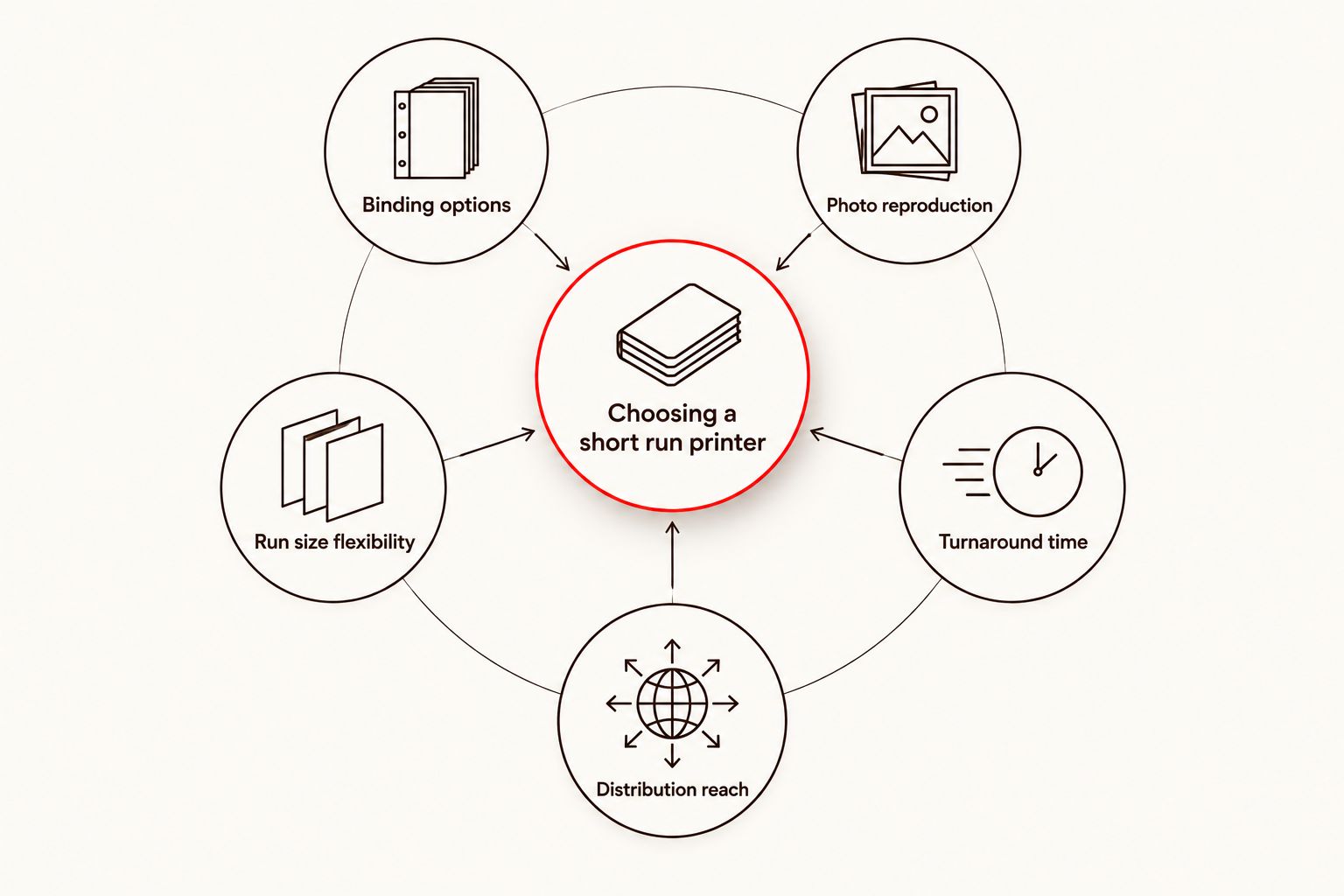
Each service was measured against the five criteria above: binding fit for archival content, photo reproduction handling, minimum order flexibility, turnaround against a fixed event date, and distribution reach. Publishing Xpress ranks first because local history print runs are almost always small, often photo-heavy, and tied to a real-world event date — the exact combination a low-minimum short-run printer with multiple binding formats is built to handle.
If the project is a historical society fundraiser, a family archive, or a centennial book with a fixed print quantity under a few hundred copies, Publishing Xpress is the default pick for 2026 — no large minimum, four binding formats, and color or black-and-white in the same order. If the goal is getting a local history book onto library and bookstore shelves statewide, pair a short print run with IngramSpark for the distribution leg. Photo-first retrospectives lean toward Blurb; proofing before committing leans toward Lulu; online-only sellers can stop at Amazon KDP and skip physical distribution entirely.
What’s the best short run book printing option for local history books in 2026?
Publishing Xpress is the best option for most local history projects in 2026 because it has no large minimum order and offers four binding formats — perfect bound, saddle stitch, wire-o, and plastic coil. Historical societies printing under a few hundred copies benefit most from that flexibility.
How many copies should a historical society print for a local history book?
Run sizes vary by project and fundraising goals, so there’s no fixed number — the key is choosing a printer with no large minimum order requirement so a small run doesn’t cost more per copy than it should.
Is perfect binding or wire-o better for a local history book?
Perfect binding suits text-heavy local histories under roughly 300 pages, while wire-o binding suits photo-heavy scrapbook-style layouts that need to lie flat for side-by-side viewing. Choose based on whether the book leans text-first or photo-first.
Can I get a local history book into libraries and bookstores?
Yes — IngramSpark connects a printed book to Ingram’s wholesale distribution catalog, which is how library systems and bookstores typically discover and order titles outside their local area.
Is Amazon KDP good for local history books?
Amazon KDP works only if the sales plan is entirely online, since it has no presence in local bookstores, museum shops, or library sale tables where most local history books actually sell.
Do I need color printing for a local history book?
Color printing matters most when the book includes restored photographs or color archival images; black-and-white printing works fine for scanned text documents and older black-and-white photographs.
How do I order a proof copy before printing a full run?
Lulu’s single-copy print-on-demand model is the fastest way to check a proof — binding, photo reproduction, and spine width — before committing to a bulk local history print order.
Most local history projects fail the proof stage on the same page: the photo section, not the text. A scanned 1940s newspaper clipping that looks fine on a monitor often prints muddy without adjusting contrast beforehand — check that page specifically before approving a full 2026 print run, not just the cover.
© 2026 Publishing Xpress. All Rights Reserved.