September 25, 2026
Best overall: Publishing Xpress short-run perfect-bound printing for self-published cookbooks you plan to sell or give away yourself. Best for single-copy fulfillment: print-on-demand perfect binding. Best for a cookbook that needs to stay open beside the stove: Wire-O binding instead of perfect binding. This 2026 guide compares the formats, the trade-offs, and the files you need before printing.
A cookbook has to do two jobs. It needs to look like a finished book, and readers need to find and follow a recipe without fighting the binding. Perfect binding gives you a square spine and a conventional paperback shape, but it does not open flat on a counter. If that difference decides your project, start with this guide to perfect binding vs. saddle stitch before choosing a printer.
The photographs matter just as much as the binding. A small image on your screen can expose blur when enlarged for print; a full-page image needs artwork that extends beyond the trim edge. In 2026, judge printing options against your actual page layout and how readers will use the book, not the appeal of a square spine alone.
Use these criteria before comparing print methods. They separate a cookbook meant for browsing from one that will spend its life open to a recipe.
For a photo-heavy 2026 cookbook, inspect an image at its intended print size. 300 pixels per inch is a useful preparation target for photographic images, but follow the chosen printer’s specifications. If artwork runs to the page edge, confirm its bleed requirement before exporting the final PDF; 0.125 inch is a common bleed allowance, not a substitute for printer instructions.
| Option | Best for | Standout feature | Key limitation |
|---|---|---|---|
| Publishing Xpress short-run perfect binding | Authors ordering finished paperback cookbooks in short runs | Perfect binding alongside other binding choices | A perfect-bound book does not lie flat |
| Print-on-demand perfect binding | Authors fulfilling individual book orders | Copies are produced as orders arrive | Less suited to authors who want a batch in hand before an event |
| Wire-O binding | Recipes used open on a counter | Pages turn back and stay open | Does not have a conventional paperback spine |
| Saddle-stitch binding | Slim recipe collections | A folded, stapled booklet format | Not suited to every cookbook length or cover design |
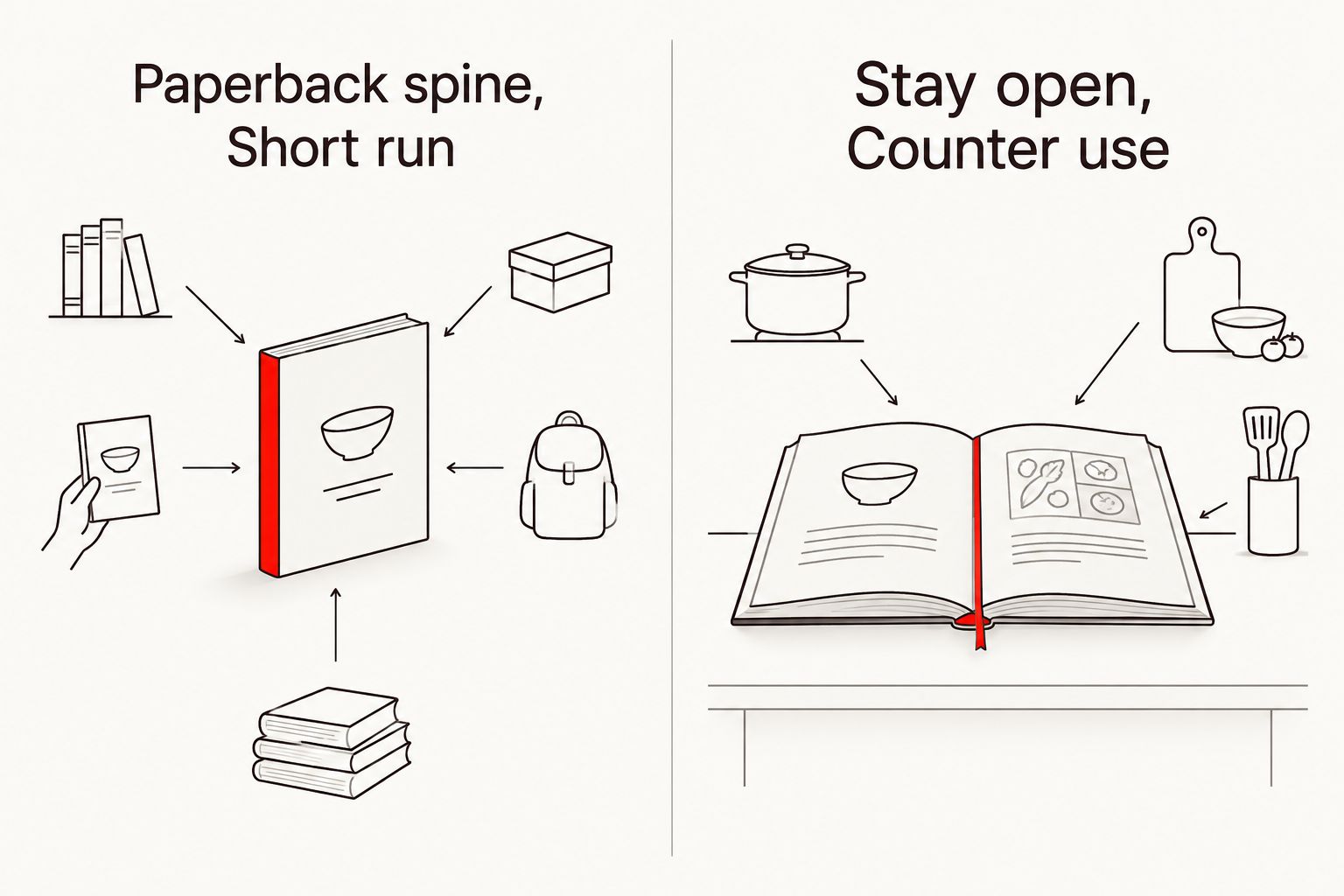
The table compares ways to produce or bind a cookbook, not four competing companies. Print-on-demand describes an order method; perfect binding, Wire-O, and saddle stitch describe how pages are held together. That distinction prevents a false comparison between a printer and a binding technique.
Publishing Xpress provides digital printing for authors and businesses, including books, and offers perfect binding. Its short-run approach fits a self-publisher who wants a batch of cookbooks to inspect, sell directly, or bring to a launch. Authors can also consider its Wire-O or plastic coil options when a stay-open book matters more than a paperback spine.
Publishing Xpress pros:
Publishing Xpress cons:
Best for: A self-publisher who wants a short run of paperback-style cookbooks and expects to handle the copies. Verdict: Buy if that describes your 2026 release; choose a stay-open binding if the book is primarily a kitchen tool.
Print-on-demand produces a copy in response to an order rather than requiring you to decide on a batch first. It can suit a cookbook whose readers order at different times. The result can still be a perfect-bound paperback, so the same spine, gutter, and stay-open limitations apply.
Print-on-demand perfect binding pros:
Print-on-demand perfect binding cons:
Best for: An author prioritizing individual-order fulfillment over keeping printed copies on hand. Verdict: Hold until you have ordered and examined a physical copy. Your screen cannot show how a recipe spread behaves near the spine.
Wire-O holds pages on a wire spine so a book can open flat and turn back on itself. That makes it a practical alternative when readers will keep one recipe visible while working. It is not perfect-bound printing, and that is exactly why it belongs in this comparison: a useful cookbook can matter more than a paperback silhouette.
Wire-O binding pros:
Wire-O binding cons:
Best for: A recipe collection intended for repeated, hands-on use. Verdict: Buy when keeping pages open is a firm requirement; skip it when a conventional paperback spine is central to the book’s presentation.
Saddle stitch folds sheets and fastens them through the center fold. It works as a booklet rather than a thick paperback, making it a candidate for a focused collection: recipes from a single event, class, or theme. Confirm that your planned page count and paper choices fit the printer’s saddle-stitch specifications before committing to the layout.
Saddle-stitch pros:
Saddle-stitch cons:
Best for: An author producing a slim booklet rather than a full-length cookbook. Verdict: Buy for the smaller project; skip it if a substantial paperback is the goal.
Start with the finished trim size and the printer’s file specifications. Set up the interior at that size, choose page margins that protect text near the binding, and place photographs at their final intended dimensions. Do not stretch a small image across a full page just because the layout has room.
Next, build the cover using the final page count and the printer’s spine measurement. A cover file made before the paper and page count are settled can put spine text in the wrong place. Check each recipe spread for ingredients stranded on one page and directions pushed onto the next; a technically printable PDF can still be frustrating to cook from.
Finally, export a print-ready PDF and inspect the actual output at reading size. Check crop-edge artwork, page numbers, small captions, dark photographs, and the gutter. Order a physical proof before approving a 2026 print run. Hold it open to a recipe, read it under ordinary kitchen lighting, and ask whether the binding choice still makes sense.
Plan your cookbook print run
Compare binding choices and prepare your files before you order.
The ranking puts short-run perfect binding first because the question is about perfect bound printing for self-published cookbooks, not binding in general. Order pattern comes next: individual fulfillment serves a different author from a planned batch. Wire-O and saddle stitch follow as deliberate alternatives for cookbooks whose physical use or length makes perfect binding the wrong answer. The ranking does not claim that any format solves every recipe layout.
Choose Publishing Xpress short-run perfect binding when you want a paperback-style cookbook and plan to order copies for direct distribution. Choose print-on-demand perfect binding when orders will arrive individually. Choose Wire-O if the reader must leave the book open on a counter; choose saddle stitch for a slim recipe booklet.
If you are undecided in 2026, test the decision with one finished recipe spread. Put its photograph, ingredients, and instructions where they belong, then picture the book open beside a cutting board. If the layout requires both hands to keep the recipe visible, change the binding before you commit to a paperback cover.
What is the best perfect bound printing for self-published cookbooks in 2026?
Publishing Xpress short-run perfect binding is the best fit when you want paperback-style cookbooks in hand for direct distribution. Check a physical proof to confirm that the recipe layout works near the spine.
Is perfect binding good for a cookbook?
Perfect binding is good for a cookbook meant to read and browse like a paperback. Choose Wire-O instead if readers need the book to stay open while cooking.
Will a perfect-bound cookbook lie flat?
A perfect-bound cookbook does not reliably lie flat on its own. Keep essential recipe text away from the gutter, or choose a stay-open binding if hands-free use is essential.
Is print-on-demand better than a short print run for a cookbook?
Print-on-demand is better for individual orders; a short print run is better when you want copies in hand. Choose according to how readers will receive the book, then inspect a proof.
How much does perfect-bound cookbook printing cost?
The cost depends on your page count, trim size, paper, color choices, and order quantity. Request quotes for the same specifications so the options are directly comparable.
What image resolution should cookbook photographs have for print?
Prepare photographs at their intended print size, with 300 pixels per inch as a useful target. Follow the printer’s file requirements and inspect a printed proof for sharpness.
Can I use saddle stitch for a self-published cookbook?
Yes, saddle stitch suits a slim recipe booklet when its page count and paper meet the printer’s requirements. It will not give you the square spine of a perfect-bound paperback.
A cookbook proof is more than a color check. In 2026, open yours to the recipe you expect readers to use most, place it on a counter, and follow the instructions without holding the pages down. If the binding gets in the way, fix the format before ordering more copies.
© 2026 Publishing Xpress. All Rights Reserved.