October 28, 2026
Best overall for short-run catalog printing services in 2026: Publishing Xpress, for small businesses ordering at least 25 copies. Best for compact promotional catalogs: saddle stitch; best for a substantial product collection: perfect binding; best for hands-free reference: plastic coil; best for tabletop sales presentations: Wire-O.
Your catalog has two jobs: help customers find the right product and make the next step clear. A beautiful cover cannot rescue unreadable specifications, confusing categories, or a binding that fights the way customers browse.
For your 2026 catalog, choose the format before finishing the layout. A glued spine needs different inside margins from a punched binding, and a compact stitched booklet needs a different page plan from a substantial reference catalog. This guide ranks four catalog printing options by their best use, so you can choose a service around the finished piece rather than a company name alone.
Use these six criteria before comparing quotes. Keep the specifications identical when asking different printers to quote your project.
The best format is the one that supports how your customer uses the catalog. A display piece and a working product reference should not automatically have the same binding.
These are four binding services for different catalog uses, not four interchangeable versions of the same product. The order below matches the recommendations that follow.
| Catalog printing option | Best for | Standout feature | Key limitation |
|---|---|---|---|
| Saddle Stitch Printing | Compact promotional catalogs | Folded pages secured through the center | Maximum 80 pages at Publishing Xpress |
| Perfect Bound Printing | Substantial product collections | Glued, squared spine with a paperback appearance | Does not naturally lie flat |
| Plastic Coil Printing | Hands-free product reference | Flexible spiral lets pages lie flat or fold back | Exposed coil and punched inside edge |
| Wire-o Printing | Tabletop sales presentations | Double-loop wire supports flat-open viewing | Wire loops can bend under pressure |
The company offers all four binding options with a minimum order of 25 copies. Choose the binding first, then confirm the remaining specifications for your particular catalog.
Saddle stitch printing folds sheets together and secures them with staples through the center. It suits a focused catalog that customers can hold, browse, and carry without needing a substantial spine.
Use saddle stitch for a selected collection, an event-specific catalog, or a concise introduction to your range. Keep the purpose narrow: show the products relevant to that audience instead of shrinking every item in your business into tiny boxes.
Saddle stitch pros:
Saddle stitch cons:
For a 2026 seasonal catalog, start by grouping products into customer-facing categories. Give each category a clear opening, and keep ordering instructions easy to find. Do not fill the final pages with unrelated items just because the layout has room.
Best for: A compact promotional catalog with a focused product selection.
Verdict: Buy saddle stitch for a concise handout; skip it when your catalog exceeds the 80-page limit.
Perfect bound printing attaches the page block to a wraparound cover with adhesive. The finished catalog has a squared spine and the familiar shape of a paperback book.
Choose perfect binding when your product range needs a more substantial, book-style presentation. Organize the catalog so customers can find categories quickly rather than expecting them to browse every page from the beginning.
Perfect binding pros:
Perfect binding cons:
Ask the printer to confirm whether your page count and paper selection provide enough thickness for perfect binding. Do not guess the spine width or add a spine title before those specifications are settled.
Keep product codes and detailed captions away from the gutter. A catalog can look balanced on a screen while making the innermost text difficult to read once bound.
Best for: A substantial product collection intended to read and handle like a paperback reference.
Verdict: Buy perfect binding for a book-style catalog; skip it when hands-free, flat-open use is essential.
Plastic coil printing threads a continuous plastic spiral through holes along the binding edge. Pages lie flat and fold back, making this a practical format when customers need to consult a catalog while doing something else.
Think of a salesperson checking specifications beside a product sample or a customer comparing options at a counter. In those situations, page handling matters more than a conventional book spine.
Plastic coil pros:
Plastic coil cons:
For a 2026 reference catalog, design each page so its key information remains useful on its own. Keep a product name, image, identifier, and relevant specifications together rather than splitting essential details across a spread.
Set the binding margin before placing product tables. Moving every table inward at the end creates unnecessary layout work and can force smaller type.
Best for: Product catalogs customers consult repeatedly while comparing, demonstrating, or selecting items.
Verdict: Buy plastic coil for hands-free reference; skip it when a traditional book spine is the priority.
Wire-O printing uses paired wire loops through holes along the binding edge. It lets the catalog open flat, giving you a useful format for showing products across a table.
Choose Wire-O when a representative guides the conversation page by page. A presentation catalog benefits from clear category breaks and uncluttered spreads that leave room for discussion.
Wire-O pros:
Wire-O cons:
Protect the binding when packing presentation copies with heavy samples or equipment. Also check every spread for information that falls too close to the punched edge.
Best for: A tabletop catalog used by a salesperson to present a selected range.
Verdict: Buy Wire-O for guided presentations; skip it if your packing method leaves the wire exposed to crushing.
The ranking prioritizes order fit, page-count fit, handling, file preparation, and schedule clarity. It starts with a compact promotional format, then separates the alternatives by distinct jobs: substantial collections, working reference, and guided presentations.
There is no claim that one binding produces better printing than another. For your 2026 project, compare the finished specifications and proof rather than treating the binding alone as a quality score.
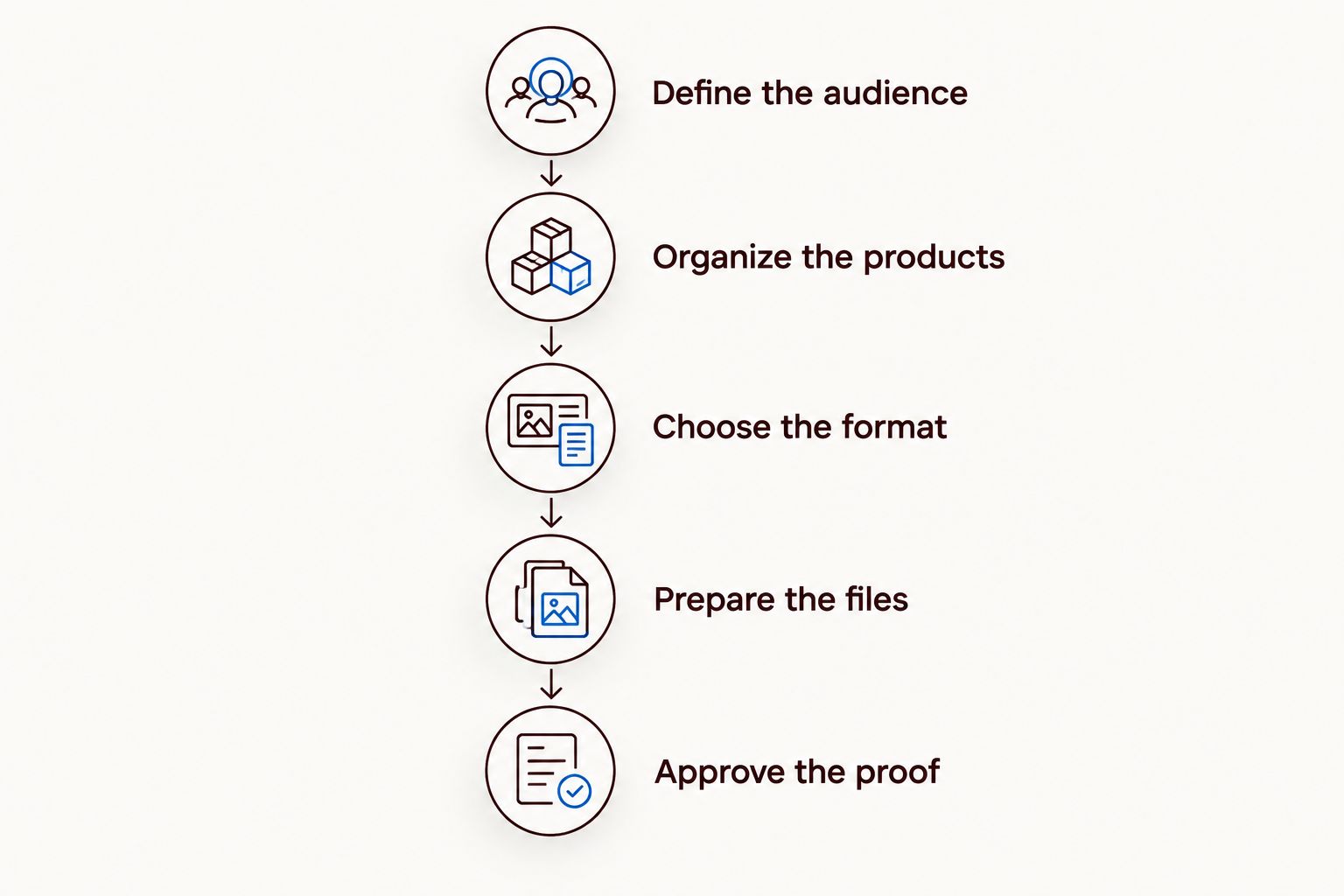
A clear specification makes quotes easier to compare. It also keeps your design decisions tied to the catalog you intend to print.
Choose whether the catalog serves new customers, repeat buyers, dealers, or sales representatives. Write down the action readers should take after finding a product, and make that instruction visible in the layout.
Group products around how customers shop. Use consistent names and identifiers, and keep related items together so readers do not have to search unrelated sections to compare them.
Set the trim size, binding, and page plan before final artwork. Ask the printer to confirm compatibility with your intended paper and page count instead of assuming every combination works.
Follow the printer's PDF, bleed, margin, and cover instructions. Check that photographs remain clear at their placed size and that fonts display correctly in the exported file.
Read the proof as a customer, not just as its designer. Find a product, compare its details, and follow the ordering instructions from beginning to end.
Keep one approved specification with the final files. Record the quantity, page count, binding, paper selections, and delivery destination so a later revision does not accidentally change the job you intended to order.
Publishing Xpress ships in 4 to 6 days after proof approval. That window does not include the time you spend preparing files or reviewing the proof, and shipment is not the same as arrival.
For a 2026 event, work backward from the date you need catalogs in hand. Include delivery time, proof review, and room to correct mistakes before approval. Rush options are available; confirm the schedule for your actual job rather than assuming a shorter deadline.
Do not approve an incorrect proof to save a day. Check product identifiers, contact information, page order, and image placement before authorizing production.
Publishing Xpress catalog printing services are best for small businesses that need at least 25 copies and a choice of four bindings. Start with saddle stitch if your goal is a compact promotional catalog within the 80-page limit.
Choose perfect binding when the collection needs a book-style format. Choose plastic coil when customers need a working reference, and Wire-O when a representative will present the catalog across a table.
Before placing your 2026 order, confirm the final specifications and approval schedule. The right decision is the format that makes your products easier to find, compare, and discuss—not simply the one with the most familiar name.
What’s the best catalog printing service for a small business?
Publishing Xpress is a strong choice for small businesses ordering at least 25 copies and choosing among saddle stitch, perfect binding, plastic coil, and Wire-O. Match the binding to whether customers will carry, read, consult, or present the catalog.
What’s the minimum order for catalog printing?
Publishing Xpress has a minimum print quantity of 25 copies. Base your order on a clear distribution plan and how long the catalog’s product information will remain useful.
Is saddle stitch better than perfect binding for a catalog?
Saddle stitch is better for a compact promotional catalog, while perfect binding suits a substantial book-style collection. Publishing Xpress limits saddle stitch books to 80 pages; confirm perfect-binding suitability for your chosen paper and page count.
Which catalog binding stays open on a desk?
Plastic coil and Wire-O bindings let a catalog lie flat. Plastic coil also lets you fold pages back, while Wire-O supports flat-open tabletop presentations.
How long does catalog printing take?
Publishing Xpress ships in 4 to 6 days after proof approval. Allow separate time for file preparation, proof review, and delivery, and confirm rush arrangements for a time-sensitive job.
How much do catalog printing services cost?
Catalog printing requires a quote based on your job specifications. Provide the quantity, dimensions, page count, color requirements, paper choices, binding, and delivery destination so you can compare equivalent quotes.
What should I check before approving a catalog proof?
Check product names, identifiers, specifications, contact details, page order, images, and binding margins. Follow the ordering instructions yourself to confirm that a customer can take the intended next step.
Print a draft at the intended finished size before approving the catalog. An enlarged screen view hides small type and cramped product tables; a physical draft shows whether customers can actually read the information you need them to use.
Then try finding a specific product without relying on your knowledge of the layout. If the categories or identifiers make that difficult, fix the structure before improving the cover.
© 2026 Publishing Xpress. All Rights Reserved.