October 29, 2026
Best for finished dissertation copies: perfect bound printing. Best for annotation: plastic coil printing. Best for presentation copies that open flat: Wire-o printing. Best for short research booklets: saddle stitch printing. For dissertation printing and binding in 2026, choose your university’s required format first; Publishing Xpress fits students who need at least 25 copies, not a single submission copy.
A dissertation has two separate jobs: meeting submission requirements and giving readers a usable document. The best binding for a committee’s working copy is not automatically the right binding for an official submission.
Publishing Xpress is best for dissertation printing and binding when you need at least 25 copies and your university accepts the selected format. That minimum is a firm decision point. If you need fewer copies, find a service that accepts your actual quantity rather than ordering extras just to meet a minimum.
This 2026 guide compares four printing and binding services by how students use the finished document. It ranks binding choices, not unrelated printing companies, so you can choose a format before requesting an order.
Judge a service against these criteria before comparing binding styles:
Do not treat a familiar binding name as evidence of academic approval. Your graduate school’s written instructions decide what is acceptable for submission.
| Rank and service | Best for | Standout feature | Key limitation |
|---|---|---|---|
| 1. Perfect Bound Printing | Finished reading and distribution copies | Glued spine with a paperback format | Does not naturally stay flat like coil or Wire-o |
| 2. Plastic Coil Printing | Annotated working copies | Flexible spiral allows pages to turn back | Exposed coil and punched binding edge |
| 3. Wire-o Printing | Presentation copies used open on a desk | Paired wire loops let pages open flat | Wire loops can deform if crushed |
| 4. Saddle Stitch Printing | Short research summaries and booklets | Folded pages secured through the center | Publishing Xpress limits this format to 80 pages |
All four formats have a distinct purpose. None overrides a university’s submission rules, and none removes the need to check your finished page count and paper choice with the printer.
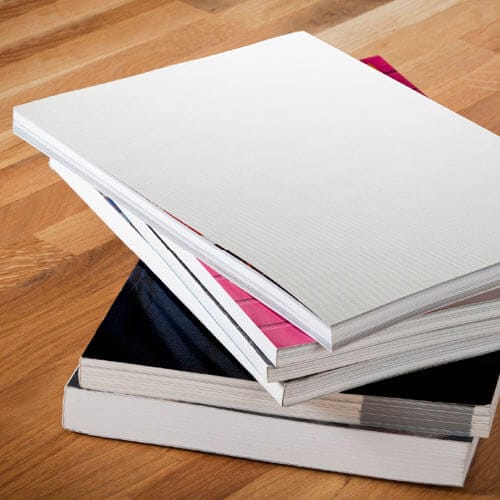
Perfect bound printing attaches the page block to a wraparound cover with adhesive. The result is a paperback-style document with a spine rather than an exposed coil or wire edge.
Choose perfect bound printing when your dissertation is finished and readers will handle it as a book. It is the default recommendation for distribution copies when your university permits the format and the printer confirms that your document’s thickness suits the binding.
Perfect bound printing pros:
Perfect bound printing cons:
Best for: Students distributing a completed dissertation to a department, collaborators, or other readers in a qualifying print run.
For a 2026 dissertation order, finish the interior before finalizing the cover. A late appendix or changed paper choice affects document thickness and therefore the cover setup.
Verdict: Buy perfect bound printing for finished reading copies when the format meets your requirements.
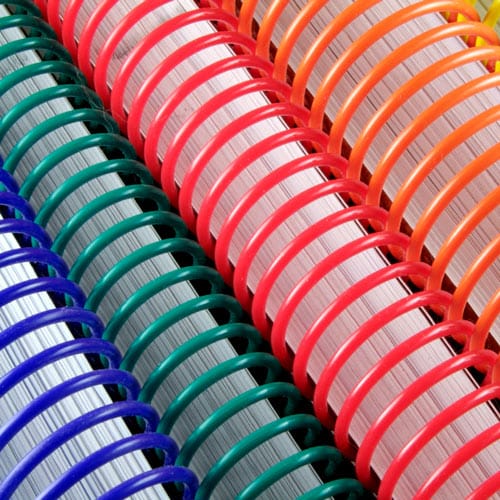
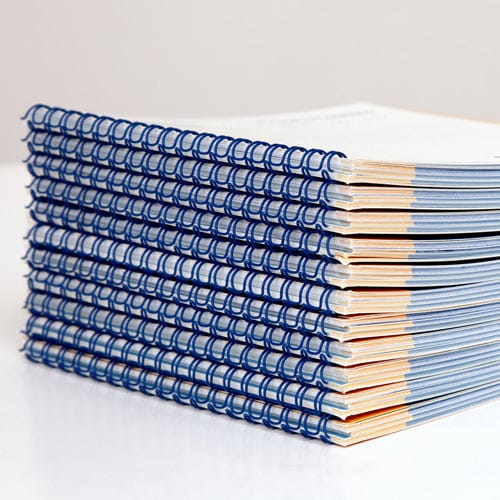
Plastic coil printing threads a continuous flexible spiral through holes along the binding edge. Pages turn around the coil, allowing the document to stay open or fold back for desk use.
Choose plastic coil printing for a working dissertation that readers will mark up repeatedly. The format serves revision sessions well, but the punched edge needs space that your text, equations, and figure labels cannot occupy.
Plastic coil printing pros:
Plastic coil printing cons:
Best for: Students preparing research copies for intensive reading, annotation, or reference during revisions.
Keep essential content away from the holes. A wide table that looks acceptable on screen still needs inspection at its final printed size, especially when its leftmost column sits near the binding.
Verdict: Buy plastic coil printing for hands-on working copies; skip it when submission rules require a different binding.
Wire-o printing uses paired metal loops through the binding edge. The pages open flat, making the format useful when readers need to consult the dissertation while discussing figures or taking notes.
Choose Wire-o printing when flat opening matters more than having a paperback spine. It works as a presentation or reference format, provided you protect the exposed wire during handling and confirm institutional acceptance where required.
Wire-o printing pros:
Wire-o printing cons:
Best for: Students distributing presentation copies that readers will keep open during meetings or research discussions.
Plastic coil and Wire-o both support flat-opening use. Choose between them by handling preference: flexible plastic spiral or paired metal loops. Do not choose Wire-o solely because the name sounds more formal.
Verdict: Buy Wire-o printing for desk-based presentation copies; skip it if rough transport is unavoidable.
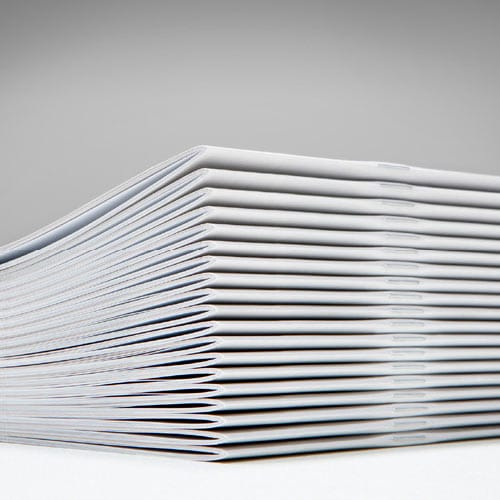
Saddle stitch printing secures folded sheets through the center fold. It creates a booklet rather than a thick, square-spined volume.
Publishing Xpress limits saddle stitch printing to 80 pages. Choose this format for a short dissertation, research summary, or defense companion only when the document fits that limit and the intended use permits it.
Saddle stitch printing pros:
Saddle stitch printing cons:
Best for: Students producing short research booklets rather than a long dissertation volume.
Do not shrink the text or remove required material to force a dissertation into saddle stitching. Select a binding that fits the complete document instead.
Verdict: Buy saddle stitch printing for qualifying short booklets; skip it for documents over 80 pages.
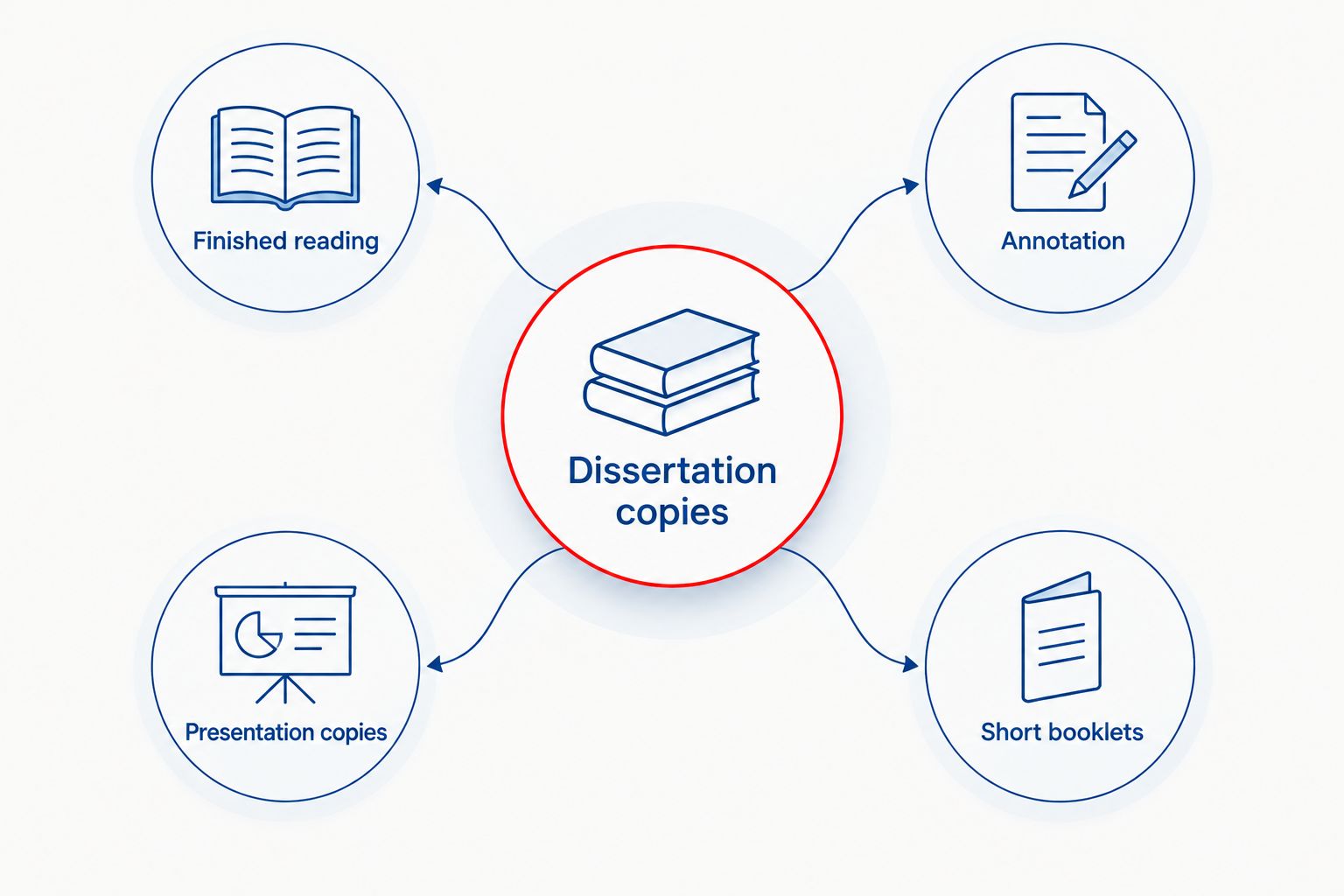
The binding choice should follow the document’s job. Use perfect bound printing for finished reading copies, plastic coil printing for annotation, Wire-o printing for flat-opening presentation copies, and saddle stitch printing for short booklets.
Once you have selected the format, confirm quantity, paper, page count, and file requirements together. These details determine whether the proposed binding fits your actual manuscript, not just its title or subject.
For your 2026 submission, use the current graduate school handbook rather than copying a previous student’s layout. The guide to printing academic theses and dissertations provides additional context for planning the printed document.
Ask the graduate school which printed copies are required and which are optional. Record the accepted binding, page size, margin rules, paper requirements, and exact cover wording before formatting for print.
Include the title page, acknowledgments, contents, references, and appendices in your production page count. Printed page count and the last numbered page are not necessarily the same, particularly when preliminary pages use different numbering.
Embed fonts and review the PDF at its intended print size. Check special characters, equations, footnotes, landscape pages, figure legends, and any chart whose meaning depends on color.
Make sure the approved file contains every final correction. Keep a clearly named copy of that PDF so later edits do not leave you unsure which version went to print.
Publishing Xpress ships in 4 to 6 days after proof approval, according to its stated shipping schedule. That is not an arrival promise: transit takes additional time, and file corrections happen before approval.
For a 2026 deadline, work backward from the date your university must receive the document. Include time for academic sign-off, PDF preparation, proof review, production, shipping, and your own inspection.
Rush options are available, but confirm the schedule for your specific order before relying on one. Do not approve an incorrect proof to save time. Printing the wrong version does not solve a deadline problem.
The ranking prioritizes the job each format performs: finished reading, annotation, flat-opening presentation, or short booklet distribution. Submission compliance comes first, followed by quantity fit, handling, page count, proof preparation, and timing.
Perfect bound printing leads for completed reading copies, not for every student. Plastic coil and Wire-o rank higher when desk use matters most; saddle stitching belongs only where the document fits its limits.
Choose perfect bound printing as the default for completed distribution copies when your university accepts it. Choose plastic coil for repeated annotation, Wire-o for presentation copies used open on a desk, or saddle stitch for a qualifying short booklet.
If you need fewer than 25 copies, use a service that accepts your quantity. If institutional requirements rule out a binding, remove it from consideration before comparing anything else.
What’s the best dissertation printing and binding option for students?
Perfect bound printing is the default for finished reading copies when your university accepts it. Plastic coil suits annotation, Wire-o suits flat-opening presentation copies, and saddle stitch suits short booklets.
Can I order just one dissertation from Publishing Xpress?
No. Publishing Xpress has a minimum print quantity of 25 copies, so students needing fewer copies should select a service that accepts their required quantity.
Is spiral binding better than perfect binding for a dissertation?
Plastic coil spiral binding is better for annotation and keeping pages open on a desk. Perfect binding is better for a conventional paperback-style reading copy; university submission rules take priority over either preference.
Can I saddle stitch a long dissertation?
Saddle stitch printing at Publishing Xpress is limited to 80 pages. If your complete document exceeds that limit, choose another binding rather than shrinking the text or removing required sections.
How long does dissertation printing take?
Publishing Xpress ships in 4 to 6 days after proof approval. Allow additional time for file preparation, corrections, proof review, and shipping transit before your submission deadline.
Will my university accept a perfect bound dissertation?
Your graduate school’s current written requirements determine whether perfect binding is acceptable. Confirm the binding and document specifications before placing an order.
Should dissertation charts be printed in color?
Use color when readers need it to interpret the chart, subject to your submission requirements. If printing in black-and-white, check that labels, line styles, and shading still distinguish the data.
Print your densest table, most detailed figure, and most complicated equation at the final page size before approving the full document. These pages expose readability problems faster than an ordinary paragraph does.
For a 2026 dissertation, a readable page matters more than a binding that merely looks right. Fix cramped labels and binding-edge text before committing to the print run.
© 2026 Publishing Xpress. All Rights Reserved.