October 27, 2026
Yes, book printing without a minimum order quantity is possible in 2026 through print-on-demand services that accept single-copy orders. You still need to meet the printer’s file and format requirements, and a single-copy order is different from a short print run with a stated minimum.
Yes. Choose a printing service that explicitly accepts a single finished book in your required format. Print on demand supports this approach: books are produced as orders come in rather than requiring you to purchase a batch in advance.
Short-run digital printing serves a different need. You order a batch together, then distribute those books yourself. For example, Publishing Xpress has a minimum print quantity of 25 copies.
| Printing approach | Best for | Main advantage | Main limitation |
|---|---|---|---|
| Single-copy print on demand | Authors needing an individual book or copies as readers order | Avoids committing to a batch upfront | Your book must fit the service’s supported specifications |
| Short-run digital printing | Authors and organizations distributing a batch together | Gives you copies to hand out, sell directly, or use at an event | Requires the printer’s minimum quantity and somewhere to keep the books |
Neither approach is automatically better. Choose the smallest order that meets your actual distribution plan, not simply the smallest order advertised.
The phrase “no minimum” answers a quantity question, not every printing question. It does not tell you whether the service supports your binding, whether readers can order directly, or when a finished book will reach you.
For your 2026 project, separate the need for a test copy from the need for finished copies. An author checking a manuscript has a different requirement from a teacher supplying a class or a nonprofit preparing books for an event.
Start with the intended recipient. If you cannot identify who needs the batch, do not increase the quantity just to satisfy a minimum. If a group already needs copies together, evaluate short-run printing alongside print on demand.
Best for: checking an individual book or supplying copies as orders arrive. A service that accepts a 1-copy order lets you obtain a physical book without purchasing a larger batch. Confirm that the single-copy option applies to your chosen format before preparing the final files.
The main benefit is avoiding an unwanted batch. This approach also suits projects whose future demand is uncertain: you do not need to predict every reader before producing the first finished copy.
The limitation is specification fit. A service’s single-copy offering does not establish that every binding, paper, trim size, or interior configuration is supported. Read the requirements for the exact book you intend to produce.
Treat a test copy as a check of that production setup. If you later move to another printer, paper, or binding, review the new proof rather than assuming the earlier copy confirms the new result.
Publishing Xpress short-run book printing is best for authors and organizations that need at least 25 copies together. That is a low-minimum service, not book printing without a minimum order quantity.
The company prints books, booklets, workbooks, magazines, catalogs, and other bound documents in black-and-white or color. Its binding choices include perfect bound, saddle stitch, wire-o, and plastic coil.
The benefit is practical when you already have a group to supply. You can plan a batch for a workshop, congregation, author event, or organizational project rather than arrange each recipient’s copy separately.
The limitation is equally clear: you must order at least 25 copies and manage their distribution. Publishing Xpress ships in 4 to 6 days after proof approval; allow separately for delivery to your address. Do not treat that shipping schedule as an arrival guarantee.
Order minimums belong to a specific service and product configuration. In 2026, compare the requirements attached to your book rather than assuming every service described as “digital printing” follows the same rules.
Check these factors before choosing:
A minimum is not a quality rating. It tells you how much you must order; it does not tell you whether the finished book suits its readers.
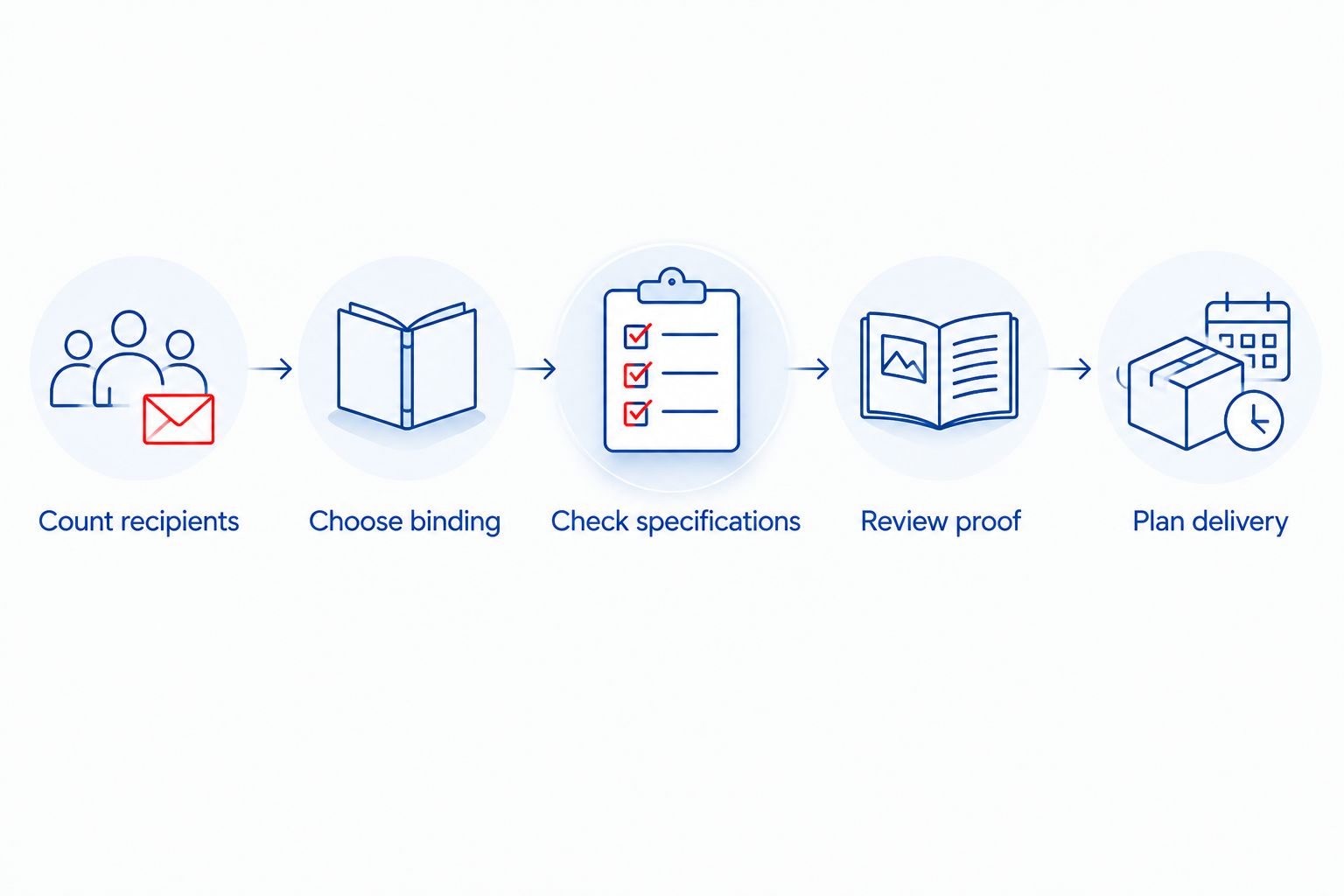
Use your distribution plan to make the decision. This 2026 ordering checklist keeps the quantity question separate from the design and delivery questions.
The sequence matters. Choosing a quantity before confirming the format can send you back to redesign the book or search for another printer.
Match the binding to the way the book will be used, then confirm the printer’s quantity requirement. A no-minimum option is not useful if its binding makes the book awkward for its intended task.
| Binding | Best for | Practical advantage | Limitation to consider |
|---|---|---|---|
| Perfect bound | Novels, memoirs, and other reading-focused paperbacks | Creates a glued spine and a familiar paperback format | Does not lie completely flat like a coil-bound book |
| Saddle stitch | Slim booklets, zines, and event programs | Secures folded pages with staples along the fold | Page capacity is limited; the client’s maximum is 80 pages |
| Plastic coil | Workbooks, planners, and manuals | Lets pages lie flat and turn around the binding | Requires clear space for punched holes along the binding edge |
| Wire-o | Calendars, portfolios, and presentation books | Lets pages lie flat for viewing or writing | Exposed wire loops can deform if crushed |
For a reading-focused paperback, start by evaluating perfect binding. For a workbook used beside a keyboard or on a desk, evaluate plastic coil or wire-o instead. These are use-case recommendations, not promises that a particular single-copy service offers those bindings.
Do not finalize the cover until the binding is settled. A perfect-bound cover needs a spine area; a punched binding needs an interior layout that keeps important material away from the holes.
A small order still needs finished files. Ordering fewer books limits the size of a mistake; it does not correct the mistake.
Review these details before submitting your book:
Your final review should include the exported PDF, not just the editable manuscript. Exporting can reveal layout problems that are easy to miss while writing.
For a more focused review, follow this guide to proofing a book before printing. Keep a clearly named final file so an earlier draft does not become the production file.
Ask direct questions about the exact book you intend to order. A general statement about minimum quantities is not enough to approve the job.
Keep the answers with your project specifications. If you change the binding or interior after receiving a quote, reconfirm the requirements rather than assuming the original answer still applies.
For a deadline-driven 2026 project, ask for the shipping date and the expected arrival date separately. They answer different questions, especially when you also need time to distribute books after receiving them.
1 copy is possible through a service that accepts single-copy book orders. Confirm the format, file requirements, and delivery arrangements before submitting the book. Do not assume a short-run printer also offers individual copies.
25 copies is the minimum print quantity. If you need fewer, choose a service that explicitly accepts your required quantity rather than ordering extra copies without a use for them.
80 pages is the maximum for the client’s saddle stitch books. Confirm how the printer counts cover and interior pages before finalizing your file. Page capacity and minimum copy quantity are separate requirements.
What’s the best option for book printing without a minimum order quantity?
A print-on-demand service that accepts single-copy orders is the best fit when you need individual books rather than a batch. Confirm that its supported binding and specifications match your project.
Does no minimum order mean I can print a book without preparing files?
No. You still need files that meet the printer’s production requirements. Check the interior PDF, cover, margins, fonts, images, and bleed before ordering.
Is print on demand the same as short-run book printing?
No. Print on demand produces books in response to orders, while short-run printing produces a batch together. A short-run service can have a minimum quantity.
Is ordering a single book always better than ordering a batch?
No. A single-copy order suits an individual need, while a batch suits a group that needs books together. Choose based on confirmed recipients, format, and distribution responsibilities.
Can I use a sample from one printer to approve another printer’s books?
No. Review the proof for the actual printer, files, and specifications you plan to use. A sample from another production setup does not confirm the new result.
Does printing my book automatically include selling it to readers?
No. Printing and selling are separate tasks unless your chosen service explicitly includes both. Confirm who takes reader orders, receives payment, and sends out each book.
A proof copy and a minimum order answer different questions. A proof helps you assess the book; the minimum tells you how many finished copies you must purchase. Ask about both before choosing a printer for your 2026 project.
If the manuscript is still changing, finish the corrections before approving a batch. The smallest sensible order is the one that gives the right readers the right version of your book.
© 2026 Publishing Xpress. All Rights Reserved.