August 13, 2026
Envelope printing for small business mailings decides whether your invoice, direct-mail piece, or client packet gets opened or tossed with the rest of the junk. Here's what to buy, what to skip, and how Publishing Xpress prices it for short runs in 2026.
A mailed piece has about three seconds to signal legitimacy before a recipient decides to open it or bin it. Envelope printing for small business mailings is the cheapest lever you have to buy those three seconds — a printed return address and logo on the envelope reads as a real business, not a mail-merge experiment.
Most small operations either overorder generic envelopes from a big-box store or underinvest and hand-stamp a logo on plain stock. Neither move matches what a business card printing order or a letterhead order already gets right: consistent color, consistent stock, consistent brand mark. Envelopes should follow the same standard, not lag behind it.
This guide is for the solo consultant, small nonprofit, law office, or retail shop mailing anywhere from 100 to a few thousand pieces a month — invoices, welcome packets, appeal letters, or direct-mail promos. If you're mailing tens of thousands of pieces through a full-service mail house, you're past this guide; talk to a mail fulfillment vendor about co-mailing rates instead.
A window envelope only works if the address on your invoice or letter lands inside the die-cut window every time. Get the window position specced against your actual document template before you print 500 of them — a half-inch mismatch means every piece needs hand-addressing.
One-color envelope printing (usually your logo and return address in black or a brand color) covers 90% of routine business mail — invoices, statements, thank-you notes. Full-color printing earns its higher per-piece cost only when the envelope itself is doing marketing work, like a direct-mail offer or an event invite.
Peel-and-seal closures save real time on any run over 100 pieces because there's no licking or moisture-sealing step — for a solo office stuffing envelopes by hand, this is the difference between an afternoon and an hour. Gummed flaps are fine for low-volume runs where speed doesn't matter.
An envelope printed on flimsy 24 lb. stock next to a heavier letterhead sheet reads as mismatched the second someone holds both. Order envelope stock in the same weight family as your letterhead and business cards so the whole mailed package feels like one brand.
A 5,000-piece minimum locks you into paper you don't need and storage you don't have room for. Publishing Xpress runs envelope printing with a 100-copy minimum and lets you reorder in increments of 1, so a two-person office isn't buying a warehouse of stationery to get printed envelopes at all in 2026.
If your appeal letter needs to hit mailboxes before a fiscal year-end or a fundraising deadline, turnaround time matters more than any other spec on this list. Confirm production time in days, not "business days with exceptions," before you commit a print date to a mail date.
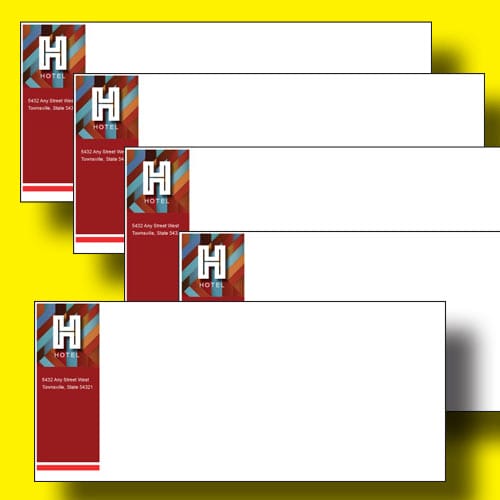
The everyday workhorse: number-10 window envelope, one-color print. This is the format behind most invoices and statements mailed in the US, and it's the one Publishing Xpress's Envelope Printing order form is built around. One spec that matters: a 100-copy minimum order with reorders in increments of 1, so a solo office isn't stuck with 5,000 unused envelopes. Verdict: Buy for routine business correspondence.
The direct-mail booster: full-color no-window envelope with a printed teaser line. Adding a one-line offer or headline to the envelope face lifts the odds it gets opened before the trash pile, which is the entire point of paying for full color here. Pair the outer envelope with a brochure printing insert so the piece has somewhere to send interest once it's opened. Verdict: Consider for a quarterly promo push, Skip for monthly billing.
The professional matched-set: envelope stock aligned to letterhead and business cards. The win here isn't the envelope alone — it's a client packet where the envelope, the letter inside, and the business card tucked in all share the same paper weight and color. This is the pick for law offices, consultants, and financial advisors mailing client documents in 2026. Verdict: Buy if you're already ordering matched letterhead.
The catalog mailer: 9×12 non-window envelope for flat inserts. When the mailing includes a folded brochure, a sell sheet, or multiple flat pages that shouldn't be creased into a number-10, the larger flat format is the right call. One number that matters: postage jumps in a different rate tier past a 1 oz. mailing weight, so weigh a filled sample before you commit to a print run. Verdict: Consider for catalog or proposal mailings, Skip for single-page letters.
| Pick | Format | Print color | Best for | Verdict |
|---|---|---|---|---|
| Everyday workhorse | #10 window | One-color | Invoices, statements | Buy |
| Direct-mail booster | #10 no-window | Full-color | Promo mailers | Consider |
| Matched-set | #10 window | One-color, matched stock | Client packets | Buy |
| Catalog mailer | 9×12 flat | One or full-color | Proposals, catalogs | Consider |
What’s the best envelope printing option for small business invoices in 2026?
A number-10 window envelope printed in one color with your logo and return address is the standard pick for invoices and statements in 2026. It keeps the address visible through the window and costs less per piece than full-color printing.
Is full-color envelope printing worth it for a small business?
Full-color printing is worth the extra cost only when the envelope itself is doing marketing work, like a direct-mail promo or event invite. For routine billing and correspondence, one-color printing does the job at a lower per-piece price.
How much do small business envelopes cost to print?
Cost depends on run size, color count, and stock weight, and Publishing Xpress quotes envelope printing with a 100-copy minimum and reorders in increments of 1 rather than a flat published price. Get a quote against your exact spec before budgeting a mailing.
What’s the minimum order for printed envelopes?
Publishing Xpress runs a 100-copy minimum on envelope printing, with reorders available in increments of 1 copy. That means a small business can order exactly what a mailing needs instead of buying a case of 5,000.
Should envelope stock match my letterhead and business cards?
Yes — matching paper weight and color across your envelope, letterhead, and business card printing is what makes a mailed packet read as one consistent brand. Mismatched stock is one of the most common and most fixable branding mistakes in small business mail.
Window or no-window envelope for business mailings?
Window envelopes work best when your document’s address block is fixed and won’t shift between mailings, since the window has to align every time. No-window envelopes give you more flexibility for hand-addressed or varied-format pieces.
Does envelope printing help with response rates on direct mail?
A printed logo and return address on the envelope signals legitimacy in the few seconds before a recipient decides to open or discard a piece. Adding a printed teaser line in full color can lift open rates further on promotional mailings.
What size envelope fits a folded brochure?
A number-10 envelope fits a standard tri-fold brochure, while a 9×12 flat envelope fits brochures, sell sheets, or multi-page inserts without an extra fold. Weigh a filled sample before printing to confirm which postage tier the piece falls into.
The detail that trips up most first-time envelope orders isn't color or size — it's the 100-copy minimum most small commercial printers quietly enforce as a floor, not a ceiling. Publishing Xpress lets you reorder in increments of 1 above that floor, which means a two-person consulting shop can print exactly 140 envelopes for a client mailing in 2026 instead of rounding up to 500 and storing the rest in a supply closet through 2027.
© 2026 Publishing Xpress. All Rights Reserved.