August 20, 2026
Spiral bound cookbook printing turns a client-facing meal plan into something coaches actually use in the kitchen instead of a PDF nobody opens. This guide breaks down which binding, paper, and print specs matter for nutrition and wellness coaches shipping recipe collections to real clients in 2026.
A nutrition coach's cookbook isn't a novel — it's a working tool that sits open on a counter next to a cutting board, gets flour on it, and needs to survive being propped against a mixing bowl. Standard perfect-bound books close themselves when you let go. Cookbook printing for nutrition coaches has to solve for lay-flat use first and everything else second, and most generic printing guides miss that entirely.
Coaches also print in smaller batches than a trade cookbook publisher. A 12-week program with 25 clients doesn't need 2,000 copies — it needs 25 to 50, reprinted as the program refills. That changes which binding and vendor make sense in 2026, and it's the reason this guide exists.
This is for nutrition coaches, wellness practitioners, and health coaches who hand clients a printed recipe collection, meal plan booklet, or program cookbook as part of a paid package. It applies whether you're printing 20 copies for a small cohort or 300 for a course launch, and whether your book is 24 pages of quick recipes or 150 pages covering a full protocol. It's not for restaurants building a retail cookbook line — Publishing Xpress covers that use case separately, and the paper and binding math runs differently at that volume.
A cookbook that snaps shut mid-recipe gets abandoned by week two. Coil and Wire-O binding open flat at any page and stay there — perfect binding and saddle stitch don't do this reliably once the book is more than 60 pages thick. If your client is going to cook from the book, lay-flat behavior isn't optional.
Meal plan booklets range from 16-page quick-start guides to 120-page full-program cookbooks. Whatever binding you pick needs to work across that range without forcing a redesign every time you add a module. Spiral bound workbook printing for wellness coaches covers the same flexibility question for non-recipe program materials, and the logic carries over directly.
Standard 80 lb. text paper wrinkles the first time it gets a water splash near the stove. Coated or lightly gloss-coated stock resists moisture better and holds up to repeated handling across a 12-week program. Matte finishes photograph better for food shots but scuff faster under daily use — pick based on how often the book actually opens.
A recipe book without photos gets followed less closely — clients want to see what the finished dish looks like before they commit to shopping for it. Color printing costs more per page than black-and-white, so budget for photos only where they change client behavior: hero shots per recipe, not every step.
A coach running a 30-person program can't absorb a 500-copy minimum built for retail print buyers. Look for a printer that prices per-copy at low volumes instead of forcing a bulk order you'll never fully use. No large minimum order requirement is the single biggest cost lever for coaches printing under 100 copies at a time.
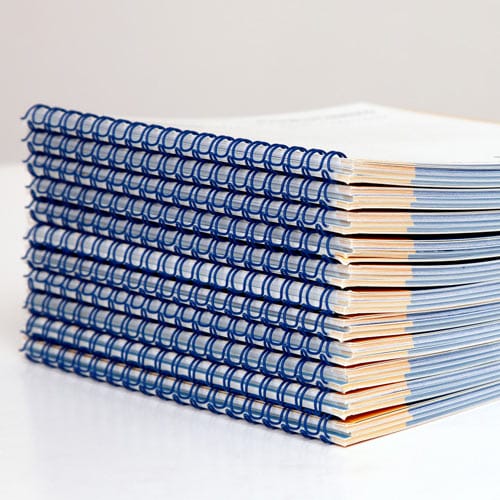
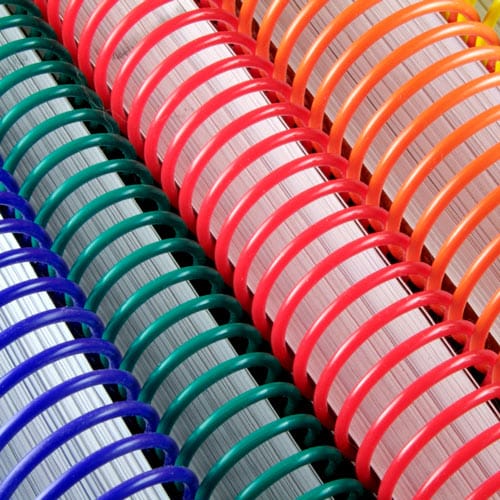
Plastic coil binding — the daily-use workhorse. Coil binding runs a continuous plastic spiral through drilled holes, and it's the pick that survives being opened and closed hundreds of times across a program. It lays completely flat at any page, which matters when a client's hands are covered in olive oil and they need the book to stay open on its own. Plastic coil binding for cookbooks covers the paper and drilling specs in more detail. Verdict: Buy for any cookbook a client will actually cook from.
Wire-O binding — the premium retail pick. Wire-O uses a double-loop metal wire instead of plastic, which gives the book a sturdier, more polished feel — the kind of detail that matters if you're selling the cookbook as a standalone product rather than bundling it into a coaching package. Wire-O printing for cookbooks and recipe books breaks down when the wire finish justifies the added cost over plastic coil. Verdict: Buy if the cookbook doubles as a retail item or a client gift.
Saddle stitch — the short-booklet pick. Saddle stitch staples folded sheets down the spine, and it only holds up cleanly under roughly 40 pages before the spine starts to bulge and pages resist lying flat. It's the cheapest option per copy and fine for a quick-start recipe guide bundled with a bigger program. Verdict: Consider for anything under 40 pages, Skip for a full meal plan cookbook.
Perfect binding — the bookstore-look pick. Perfect binding glues pages to a flat spine, giving the book a squared-off, retail-shelf look — but it will not lay flat on a counter, and a book under roughly 60 pages barely takes a readable spine title at all. It reads as a real book, not a working tool. Verdict: Skip for kitchen-use cookbooks, Consider only if the book is meant to sit on a shelf, not a counter.
| Binding | Lays flat | Best page range | Photo-friendly | Verdict |
|---|---|---|---|---|
| Plastic coil | Yes | 16–150 pages | Yes | Buy for daily kitchen use |
| Wire-O | Yes | 16–150 pages | Yes | Buy for retail or gift copies |
| Saddle stitch | Partial | Under 40 pages | Yes | Consider for quick-start guides |
| Perfect bound | No | 60+ pages | Yes | Skip for working cookbooks |
What’s the best binding for cookbook printing for nutrition coaches?
Plastic coil binding is the best fit because it lays flat at any page and survives repeated kitchen use. Wire-O binding is the better choice when the cookbook doubles as a retail product in 2026.
Is Wire-O better than plastic coil for a nutrition coach’s cookbook?
Wire-O looks more polished and holds up slightly better over years of use, but plastic coil costs less and performs the same for daily kitchen handling. Pick Wire-O only if the book is sold or gifted, not just used internally.
How many pages should a coaching cookbook be?
Most nutrition coaching cookbooks run 40 to 120 pages, covering a meal plan cycle plus recipes and shopping lists. Under 40 pages, saddle stitch binding works fine and costs less per copy.
Can I print a small batch of cookbooks for one client cohort?
Yes — short-run digital printing handles batches as small as a single cohort without the large minimums retail publishers require. This is the main reason coaches avoid traditional offset print runs.
Does paper stock matter for a recipe book?
Yes, a coated or lightly gloss stock resists moisture and repeated handling far better than standard uncoated text paper. It also reproduces food photography with more contrast.
Should a coaching cookbook be color or black-and-white?
Color printing is worth the added cost for a hero photo per recipe, since clients follow recipes more closely when they can see the finished dish. Full-page color on every spread usually isn’t necessary.
What’s the difference between saddle stitch and coil binding for a cookbook?
Saddle stitch staples folded sheets and only holds up under roughly 40 pages before the spine bulges. Coil binding handles any page count from 16 to 150-plus pages and lays flat the entire time.
Do I need an ISBN to print a cookbook for my coaching clients?
No — an ISBN is only needed if you plan to sell the book through retail or online bookstores. A cookbook printed for internal client use doesn’t require one.
The detail most coaches skip is spine expansion — a 100-page coil-bound cookbook needs roughly a 1/2 inch coil diameter to open properly, and ordering the wrong diameter is the single most common reprint request on short-run cookbook jobs in 2026. Check the page count against the coil size chart before you submit files, not after the first batch ships.
© 2026 Publishing Xpress. All Rights Reserved.