August 2, 2026
Spiral bound calendar printing for businesses comes down to one real decision: Wire-O or plastic coil, because both survive a year of daily page turns better than any glued or stapled spine. Publishing Xpress builds both in 2026, and neither one forces you into a warehouse-size order.
"Spiral" is the term most buyers reach for, but it's not a single product. What you're actually choosing between is Wire-O (double-loop wire) and plastic coil (a single spiraled plastic strand) — both let a calendar open flat, unlike saddle stitch or perfect binding. That distinction matters more than paper stock for a calendar, because the binding is what takes the abuse: a desk calendar gets flipped roughly 12 times a year at minimum, more if someone actually uses the notes section. A spine that can't take that gets tossed by spring.
Publishing Xpress runs both formats without a large minimum order requirement, which matters if you're printing 40 calendars for top clients instead of 4,000 for a retail shelf. That's the gap most business buyers hit first: national print chains want volume, and a 50-unit run of branded calendars for a law firm's client list doesn't fit their model.
This guide is for marketing managers ordering client-gift calendars, HR teams printing employee desk calendars, and nonprofits or real estate offices handing out branded calendars to donors and past clients. If you need under 500 units with a logo, a set month-grid, and a binding that survives a full year on someone's desk, keep reading.
A calendar that won't stay open at the current month gets ignored within a week. Wire-O opens to a true 360 degrees against a wall or flat on a desk; plastic coil comes close but has a bit more spring-back at the spine. For anything mounted or propped open constantly, Wire-O is the safer call.
A calendar cover takes more handling than any other printed piece in your building — twelve months of flipping, corner-bending, and occasional coffee cups. A cover that's too light curls and tears at the punch holes by Q3.
The entire point of a business calendar is the branding, not the dates. Every month-grid needs a header strip or footer band reserved for your logo, and that layout has to be locked before the file goes to press, not adjusted after.
Some businesses want a plain grid; others want a photo or project spotlight per month. Coil and Wire-O both handle mixed photo-and-grid layouts, but confirm the page count matches a true 12- or 13-month spread before you finalize files.
A calendar run should match your client list or headcount — not a printer's bulk minimum. Publishing Xpress prints without a large minimum order requirement, which is the difference between ordering exactly 85 units for your top accounts and being pushed into 500 you'll never hand out.
Business calendars cluster around the same order window every fall. Get files finalized and submitted well ahead of the holiday season — the buyers who wait until December are the ones stuck with whatever's left on the shelf.
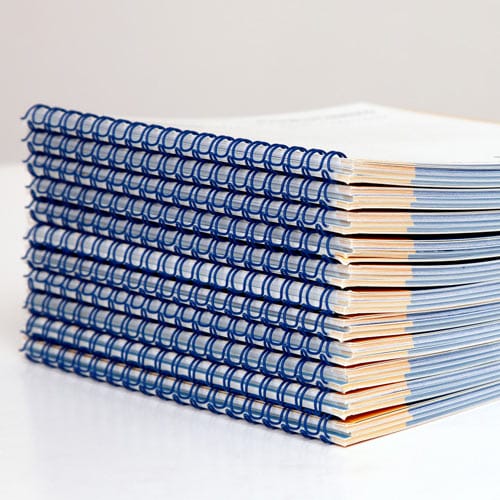
The double-loop wire lets the calendar hang flat against a wall or sit open on a desk at a full 360 degrees, which matters if it's going in front of a client instead of a back office. It's the standard format for wire-o bound calendars built for repeat annual use, and pairs with the Wire-O Printing line for the binding itself. Verdict: Buy for client gifts and anything displayed rather than stashed in a drawer.
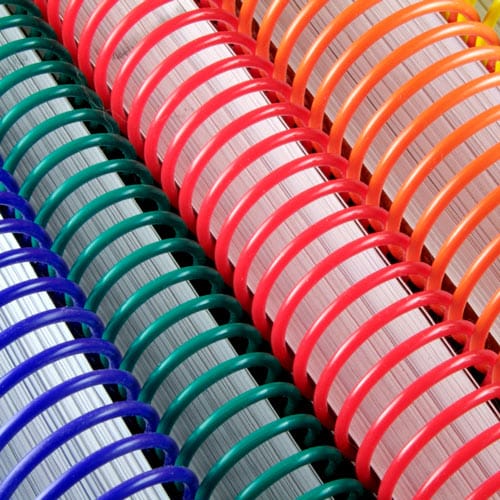
Coil calendars run lighter per unit and hold up fine for desk use even if they don't lay quite as flat as Wire-O. For planner and journal-style calendars going out to 300 or more employees or clients, the per-unit savings add up fast, and the Plastic Coil Printing option covers the binding directly. Verdict: Buy for internal distribution and larger giveaway runs.
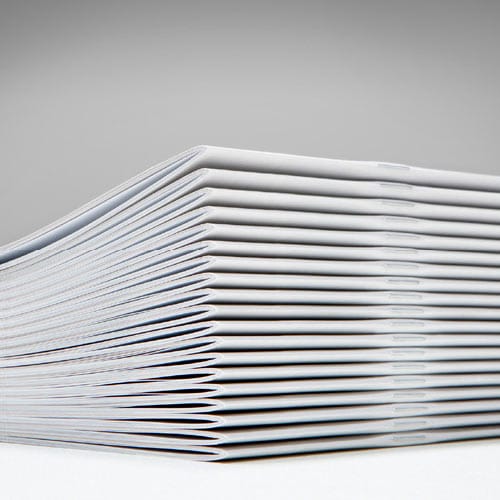
A small saddle-stitched calendar or planner insert works as a trade-show table giveaway or conference bag item — something handed out by the hundreds, not something meant to survive December. The Saddle Stitch Printing format keeps unit cost low for that kind of short-lifespan run. Verdict: Consider for events, skip it if you need a calendar that's still on someone's desk in October.
Some vendors bind a 12-month calendar like a paperback, gluing the spine instead of coiling or wiring it. It looks fine on day one, but the pages don't lay flat and the glued fold starts cracking around month six of daily use. Verdict: Skip for anything meant to open flat on a desk or wall.
| Format | Lay-flat | Best for | Order flexibility | Verdict |
|---|---|---|---|---|
| Wire-O wall calendar | Full 360 degrees | Client gifts, wall display | No large minimum | Buy |
| Plastic coil desk calendar | Near-flat, slight spring-back | 300+ unit internal runs | No large minimum | Buy |
| Saddle-stitch mini planner | Does not lay flat | Trade-show giveaways | No large minimum | Consider |
| Perfect-bound calendar book | Does not lay flat | Nothing recommended | Varies by vendor | Skip |
“If a calendar’s spine can’t survive being flipped 365 times, it doesn’t belong on a client’s desk.”
What’s the best binding for spiral bound calendar printing for businesses?
Wire-O binding is the best choice for business calendars meant to lay flat on a wall or desk all year. Plastic coil is the close second, better suited to large giveaway runs where per-unit cost matters more than the last few degrees of flatness.
Is Wire-O better than plastic coil for a calendar?
Wire-O opens to a full 360 degrees, which plastic coil doesn’t quite match. For calendars mounted on a wall or displayed for clients, Wire-O wins; for internal desk calendars ordered in bulk, coil is the more practical pick.
Can Publishing Xpress print a small batch of branded business calendars?
Yes. Publishing Xpress doesn’t require a large minimum order, so a run of 40 to 80 calendars for a client list is handled the same way as a larger internal run.
Does a business calendar need to be printed in color?
No. Black-and-white interiors work fine for a plain date-grid calendar, while color makes more sense when photo pages or a branded header are part of the design.
How far ahead should a business order its 2026 calendars?
Order well before the Q4 rush, since most business calendar orders cluster into the same fall window every year. Waiting until December limits your options and your turnaround.
What size should a business wall calendar be?
Most business wall calendars run a standard 12-month spread sized to hang comfortably in an office, while desk calendars are typically smaller to fit on a desktop stand. The right size depends on whether it’s wall-mounted or desk-propped.
Can a saddle-stitched calendar work for a business giveaway?
Yes, but only for short-term use like a trade-show table item. Saddle stitch doesn’t lay flat the way coil or Wire-O does, so it’s not the right pick for a calendar meant to sit open on a desk all year.
What ruins a business calendar’s durability?
Thin interior paper stock and glued or stapled spines are the two most common failure points. A calendar bound like a paperback book cracks at the fold well before the year is out.
The binding decision matters more than the artwork decision for a business calendar — a beautifully designed calendar with the wrong spine is unusable by month six, while a plain grid on the right binding lasts the full 12 months on someone's desk. Pick the spine first, then design around it.
© 2026 Publishing Xpress. All Rights Reserved.