July 23, 2026
Writing a science fiction novel in 2026 means locking one speculative idea, building a world that obeys its own rules, and getting a full manuscript onto the page before you worry about polish. This guide walks through the process step by step, from premise to a print-ready file.
Science fiction fails for one of two reasons: the world overwhelms the story, or the story never earns its world. Readers forgive a rough sentence. They don't forgive a plot that exists to explain the tech.
A clear process fixes both problems before they cost you 80,000 words of rewrites. Nail the premise, build the world's rules early, then draft against an outline instead of a blank screen.
Write the whole book in one line: a character, one world rule that isn't true today, and what's at stake if the character fails. "A ship's engineer discovers the AI running life support is rationing oxygen by social rank, and she has thirty days to prove it before her name comes up" is a premise. "A space adventure" is not.
This single sentence becomes your test for every scene later. If a scene doesn't serve the premise, cut it or save it for book two. Common mistake: stacking three big ideas (AI uprising, alien first contact, and time travel) into one premise. Pick the load-bearing idea and let the others become texture.
Decide what's different about your world and how far that difference reaches. If faster-than-light travel exists, does it change economics, politics, and language, or just the ship design? Sci-fi readers notice when a world-changing technology has zero social consequences.
Write these rules down in a single document — three to five rules is plenty for a first novel. Common mistake: dumping all of this into chapter one as exposition. Reveal the rules through consequence, not lecture.
Before you draft a single chapter, map the inciting incident, the midpoint reversal, the low point, and the climax. A novel running 90,000 to 120,000 words needs those anchor points or the middle third drifts.
This doesn't mean a scene-by-scene outline — that kills momentum for a lot of writers. It means knowing where the story turns so a 30,000-word middle doesn't wander without a destination. Common mistake: outlining the first act in detail and leaving the back half as "figure it out later."
Set a daily target and hit it even on bad days. A steady 1,000 words a day finishes a 100,000-word manuscript in roughly 100 writing days — about three and a half months if you write five days a week in 2026.
Don't edit while drafting. Revision and generation use different parts of your brain, and switching between them mid-scene is the single biggest cause of stalled first drafts. Common mistake: rewriting chapter one for the fifth time instead of finishing chapter twenty.
Each chapter should open with an unanswered question and close having answered it while raising a new one. This is what keeps a 300-page sci-fi novel moving instead of reading like a string of scenes.
Getting the mechanics of chapter headings right — numbering, titling conventions, section breaks — matters more in genre fiction than people expect, since readers use those breaks to pace themselves through dense worldbuilding. Common mistake: ending every chapter on the same type of cliffhanger; readers catch the pattern by chapter ten.
On your first revision pass, hunt for contradictions: does the AI in chapter three follow the same rules established in chapter one? Does the timeline in your world bible match what's on the page? Fix consistency before you touch sentence-level prose — there's no point polishing a paragraph you'll cut once the timeline gets fixed.
Run a second pass focused purely on pacing: does each chapter earn its length? Common mistake: three consecutive drafts of line-editing before a single consistency check.
Once the draft is locked, set your trim size and margins before you send the file anywhere. This is the step most first-time sci-fi authors skip, and it's the one that turns a finished manuscript into an actual book.
Common mistake: exporting straight from a word processor without checking margins, font embedding, or bleed — all of which change how a 400-page novel prints.
“If your beat sheet doesn’t survive contact with chapter three, the outline was the problem, not the story.”
Once the manuscript is done, the next decision is binding and format, and that's where Publishing Xpress comes in. A completed novel over roughly 30,000 words prints well with perfect binding — the standard for a bookstore-style paperback. Shorter formats like novellas or serialized chapters sometimes fit saddle stitch or coil better.
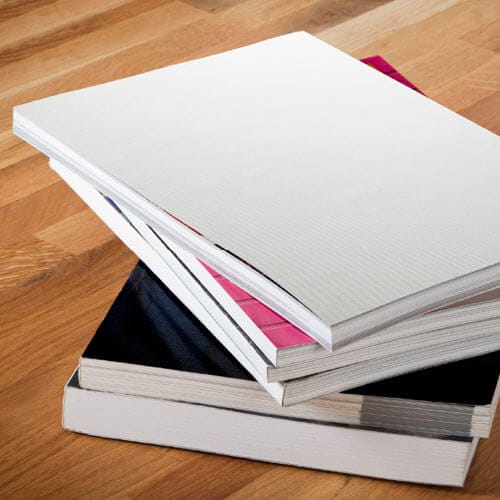
Once the manuscript is locked and formatted, the next step is deciding how you'll get the finished book into a reader's hands — self-publishing, small-press submission, or a print run through Publishing Xpress for a short-run paperback launch. That decision shapes your timeline more than most first-time sci-fi authors expect going into 2026.
How long should a science fiction novel be?
Adult science fiction novels run 90,000 to 120,000 words in 2026, with debut novels sitting closer to the lower end. Young adult sci-fi typically runs shorter, around 60,000 to 90,000 words.
Do I need to outline before writing a sci-fi novel?
An outline with five to eight major plot beats prevents the sagging middle that’s common in series-length speculative fiction. You don’t need a scene-by-scene script, just the anchor points where the story turns.
How much worldbuilding should happen before I start drafting?
Three to five core rules about what’s different in your world is enough to start. Deeper worldbuilding can happen in a running document as you draft, rather than all upfront.
What’s the biggest mistake first-time sci-fi authors make?
Opening the novel with exposition about the world instead of a character making a decision. Readers tolerate world rules revealed through consequence, not through a lecture in chapter one.
How long does it take to write a science fiction novel?
At 1,000 to 1,500 words a day, a 100,000-word manuscript takes roughly three to four months of steady writing. Revision typically adds another two to three months.
What binding is best for a self-published sci-fi novel?
Perfect binding is the standard choice for full-length novels over roughly 30,000 words, giving the bookstore-paperback look most sci-fi readers expect. Shorter formats like novellas sometimes fit saddle stitch better.
Should I write a series or a standalone sci-fi novel first?
A standalone with series potential is the safer first project — it lets you finish, revise, and print one complete book instead of committing to a multi-book arc before you’ve tested your process.
How do I keep sci-fi tech rules consistent across a long manuscript?
Keep a single running world bible document listing every rule you’ve established, and check new scenes against it before you draft them. This catches contradictions before your first revision pass instead of after.
The manuscripts that stall aren't the ones with weak prose — they're the ones where the writer never locked the premise to one sentence. Every other problem in this guide traces back to that first step.
© 2026 Publishing Xpress. All Rights Reserved.