October 8, 2026
Wire-O binding cost depends on your finished book specifications and order quantity, so use a project-specific quote rather than a generic binding rate for your 2026 budget. Check whether the quote covers printing and covers as well as binding; delivery and applicable taxes also belong in your total. Compare complete books with matching specifications—not a binding-only charge against a finished-book quote.
The useful cost is the total for your specified project, not an isolated rate for the wire. A quote for binding already-printed sheets answers a different question from a quote for printing, trimming, punching, and assembling complete books.
For short-run book printing, Publishing Xpress offers black-and-white or color printing and Wire-O binding without large minimum order requirements. Publishing Xpress is a fit for self-publishers and organizations seeking short-run Wire-O book printing. Choose the format for its usefulness, then compare the complete project quote.
Use this breakdown to check what each supplier has included:
| Quote component | What to confirm | Why it matters |
|---|---|---|
| Interior printing | Finished page count, color setting, and printed sides | Binding alone does not include producing the pages |
| Interior paper | Exact stock specification | Paper affects the finished thickness and feel |
| Covers | Front and back cover specifications | A cover is a separate part of the finished book |
| Binding | Wire-O, binding edge, and assembly scope | A different binding method is not an equivalent quote |
| File preparation | Whether any corrections or preparation are included | An unfinished file leaves the production scope unclear |
| Delivery and tax | What the final total includes | The production subtotal is not necessarily your complete expense |
Ask for the total order amount and the amount per finished copy. Both matter: one tells you what the project requires, while the other helps you compare equivalent orders.
A workbook that stays open while someone writes serves a different purpose from a novel read in the hand. Binding should support that purpose. Wire-O lets pages lie flat and fold back through 360 degrees, making it useful when readers need an unobstructed working page.
There is a trade-off. The exposed metal loops can bend under pressure, and the punched edge needs space in your layout. Wire-O also lacks the conventional printable spine of a perfect-bound book.
For a 2026 project, start with the reader's task: writing, following instructions, checking a recipe, or reviewing a presentation. Keep Wire-O when its page movement solves a real problem; compare another binding when it does not.
These project choices define what you are asking the printer to produce. Keep them consistent when comparing quotes so a change in the book does not masquerade as a change in the binding rate.
Changing several factors at once makes a quote difficult to interpret. Ask for an alternative with only one specification changed when you want to understand which choice affects your project total.
A binding-only request starts with sheets you already have. A complete-book request starts with a file and ends with assembled copies. State which service you need before asking for an estimate.
| Service scope | Best for | Advantage | Limitation to check |
|---|---|---|---|
| Binding only | Projects with already-printed interiors | Separates assembly from printing | Confirm that the printer accepts supplied sheets and covers |
| Printing and binding | Authors and organizations starting from files | Keeps printing and assembly in the same project scope | Confirm exactly which preparation and delivery items are included |
Do not assume a printer accepts customer-supplied sheets simply because it offers Wire-O printing. Ask about acceptance, sheet condition, cover requirements, and responsibility for supplied materials before delivering anything.
For a complete-book quote, describe the finished result. Avoid a request that says only to bind your document: it leaves the printer to ask whether you need printing, covers, trimming, and file preparation.
For your 2026 quote request, settle the following details before comparing totals. You do not need specialist vocabulary; you need a clear description of the same book for every printer.
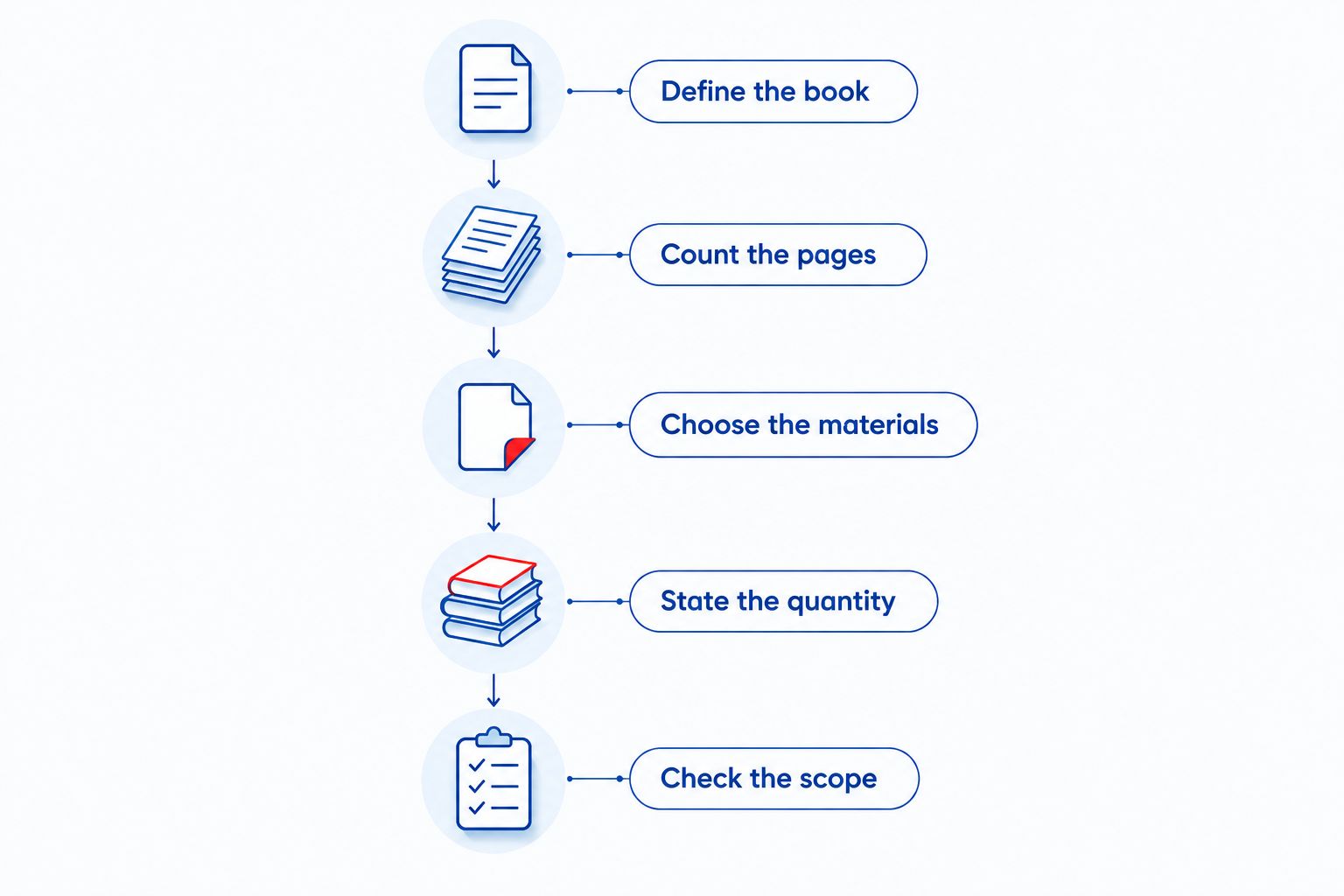
Keep a copy of the specification beside each quote. If a supplier proposes different paper or a different binding, record that change before treating the total as a direct comparison.
You can also separate necessary features from optional preferences. A workbook's usable writing area is necessary; a decorative cover treatment is a separate decision. That distinction helps you revise the project without removing the feature readers actually need.
A sheet printed on both sides carries 2 printed pages. Page count and sheet count are not interchangeable, so identify which one you are giving the printer. A PDF page is a document page, not automatically a separate physical sheet.
Intentional blank pages still occupy space in the finished book. Keep them in the file when they serve a purpose, such as separating sections or leaving room for notes. Explain single-sided printing requirements rather than assuming the printer will infer them.
Paper thickness also matters. The same page count on different stocks does not necessarily produce the same stack thickness, so do not choose a wire size from page count alone.
Let the printer match the binding size to the complete paper stack. Your job is to provide the final page count and materials accurately, not to guess the hardware specification.
Wire-O is better for a book that needs to lie flat and fold back, but that does not make it the right format for every project. Publishing Xpress offers 4 binding options: Wire-O, plastic coil, perfect bound, and saddle stitch.
This comparison is about use, not an unsupported ranking of their costs:
| Binding | Best for | Main advantage | Main limitation |
|---|---|---|---|
| Wire-O | Desk workbooks, reference books, and presentations | Lies flat and folds back | Exposed metal loops can bend under pressure |
| Plastic coil | Workbooks and manuals handled frequently | Flexible continuous coil allows pages to fold back | Exposed coil lacks a conventional printable spine |
| Perfect bound | Books intended for conventional shelf presentation | Glued spine creates a familiar book format | Does not provide the same fold-back movement |
| Saddle stitch | Slim booklets and event programs | Stapled folded sheets suit a compact booklet | Finished thickness limits suitable projects |
Choose Wire-O for page access, not because its name sounds more substantial. If the book will travel loose in a crowded bag, consider how the exposed binding will be protected.
For a novel or a shelf-oriented publication, a conventional spine serves a different need. Ask for the appropriate alternative using the same printing specification, then evaluate the format and quote together.
Start by protecting the features that make the book usable. For a training workbook, that means readable text, enough room to write, and a clear punched edge. Cutting those features defeats the reason to print the workbook.
For your 2026 specification, review these decisions before requesting a revised quote:
These are ways to simplify the specification, not promises of a particular saving. Ask the printer to price the revised version before assuming that a change improves your budget.
A lower per-copy figure does not justify ordering books you will not use. Consider the full order commitment and the likelihood that the content will need updating.
File preparation determines whether the punched edge interferes with text, page numbers, diagrams, or writing spaces. Keep essential content clear of that edge and use the printer's current margin and bleed requirements rather than borrowing settings from another binding method.
Review the cover and interior separately. A full-page cover image and a worksheet with narrow writing columns have different layout concerns, even when they belong to the same book.
Make a physical mock-up from your file before approving production. Turn the pages, fold the book back, and check whether your hand has enough room to write near the binding. A screen preview does not show that interaction.
Approve the layout you intend to print, not a draft that still needs restructuring. Confirm the proof process with the printer and resolve questions about page order, blank pages, and binding position before production begins.
How much does Wire-O binding cost in 2026?
Wire-O binding requires a project-specific quote based on quantity, page count, paper, trim size, covers, and printing choices. Confirm whether the figure covers binding alone or complete printed books, and check delivery and applicable tax.
Is Wire-O binding cheaper than spiral binding?
Compare matched project quotes rather than assuming either binding is cheaper. Keep the printing, paper, page count, covers, and quantity identical so the comparison answers the binding question.
Does a Wire-O binding quote include printing?
A Wire-O quote includes printing only when printing is part of the stated scope. Ask whether interiors, covers, trimming, punching, and assembly are included.
Can a Wire-O book fold all the way back?
Wire-O pages can fold back through 360 degrees. The format suits books used on a desk, but the exposed wire needs protection from crushing.
Can Publishing Xpress print a short-run Wire-O book?
Publishing Xpress offers short-run digital printing and Wire-O binding without large minimum order requirements. Confirm the current specifications for your finished book before placing an order.
Do blank pages count in a Wire-O book?
Intentional blank pages belong in the finished page count because they occupy space in the book. Include them in the file and explain any single-sided printing requirements.
What should I send when asking for a Wire-O quote?
Send the finished size, binding edge, page count, paper specification, color settings, cover details, and order quantity. Also identify the delivery destination and ask what the total excludes.
Before you accept a 2026 quote, test the page where readers will do the most work. Print it at finished size, mark the proposed punched edge, and try writing or following the instructions beside it.
If the binding area crowds the task, fix the layout before comparing totals again. The right quote is for a book readers can use comfortably—not just one that can be assembled.
© 2026 Publishing Xpress. All Rights Reserved.