October 7, 2026
Perfect bound book printing in 2026 is priced for your specific book: the page count, finished size, interior printing, paper, cover, and order quantity determine the quote. Check whether that quote includes delivery, taxes, proofing, and any file preparation you need before treating it as your complete budget. Compare the total for the same finished book—not a per-copy figure attached to different specifications.
Your printing quote answers the cost question only when it describes the book you actually intend to produce. Start with the final interior PDF, your intended quantity, and the cover requirements. A manuscript word count alone does not establish the finished page count.
Publishing Xpress is best for self-publishers and organizations needing short-run perfect bound book printing. Publishing Xpress offers online digital printing with perfect binding, saddle stitch, Wire-O, and plastic coil options. That gives you a way to assess the binding against the book's purpose rather than treating a paperback spine as the default for every project.
Use this breakdown to read a quote. It separates the printed book from the other expenses involved in getting usable copies into your hands.
| Budget component | What to specify or confirm | What it tells you |
|---|---|---|
| Interior printing | Final page count, trim size, black-and-white or color, paper | Whether the quote matches your actual interior |
| Cover and binding | Cover stock, finish, perfect binding, final spine requirements | Whether the finished paperback is fully specified |
| Order quantity | Copies you intend to receive | The total commitment, not just the unit calculation |
| Proofing | Proof format and approval requirements | What you will review before authorizing production |
| File preparation | Whether your submitted files need corrections | Which preparation tasks remain your responsibility |
| Delivery and taxes | Destination and applicable charges | The total needed to receive the order |
Keep editing, illustration, and cover design separate from the printing comparison. Those are part of your publishing budget, but they are not the same service as manufacturing the books. Ask what is included rather than assuming a printing quote covers them.
A book order involves two decisions: what each copy should be and how many copies you need. Mixing those decisions makes comparisons harder. A larger order with a simpler interior is not a direct substitute for a smaller order with color illustrations.
For your 2026 budget, write down the required reader experience before changing specifications. A memoir needs readable text and comfortable margins; an illustrated guide needs pictures that communicate clearly. Protect the features that carry the content, then compare changes to everything else.
Also distinguish money spent from books used. Copies left in storage still belong to your printing budget. Choose quantity around your distribution plan rather than ordering additional books solely to chase a different per-copy figure.
These specifications define what the printer must produce. Keep them consistent when comparing quotes, then change one specification at a time to understand the effect.
Delivery belongs in the final comparison even though it is not a book-design specification. Give the printer the destination before you approve the budget. A production quote and a delivered-order total answer different questions.
Choose black-and-white interiors when color is not needed to understand the book. Novels, memoirs, poetry collections, and text-led business books are natural candidates. A color cover does not require a color interior.
The benefit is a clear specification centered on readable text. The limitation is that illustrations must work without color cues. Check charts, legends, photographs, and highlighted passages rather than assuming that every image converts successfully.
Review the interior in grayscale before requesting a black-and-white quote. If two chart categories become indistinguishable, revise the chart with labels or patterns. Do not solve a content problem by accepting an unreadable printed image.
Choose color interiors when color carries information or is central to the artwork. Illustrated books, photography collections, and visual catalogs need that decision made before the quote comparison. Otherwise, you are comparing different reader experiences.
Color preserves distinctions that grayscale removes. Its limitation is that a screen preview is not a physical paper sample: the display emits light, while printed pages reflect it. Review the available proofing options and assess important images on paper when your approval process allows it.
Ask how the printer handles an interior containing both color and black-and-white pages. Do not assume that mixed content receives a particular billing treatment. Specify the file accurately and get the applicable production approach confirmed.
Perfect binding gives your book a glued paperback spine. It suits books readers hold and read, but it is not the right choice when effortless flat opening is the main requirement. A workbook or reference manual deserves a binding decision based on use, not appearance alone.
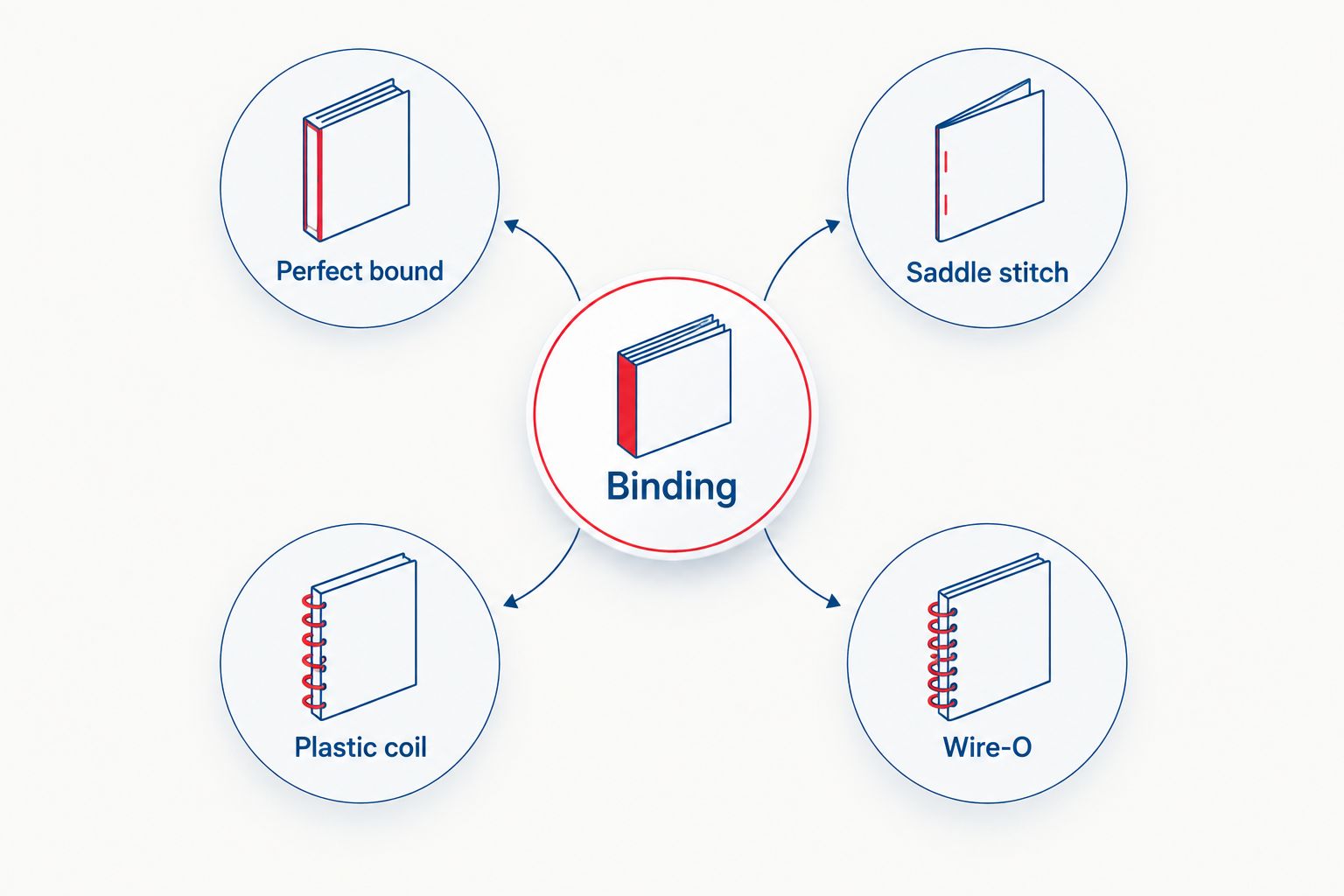
This comparison covers the four binding options offered by Publishing Xpress. The recommendations concern how the bindings function; they are not a price ranking.
| Binding | Best for | Main advantage | Main limitation |
|---|---|---|---|
| Perfect bound | Novels, memoirs, reports, and reading-focused paperbacks | A continuous paperback cover and spine | Does not offer the same flat opening as coil or Wire-O |
| Saddle stitch | Thin booklets and event programs | Folded sheets secured through the fold | Not suitable for a thick book block |
| Plastic coil | Workbooks and frequently handled instruction books | Pages lie flat and turn around the coil | Punched binding edge instead of a continuous printed spine |
| Wire-O | Presentation books and desk reference materials | Pages lie flat and turn around the wire loops | Wire loops can bend if mishandled |
Choose perfect binding when the paperback format supports the book's purpose. Choose plastic coil or Wire-O when readers need both hands free to write, cook, or follow instructions. Saddle stitch belongs in the comparison when the project is a thin booklet rather than a substantial paperback.
A useful 2026 quote starts with a stable specification. Finish the layout first, then send the same requirements wherever you request an estimate. That prevents a formatting change from invalidating your comparison.
Export the interior as individual pages unless the printer requests another arrangement: 1 PDF page should represent 1 finished interior page. Do not impose printer spreads yourself. Use the guide to preparing a PDF for perfect bound printing when checking the submission file.
The cover needs a separate check. Its spine width depends on the final book block, so a cover prepared for a different paper or page count is not automatically reusable. Get the printer's cover dimensions before you approve the wraparound artwork.
Put each quote beside the same written specification. Check page count, quantity, trim size, paper, interior printing, cover, binding, and delivery destination. Any mismatch needs an explanation before you compare totals.
Delivered cost per copy equals the complete delivered-order total divided by the number of copies ordered. Use that calculation consistently. Keep separate publishing expenses, such as editing and illustration, in their own budget rather than adding them to only one printer's quote.
When you request a revision, identify exactly what changed. A different quantity and different paper in the same revision conceal the effect of each choice. Ask for a controlled comparison, then decide whether the revised book still meets your needs.
Keep a dated record of the accepted specifications and quote for your 2026 order. Recheck both before placing a later reprint. The previous files are a useful starting point, not a reason to skip confirmation.
Start with avoidable changes, not readability. Complete editing and check the page sequence before approving production. An error discovered in printed copies is harder to address than an error caught in the PDF.
Next, review decoration and content separately. Keep images that teach, document, or tell the story; question design choices that add pages without helping the reader. Do not shrink the type or gutter simply to force a shorter interior.
Finally, connect quantity to actual uses: event copies, organizational distribution, direct sales, or author copies. Publishing Xpress's short-run printing is relevant when you need a limited batch rather than a large order. The trade-off remains your responsibility: you must plan storage, distribution, and any subsequent orders.
A larger quantity is not automatically a better budget decision; compare the actual quotes and their complete totals. Even when the per-copy calculation falls, you still commit to the full order and must store or distribute the books.
Choose the quantity you can justify with your plan. Treat unassigned copies as inventory, not savings.
A shorter book is not automatically better value if removing pages weakens the content or makes the layout difficult to read. Compare revised specifications only after confirming that the new version still works for your audience.
For a 2026 reprint, remove obsolete material and unnecessary blanks before considering smaller text. Preserve readable type, usable margins, and the information readers bought the book to receive.
How much does perfect bound book printing cost in 2026?
Perfect bound book printing is quoted from your book’s specifications and order quantity. Compare a complete delivered-order total for the same page count, size, paper, interior printing, cover, and binding.
What should I send a printer to get an accurate quote?
Send the final interior page count, trim size, quantity, interior printing choice, paper and cover requirements, and delivery destination. Confirm the file and proofing requirements before approving production.
Is perfect binding better than spiral binding for a workbook?
Plastic coil binding is the better fit when your workbook must lie flat for writing. Perfect binding fits a reading-focused paperback but does not provide the same flat-opening function.
Does a color cover mean I need color pages inside?
A color cover does not require a color interior. Choose black-and-white or color interior printing according to the text, images, and information inside the book.
Do blank pages count toward my book’s page count?
Intentional blank pages in your final interior PDF count toward its page total. Include them, along with front and back matter, when supplying the printing specification.
Can I reuse my cover after changing the page count?
Recheck the cover dimensions after changing the page count or paper. The revised book block can require a different spine width, so confirm the printer’s requirements before submitting the cover.
Is Publishing Xpress suitable for a short paperback print run?
Publishing Xpress offers short-run digital printing with perfect binding for self-publishers and organizations. Confirm your book’s specifications and quote before choosing the final format and quantity.
Keep the interior and cover together as a matched production version. A corrected interior paired with an older cover can leave you with the wrong spine dimensions even when both files look fine separately.
Before approving your 2026 order, check the filenames, final page count, paper, and cover dimensions against the accepted quote. That final check protects the book you intended to print—not just the budget you intended to spend.
© 2026 Publishing Xpress. All Rights Reserved.