August 2, 2026
Chambers of commerce and business associations print a member directory to prove who belongs, sell sponsor ad space, and hand new members something physical at orientation. This guide covers what to look for in directory printing for chambers of commerce, which binding type fits which membership size, and what to skip.
A membership directory is a sales document disguised as a reference book. Sponsors pay for ad pages inside it, prospects flip through it at the front desk, and staff hand it to every new member during onboarding. Print it wrong — flimsy cover, staples on a 90-page book, wrong trim size for a binder — and it looks like an afterthought instead of the association's flagship print piece.
Chambers and associations aren't printing novels. They're printing a working document that gets referenced weekly, sold against, and reprinted every 12 to 24 months as membership turns over. The binding and paper decisions that matter for a novel don't apply here; the decisions that matter are durability, lay-flat use, and how fast you can reprint when the roster changes.
This is for chamber of commerce staff, association executive directors, and membership coordinators producing an annual or biennial printed directory of 50 to 500-plus member listings, often bundled with sponsor ad pages. It's not for associations publishing a digital-only member portal — this is for the physical book that sits at the front desk, ships to members, and gets handed out at ribbon cuttings. If your directory doubles as a nonprofit annual report with financials and program summaries rather than a member roster, nonprofit directory printing covers that variant separately.
Membership directories grow. A chamber with 120 members this year might list 145 next year, and the binding choice has to survive that growth without a redesign. Saddle stitch tops out around 48-64 pages before staples start to strain; perfect binding handles 64 pages and up cleanly. Count your current roster, add projected new members, and size the binding to the number you'll hit in 2026, not the number you have today.
A directory that lives at a reception desk gets opened flat, dozens of times a day, by people scanning for one listing. Saddle stitch and perfect binding both close somewhat under their own weight; Wire-O and plastic coil open to 360 degrees and stay flat on a counter. If the directory's main job is desk reference rather than mail-out, lay-flat binding matters more than spine appearance.
Most chambers reprint annually around dues renewal season. If your association updates every 12 months, a quick-turn short run beats a large print run designed to last three years. Ask how fast a reprint can turn around before committing to a run size — a fast reorder window means you can order conservatively and reprint rather than over-ordering to avoid running out.
A directory gets handled, dropped, coffee-ringed, and stacked on other paperwork. Thin text stock curls and tears within months at a busy front desk. A heavier cover stock — coated or uncoated depending on whether photos run through the book — holds up through a full membership year without looking beat up by the time the next edition ships.
Most chamber directories carry paid sponsor pages that fund the print run. Where those pages sit — front section, back section, or interspersed by category — affects both how sponsors value the placement and how the binding handles mixed paper weights if ad pages run on heavier stock than the listings. Decide the ad layout before quoting the print job, not after.
A 200-member chamber doesn't need a 2,000-copy print run. Directory printing for chambers of commerce should scale to actual distribution: active members, a handful of prospect copies, and a small buffer for the front desk. No large minimum order requirement means you're not paying to print and store hundreds of extra copies that go stale the moment membership changes.
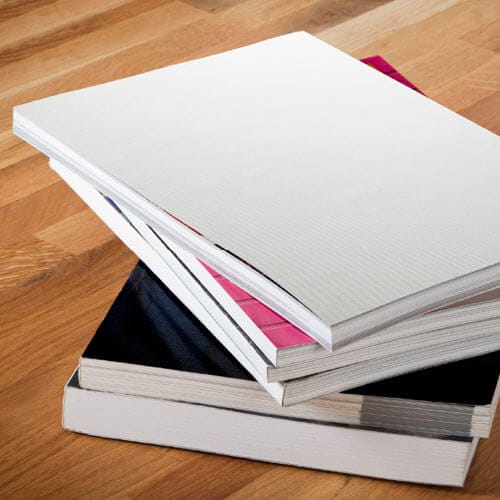
Perfect Bound — the safe pick. Once a directory clears 64 pages, short-run perfect binding gives it a printed spine and a book-like feel that reads as a reference document instead of a handout. It handles growth well: a 90-page directory this year and a 120-page directory next year use the same production process. Verdict: Buy for any chamber directory over 64 pages.
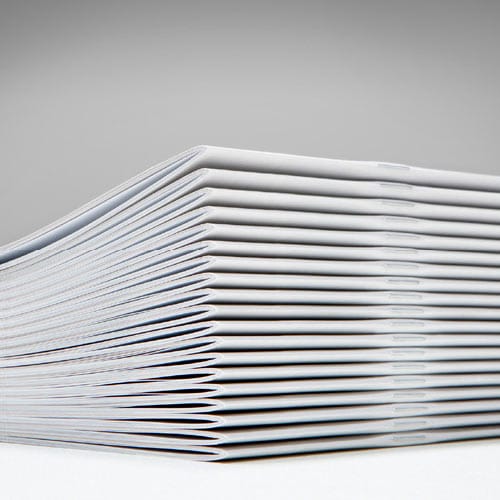
Saddle Stitch — the budget pick. For associations under 48 pages, saddle stitch is faster and cheaper to produce, and it's the standard choice for smaller chambers still building their sponsor base. Staples show through the spine on thicker books, which is exactly why it caps out where perfect binding takes over. Verdict: Buy for rosters under 48 pages, Skip past 64.
Wire-O — the lay-flat pick. A directory that opens flat and stays flat at a front desk or during a member-services call is worth the extra production step. Wire-O takes heavier paper stock better than coil and won't crack at the spine after repeated daily use through 2026 and beyond. Verdict: Consider for any directory that lives at a counter rather than in a mailer.
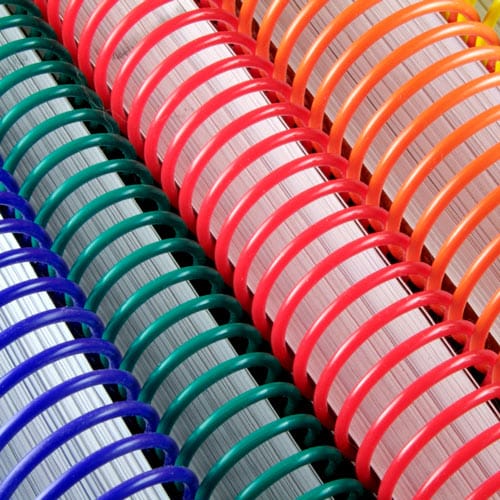
Plastic Coil — the flexible pick. Coil binding lay-flats like Wire-O at a lower production cost, but it's less durable on thick covers and the coil can deform if the book gets stacked under other paperwork for months. It's a reasonable middle option for associations testing a lay-flat format before committing to Wire-O. Verdict: Hold — fine for a first print run, worth upgrading to Wire-O on the second.
| Binding | Page range | Lay-flat | Cost tier | Best for | Verdict |
|---|---|---|---|---|---|
| Saddle Stitch | Up to 64 pages | Partial | Lowest | Small chambers, mailers | Buy under 48 pages |
| Perfect Bound | 64+ pages | No | Mid | Growing rosters, sponsor sections | Buy |
| Wire-O | Any | Full 360° | Higher | Front-desk reference | Consider |
| Plastic Coil | Any | Full 360° | Mid | First-run testing | Hold |
What’s the best binding for a chamber of commerce membership directory?
Perfect binding is the best fit once a directory clears 64 pages, since it holds a printed spine through growth. Saddle stitch works fine under 48 pages and costs less to produce.
How many pages should a business association directory be before switching from saddle stitch to perfect binding?
Switch around 64 pages. Staples on a saddle-stitched book start pulling through the spine past that point, especially with heavier ad pages mixed in.
Is Wire-O binding better than plastic coil for member directories?
Wire-O holds up better on directories that get opened flat daily at a desk, since it handles heavier cover stock without deforming. Plastic coil costs less and works fine for a lower-traffic first print run.
How much does directory printing for chambers of commerce cost in 2026?
Cost depends on page count, binding type, and quantity, with perfect binding and Wire-O running higher per-unit than saddle stitch. Get a quote against your actual member count rather than a round number to avoid overpaying for excess copies.
Can you print a small quantity of a membership directory without a large minimum order?
Yes — short-run digital printing lets a chamber order to its exact membership count instead of a bulk minimum. That matters most for associations under 200 members where a standard print minimum would waste half the run.
How often should a chamber reprint its member directory?
Most chambers reprint annually around dues renewal, since membership turnover makes a two-year-old directory noticeably out of date. A short reprint cycle also lets sponsor ad pages rotate more often.
What paper stock works best for a directory left on a front desk?
A heavier cover stock, coated if photos run through the interior, holds up to daily handling better than standard text weight. Thin stock curls and tears within a few months at a busy counter.
Should sponsor ad pages go in the front or back of a member directory?
Front-section placement gets more views since readers flip past it before reaching listings, which is why premium sponsor rates usually track to front placement. Back-section ads cost less and still get seen by anyone paging through the full book.
Print 10% over your active member count, not a round number pulled from last year's run. That buffer covers new-member handouts, replacement copies for the front desk, and prospect copies for chamber events — without leaving a few hundred stale directories in a closet when membership turns over before the next reprint.
© 2026 Publishing Xpress. All Rights Reserved.