August 6, 2026
A museum exhibit catalog has to survive gallery lighting, gift-shop handling, and a fixed opening date — custom book printing for museum exhibit catalogs means matching binding, paper stock, and turnaround to that pressure, not just picking whatever a general printer offers.
Exhibit catalogs run on a hard deadline — the opening date doesn't move because a print job slipped. They also carry more full-bleed photography per page than a typical trade book, which means paper stock and bleed setup matter more than they do for a novel or a workbook.
Most general commercial printers quote museum work like they'd quote a brochure run: big minimums, generic gloss stock, no binding guidance. Publishing Xpress prints short runs without forcing a large minimum order, which fits how museums actually order catalogs — tied to a single show, not an ongoing print schedule.
This guide is for curators, exhibit coordinators, and registrars at museums, historical societies, and university galleries producing a catalog for a specific exhibit — typically 100 to 500 copies, sold in the gift shop or handed out at member previews. It's also for nonprofit arts organizations and small galleries running a single-show catalog on a tight budget who don't want a print vendor built for 5,000-copy trade runs.
Artifact and installation photography is the entire point of an exhibit catalog — if the color shifts or the paper is too thin, the images look worse than they did in the gallery. Look for gloss or matte text stock in the 80-100 lb range built for photo-heavy interiors, not the 60 lb stock used in plain-text books.
A catalog gets picked up, flipped through, and set down in a gift shop dozens of times a day during a run. Perfect binding holds up on a shelf with a printed spine; wire-o and coil survive constant flat-opening for reference tables and checklists.
Full-page photography needs images to run past the trim edge, which requires 0.125 inches of bleed built into the file before it ever reaches the printer. A vendor that doesn't ask about bleed setup will hand back catalogs with unwanted white borders around key images.
Exhibit catalogs are tied to one show, not an ongoing print schedule, so a 2,000-copy minimum doesn't fit. Confirm the printer works in runs under 500 copies without inflating the per-unit cost past what a gift-shop price point can absorb.
An exhibit opening doesn't move for a slow proof cycle. Ask for a specific production timeline in days, not "a few weeks," and build in a buffer before the opening reception.
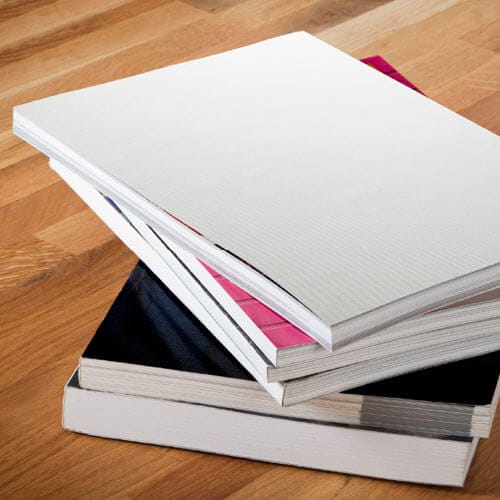
Perfect Bound Catalog — the safe pick. Works cleanly for catalogs from roughly 64 pages up through 300-plus, gives you a printed spine for shelf display, and reads as a real book rather than a handout. This is the format most exhibit catalogs sold in a gift shop should use in 2026. Verdict: Buy for main-exhibition catalogs meant to be sold, not just handed out. See perfect binding vs. saddle stitch for the full page-count breakdown.
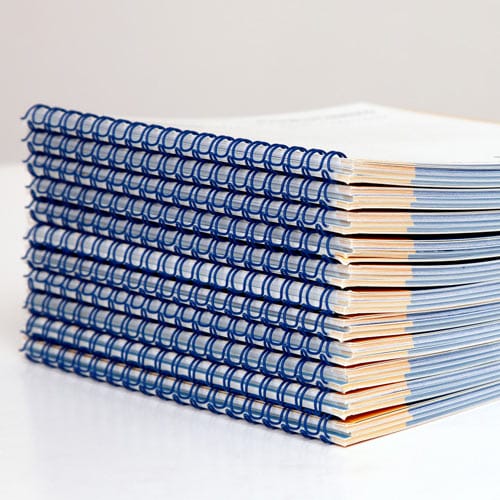
Wire-O Bound Catalog — the wildcard. Opens flat at 360 degrees with no gutter loss, which matters when a checklist page sits open next to a display case for weeks. It's the format architects use for portfolio books for exactly the same reason. Verdict: Buy for exhibits that pair the catalog with reference tables or loan checklists — see how Wire-O portfolio binding handles constant flat use.
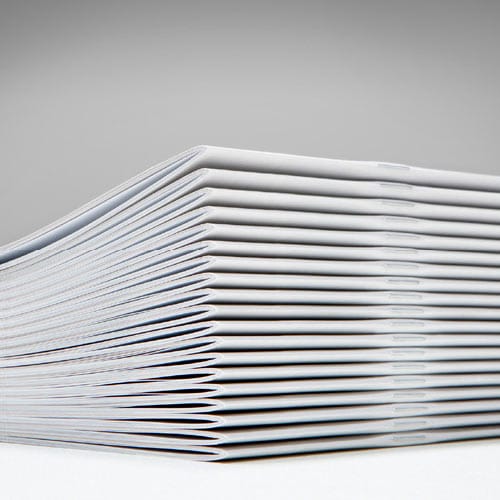
Saddle Stitch Booklet — the budget pick. Cheapest option for a single-room show, but it tops out around 64 pages before the spine starts to bow. Verdict: Consider for pop-up or one-gallery exhibits, Skip if the catalog runs past 80 pages.
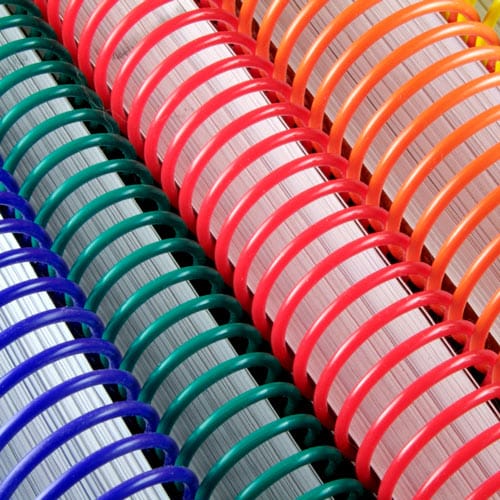
Plastic Coil Bound — the durable option. Takes daily flat-opening abuse better than perfect binding, which makes it a fit for docent training copies and internal reference sets. Verdict: Consider for staff and press-kit copies, Skip for retail sale — it reads as a manual, not a keepsake.
100 lb Gloss Text Stock — the photo-quality pick. Heavier stock than a standard trade book, built to hold ink density on full-bleed photography without show-through. Verdict: Buy whenever the catalog leans on large installation or artifact photos rather than dense text.
“If the catalog needs to lie flat next to the artifact checklist, wire-o wins every time.”
| Binding | Photo quality | Lays flat | Best page range | Retail-ready | Verdict |
|---|---|---|---|---|---|
| Perfect bound | High (gloss/matte stock) | No | 64-300+ pages | Yes | Buy |
| Wire-O | High | Yes, 360 degrees | 24-200 pages | Partial | Buy |
| Saddle stitch | Medium | No | Under 64 pages | Limited | Consider/Skip |
| Plastic coil | High | Yes, 360 degrees | 24-150 pages | No | Consider |
What’s the best binding for a museum exhibit catalog?
Perfect binding is the best default for museum exhibit catalogs over 64 pages sold in a gift shop, because it gives a printed spine and shelf presence. Wire-O is the better pick when the catalog doubles as a reference document that needs to lie flat.
Is wire-o better than perfect binding for exhibit catalogs?
Wire-O is better when the catalog is used as a working reference next to display cases, since it opens flat at 360 degrees. Perfect binding is better for catalogs meant primarily for retail sale in a gift shop.
How many copies should a museum order for an exhibit catalog?
Most single-show exhibit catalogs run 100 to 500 copies, tied to the length of the exhibit rather than an ongoing print schedule. Custom book printing for museum exhibit catalogs in 2026 works best with a printer that doesn’t force a large minimum order for that range.
What paper stock is best for exhibit catalog photography?
80 to 100 lb gloss or matte text stock holds ink density and color accuracy on full-bleed artifact and installation photography. Lighter stock under 60 lb causes show-through and dulls photo contrast.
Does an exhibit catalog need full bleed printing?
Yes, if any photo runs to the edge of the page, the file needs 0.125 inches of bleed built in before it reaches the printer. Skipping bleed setup produces unwanted white borders around full-page images.
Can a saddle stitch catalog work for a large exhibition?
Saddle stitch works cleanly under 64 pages but the spine starts to bow past that, making it a poor fit for major exhibitions with dense catalogs. Switch to perfect binding once the page count climbs past 80.
How long does exhibit catalog printing take before an opening?
Turnaround varies by binding and run size, so confirm a specific production timeline in days rather than a vague window. Build in a buffer of at least a week before the opening reception in case proofs need a revision round.
What binding is most durable for handling during a long exhibit run?
Plastic coil and Wire-O both handle repeated flat-opening better than perfect binding, which makes them a fit for docent copies and reference sets used daily. Perfect binding still holds up fine for retail copies handled less frequently.
The detail most curators miss isn't the binding — it's the bleed setup on the file before it ever reaches a printer. A catalog with a dozen full-bleed installation shots and no bleed margin built in comes back with visible white slivers at every trim edge, and that's a reprint, not a quick fix.
© 2026 Publishing Xpress. All Rights Reserved.