August 1, 2026
Food bloggers and influencers turn a blog's worth of recipes into a printed cookbook to sell at markets, ship to email subscribers, or fund a Kickstarter — the binding you choose decides whether that book survives a kitchen counter or falls apart by the third use.
A food blogger's cookbook gets opened flat on a counter next to a mixing bowl, not read cover to cover on a couch. That's a different job than a novel, and it's why generic advice on cookbook printing for recipe collections undersells the binding decision.
In 2026, most self-published food creators skip traditional publishers and go straight to a short-run printer, which means the binding, paper stock, and trim size choices land entirely on the author. Get the binding wrong and readers photograph a book that won't stay open — bad for the recipe, worse for your brand.
This is for food bloggers, Instagram and TikTok food creators, and recipe-focused YouTubers turning a content library into a physical cookbook — whether that's a 40-recipe zine sold through a link in bio or a 150-page hardcover-style book funded through a Kickstarter campaign. You've got photography assets, a following that already trusts your recipes, and a print run that's probably somewhere between 100 and 2,000 copies, not 10,000.
A cookbook that snaps shut mid-recipe is a cookbook nobody re-buys as a gift. Binding types that open to a full 180 degrees — Wire-O and plastic coil — matter more here than almost any other spec, because the book gets used one-handed while the other hand is stirring something.
Food photography sells the recipe before anyone reads the ingredient list. Full-bleed printing means your hero shots run edge to edge with no white border cutting off the plate, and color accuracy means the mole sauce doesn't print orange instead of deep red.
Standard 60 lb. text paper feels thin and stains fast. A 100 lb. gloss or matte text stock holds up to a stray drip of olive oil and keeps photos looking sharp instead of muddy, which matters more in a cookbook than in almost any other book category.
Most food creators don't know if they'll sell 200 copies or 2,000 until the book is live. A printer with no large minimum order requirement lets you test demand with a small batch and reorder once you see how fast it moves, instead of sitting on a garage full of unsold stock.
A cookbook tied to a holiday season, a Kickstarter fulfillment date, or a book tour stop has a hard deadline. Confirm turnaround before you commit to a binding type — some formats, like case-bound hardcovers, take meaningfully longer to produce than Wire-O or coil.
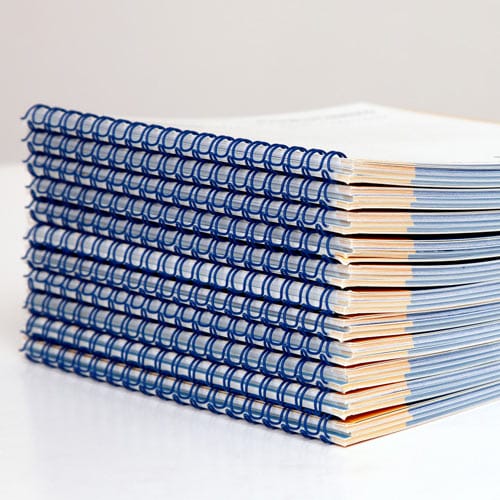
Wire-O uses a double-loop metal wire through punched holes, and it's the binding most kitchen-counter cookbooks actually need. The pages sit fully flat at any point in the book, even the first and last spread, which a perfect-bound spine can't match. It works well from around 32 pages up through a few hundred, covering most food blogger cookbook lengths. Check the Wire-O printing for cookbooks breakdown for page count and paper stock pairings. Verdict: Buy for any recipe book over 60 pages where lay-flat use matters more than a bookstore-shelf look.
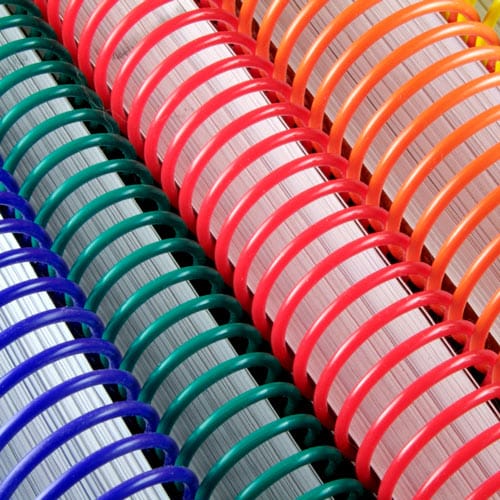
Plastic coil does the same lay-flat job as Wire-O at a lower per-unit cost, which makes it the pick for a first print run when you're not yet sure how many copies you'll sell. It's slightly less durable over years of heavy daily use than Wire-O, but for a 6-12 month shelf life it holds up fine. See plastic coil binding for recipe books for spec details. Verdict: Buy for a first-run cookbook under 500 copies where budget matters more than long-term durability.
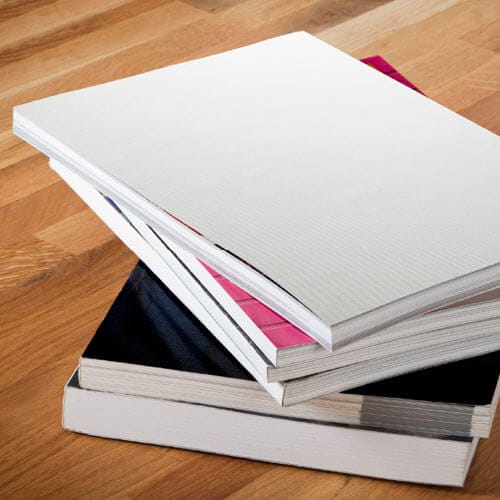
Perfect binding glues pages to a flat spine, giving the polished, squared-off look readers expect from a bookstore cookbook. It needs at least 32 pages to hold a spine properly, and it won't lie fully flat the way Wire-O or coil does — a real tradeoff if your recipes run across a two-page spread. Verdict: Buy if you're pitching the book to shops or gift markets and the shelf-facing spine matters more than kitchen-counter use.
Saddle stitch staples folded sheets along the spine, and it's the cheapest, fastest option for a short recipe zine or a seasonal sampler you're giving away or selling for a few dollars. It caps out around 80 pages before the spine loses its shape and pages start falling loose. Full binding limits are in the saddle stitch binding guide. Verdict: Consider it only for a 20-60 page seasonal mini-cookbook, and Skip it for anything closer to a full-length book.
“If the cookbook won’t lie flat next to the stove, the binding failed before the first recipe gets cooked.”
| Binding | Lies Flat | Best Page Range | Best For | Verdict |
|---|---|---|---|---|
| Wire-O | Yes, fully | 32-300+ pages | Everyday kitchen use | Buy |
| Plastic coil | Yes, fully | 32-250 pages | First print run on a budget | Buy |
| Perfect bound | No | 32+ pages | Retail and gift shelves | Buy for retail |
| Saddle stitch | Partial | 20-80 pages | Seasonal mini-cookbooks | Consider |
Publishing Xpress runs all four binding types through the same short-run cookbook printing process in 2026, so switching formats between your first proof and your reorder doesn't mean starting over with a new vendor.
What’s the best binding for a cookbook printed by a food blogger?
Wire-O binding is the best choice for most food blogger cookbooks because it lies fully flat at any page, which matters for a book used one-handed in a kitchen. Plastic coil is the close budget alternative with the same lay-flat function.
Is Wire-O better than plastic coil for a cookbook?
Wire-O holds up better over years of heavy daily use, while plastic coil costs less per copy and works fine for a book with a shorter expected shelf life. Both lie flat, so the choice usually comes down to budget and how long you expect the book to stay in rotation.
How many recipes fit in a 100-page cookbook?
A 100-page cookbook typically holds 50-70 recipes when each recipe gets a full page or a two-page photo spread. Denser layouts with multiple recipes per page can fit more, but food bloggers usually favor the photo-heavy format.
Can you print a full-color cookbook affordably in a small run?
Yes, short-run digital printing makes full-color cookbook printing affordable without the large minimum orders traditional offset printing requires. A run of 100-500 copies is realistic for testing demand before committing to a bigger reorder.
What trim size works best for a recipe book?
An 8.5 x 8.5 inch square trim is a common cookbook size because it fits full-page food photography without wasted margin space. Standard 8.5 x 11 also works well for recipe books with denser text layouts.
Is perfect binding good for a coffee-table style cookbook?
Perfect binding works well for a coffee-table cookbook meant for display and gifting rather than daily kitchen use, since it gives a polished, bookstore-style spine. It needs at least 32 pages to hold the glued spine properly.
Should a self-published cookbook use saddle stitch binding?
Saddle stitch works only for shorter cookbooks under about 80 pages, like a seasonal recipe zine or a giveaway sampler. Past that page count the stapled spine starts losing pages within months of regular use.
The binding choice most food creators skip researching — paper finish — changes how the book photographs for your own marketing. Gloss text paper makes food photography pop with more saturated color, but it also picks up glare under studio lights when you're shooting the finished book for Instagram; matte text trades a little photo punch for a flat-lay shot that reads cleaner on camera.
© 2026 Publishing Xpress. All Rights Reserved.