October 9, 2026
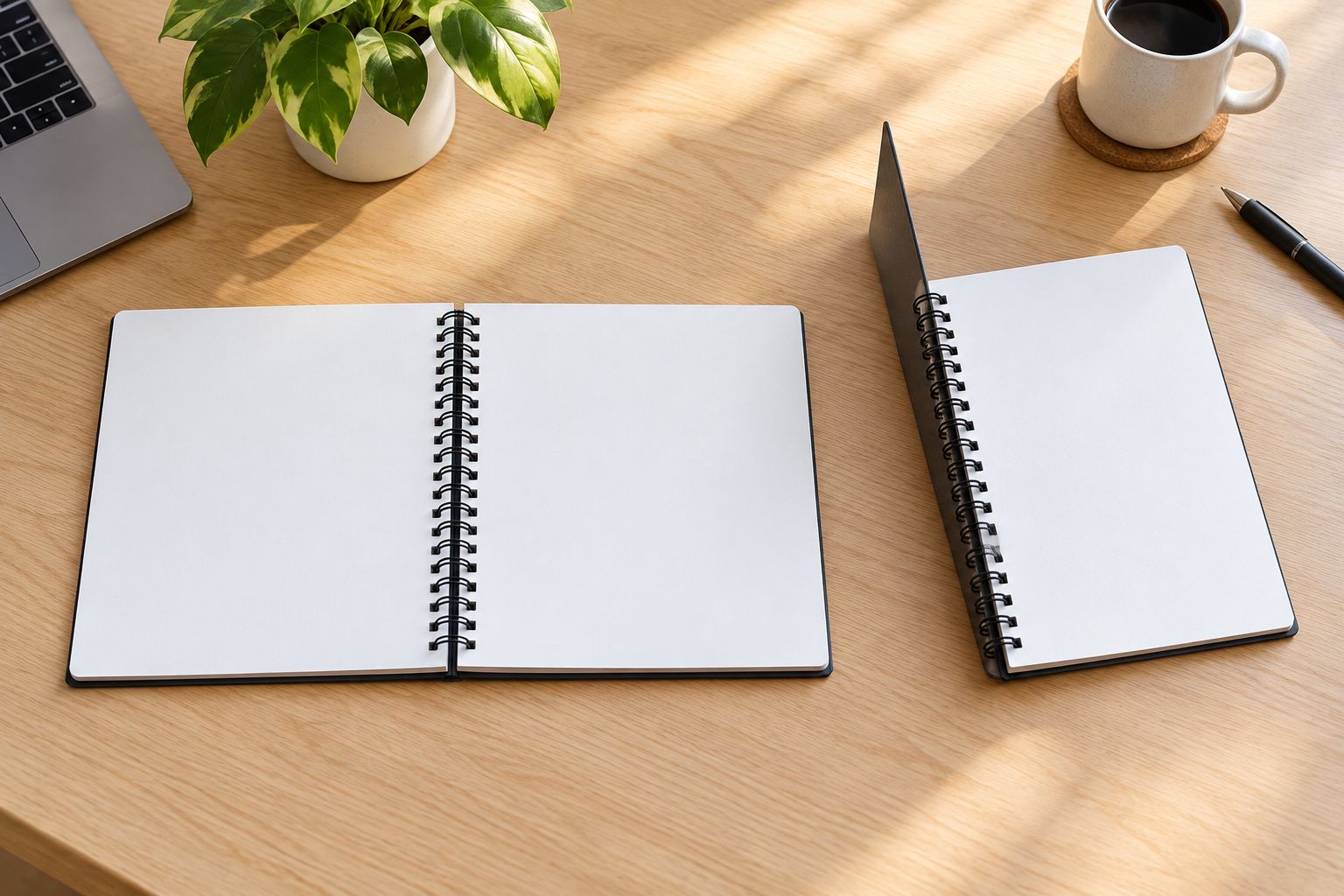
Yes, Wire-O bound books can lie flat at 180 degrees, and their pages can fold back through 360 degrees so you can use one page at a time. The wire still occupies space along the binding edge, so flat opening does not mean an uninterrupted surface across the center; curled paper or damaged wire can also prevent an otherwise flat-opening book from resting evenly.
Wire-O binding allows an open spread to rest flat without bending a glued spine. Each sheet turns around the paired wire loops through holes along its binding edge. The sheets move independently rather than pulling against an adhesive-bound book block.
That makes Wire-O useful when you need to read instructions while working, write answers in a workbook, or display a page on a desk. Before finalizing your layout, review how to prepare files for Wire-O binding so the punched edge does not interfere with your content.
The distinction is between a book that opens flat and a spread that is visually continuous. Wire-O delivers the former. It does not deliver the latter, because the holes, wire, and separation between sheets remain visible.
| Binding | Flat-opening behavior | Best for | Main limitation |
|---|---|---|---|
| Wire-O | Opens flat; pages also fold back | Desk workbooks, reference manuals, presentation books | Exposed wire can bend; punched margins interrupt spreads |
| Plastic coil | Opens flat; pages also fold back | Planners and workbooks carried between locations | Coil and holes occupy the binding edge |
| Standard perfect binding | Does not reliably stay flat without support | Novels and text-focused books with a printable spine | Glued spine resists flat opening |
| Saddle stitch | Can open flat, particularly in thinner booklets | Event programs and brief instructions | Folded construction limits suitable book thickness |
These are construction differences, not a ranking of print quality. For a 2026 book project, choose the binding around what your reader needs to do with the open pages, then plan the layout around that construction.
A book that keeps closing interrupts the task it is meant to support. In a recipe book, you need both hands for cooking; in a course workbook, you need a stable writing surface. Flat opening solves that practical problem.
But binding alone does not make a book easy to use. An answer box placed against the wire remains awkward, even when the sheet rests flat. Choose flat-opening construction and a usable binding margin together.
At 180 degrees, a Wire-O book opens with facing pages spread across the work surface. You can read both pages without continually holding the book open. The wire acts as the turning point rather than a stiff spine that needs to be pressed down.
An open spread contains 2 facing pages, but those pages do not become one continuous sheet. Each has its own punched edge. Keep that separation in mind when you place charts, diagrams, or photographs across a spread.
For instructions, put each essential diagram on a single page whenever possible. A line that crosses the binding must visually jump across the gap, which makes it harder to follow. The same issue applies to a recipe whose ingredient list ends on one side and whose first instruction begins too close to the wire.
Best for: readers who need both facing pages visible while their hands are busy. The trade-off is desk space: an open spread takes more room than a book folded back to show one page.
Wire-O pages can rotate through 360 degrees so the pages you are not using sit behind the current page. This fold-back position reduces the book's footprint and lets you focus on a single sheet. It is useful at a crowded desk, a workbench, or a kitchen counter.
Fold-back use is different from pressing an open spread flat. You are rotating the sheets around the wire, not forcing a spine to flex. Turn pages gently and stop if a sheet catches rather than pushing it past resistance.
A folded-back book still has thickness underneath the page you are using. Near the beginning or end, that stack changes the height of the writing surface. Flat-opening behavior does not mean every page sits directly against the tabletop.
Best for: readers working from one page in a limited space. Keep content self-contained if fold-back use is central to your 2026 design; a worksheet that depends on the facing page loses convenience in this position.
Wire-O construction supports flat opening, but the finished book still depends on its materials and assembly. Check these factors when an open book does not rest or turn as expected:
Do not treat a difficult page turn as a reason to push harder. First look for a caught sheet, distorted loop, or damaged hole. Pressure can turn a small handling issue into torn paper.
If completely even presentation is essential, inspect a representative bound sample with the paper and cover construction you intend to use. A screen preview shows placement, but it cannot demonstrate how the finished book rests on a table.
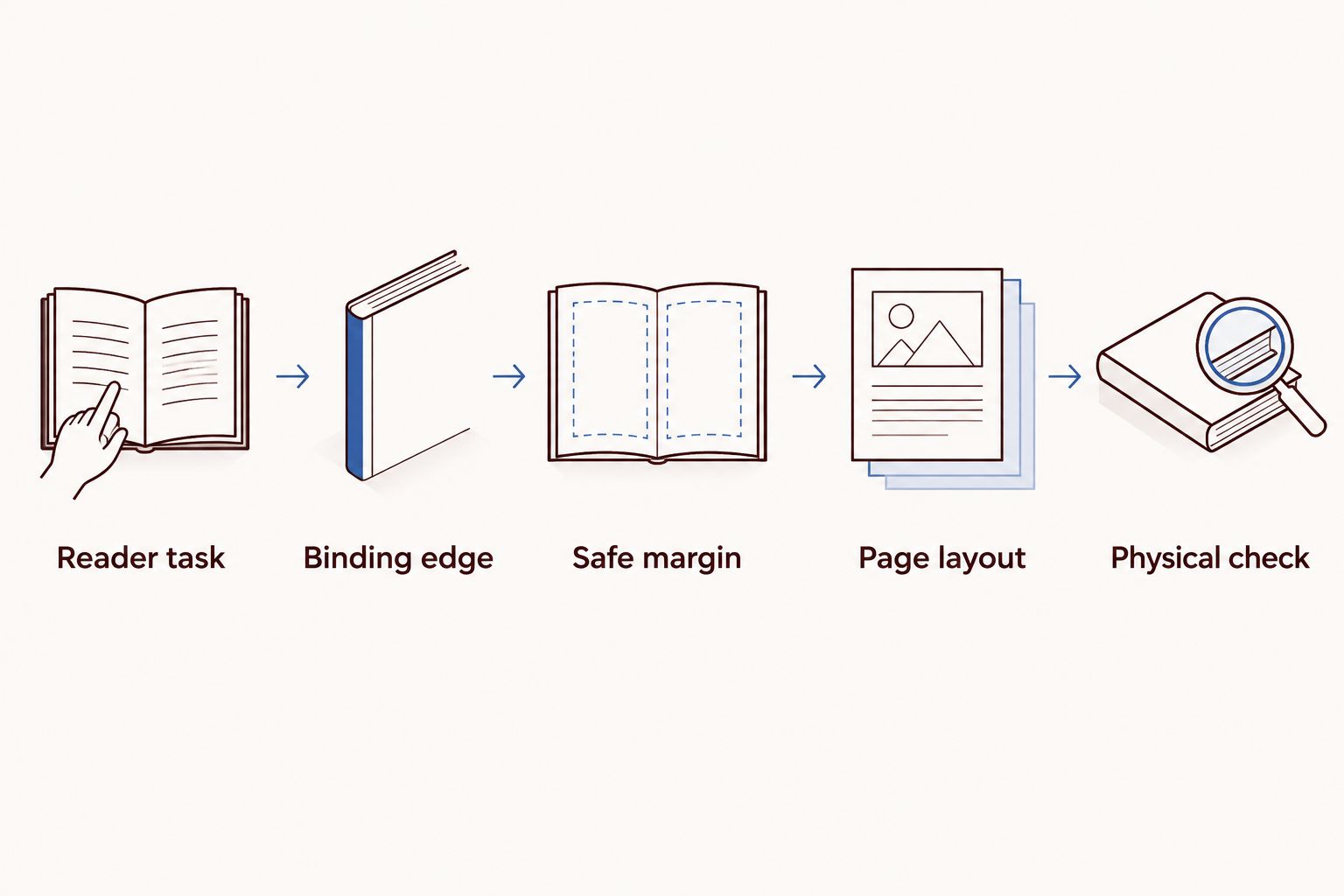
Design the page around the reader's task, not just the binding's ability to open. For a 2026 workbook or manual, follow this sequence before you approve the print file.
Do not copy a margin measurement from an unrelated book and assume it fits. Punch position and production requirements need to match the job. A generous-looking margin on screen is not proof that a handwritten answer will be comfortable next to the wire.
A caption needs to stay readable; an answer space also needs room for a hand and pen. Place writing boxes away from the punched edge and leave enough room for the intended response. Do not run ruled lines straight into the wire.
Check both sides of the spread. A writing area that feels comfortable on a right-hand page can feel different on a left-hand page because the binding sits beside the writer's hand.
Wire-O lets you view an illustration without spine curvature hiding its inner edge. However, a photograph spanning facing pages still crosses separate sheets and a binding gap. Faces, small labels, and precise alignment details belong away from that interruption.
Use single-page artwork when the reader must see the entire image without a break. Reserve spread-based compositions for designs that tolerate separation at the center.
Wire-O and plastic coil both support 180-degree flat opening and 360-degree fold-back use. Neither wins simply because it lies flat. The useful comparison is the binding material and how you expect the book to be handled.
Wire-O uses paired metal loops; plastic coil uses a continuous plastic spiral. The exposed metal loops can become misshapen under pressure, while plastic coil is flexible. Both require punched pages and adequate clearance beside the binding.
For a desk-based workbook, Wire-O is a suitable choice. For a workbook repeatedly packed into a crowded bag, consider how the exposed binding will be protected and compare a physical sample of each construction. Choose for handling conditions, not for a flat-opening advantage both formats share.
A standard perfect-bound book does not reliably open to 180 degrees and stay there without support. Its pages attach to a glued spine rather than rotating individually around wire loops. Pressing it down is not equivalent to choosing flat-opening construction.
Perfect binding serves a different purpose: it gives a book a conventional paperback form and a printable spine. That is useful for a novel or text-focused title, but it does not solve hands-free reading in the same way.
For a 2026 cookbook or workbook, make staying open an explicit requirement before selecting the binding. If the project also needs an uninterrupted image spread, discuss that separate requirement rather than assuming any flat-opening format removes the center gap.
Publishing Xpress Wire-O book printing suits authors and organizations creating short-run books for hands-free desk use. Wire-O is one of the company's stated binding options, alongside perfect binding, saddle stitch, and plastic coil. The company also prints black-and-white and color documents.
When discussing your project with Publishing Xpress, describe how readers will use it: open across a desk, folded back during exercises, or carried between sessions. Ask for the file requirements that apply to your chosen paper, cover, and binding.
The benefit of Wire-O is practical page movement. Its limitation remains the exposed wire and interrupted binding edge; selecting a printer does not remove those construction trade-offs.
Can Wire-O bound books lie flat without being held open?
Yes, Wire-O bound books can open flat at 180 degrees without the resistance of a glued spine. Curled sheets or damaged wire can still prevent the finished book from resting evenly.
Can you fold a Wire-O book all the way back?
Yes, Wire-O pages can rotate through 360 degrees for single-page use. Turn sheets gently around the loops rather than forcing a page that catches.
Does Wire-O binding make a continuous flat spread?
No, Wire-O binding leaves a gap, punched margins, and wire between the 2 facing pages. Keep essential text and precise image details away from that interruption.
Is Wire-O binding good for a workbook you write in?
Yes, Wire-O binding supports a stable, flat-opening workbook. Keep answer areas away from the punched edge so the wire does not crowd your hand.
Is plastic coil better than Wire-O for lying flat?
Plastic coil and Wire-O both lie flat and allow pages to fold back. Choose between them based on handling, binding material, and the finished sample rather than flat opening alone.
Does Publishing Xpress offer Wire-O book printing?
Yes, Publishing Xpress offers Wire-O binding for printed books and documents. Confirm the file requirements for your particular project before submitting the final layout.
For your 2026 print project, test the page readers will find hardest to use—not just the cover or the middle spread. Choose a worksheet near the front, a dense diagram beside the wire, or a recipe near the back, then perform the actual task.
A book passes the useful-flatness test when you can use its content comfortably, not merely when it stays open. That check catches cramped writing areas and interrupted illustrations that a flat-opening binding cannot fix.
© 2026 Publishing Xpress. All Rights Reserved.