August 2, 2026
Booklet printing for insurance agencies isn't about picking a pretty cover — it's about matching binding, page count, and paper stock to a document clients actually keep. This guide breaks down what to look for, which format wins for which use case, and what to skip before you send a file to print in 2026.
Insurance agencies hand clients dense material: coverage limits, exclusions, claims steps, renewal terms. A client guide printed wrong — a flimsy staple job on a 90-page policy explainer, or an oversized perfect bound spine on a 20-page summary — reads as sloppy before anyone opens page one.
Clients keep leave-behinds that look built to last and file the ones that don't. In 2026, agencies producing group benefits handbooks, Medicare supplement guides, or commercial umbrella explainers need binding decisions tied to two variables: how many pages, and how often the content changes. Get those two right and the format question mostly solves itself.
This guide is for agency owners, marketing coordinators, and account managers who hand clients a printed guide at binding, renewal, or open enrollment. It's for independent agencies producing carrier comparison booklets, group benefits handbooks for HR contacts, Medicare supplement explainers, and claims-process guides that need to survive a full policy year in a glovebox or filing cabinet.
If your booklet gets reprinted every time a rate table changes, the binding choice matters as much as the content inside it — see how other professional-services firms handle the same problem in informational booklet printing for businesses.
Insurance guides get pulled out of drawers, glove boxes, and binders — not read once and tossed. A stapled booklet past 60 pages splits at the fold within months; a coil or Wire-O bound guide takes the same handling and still opens flat two years later. Match the format to how long the piece needs to survive, not how it looks on delivery day. Perfect bound vs saddle stitch breaks down where each format fails.
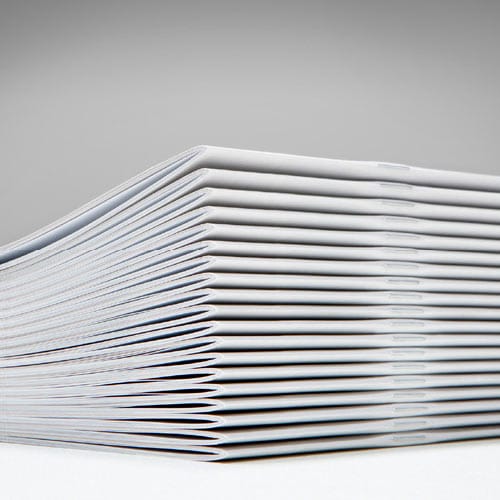
Saddle stitch tops out for practical use around 64 pages — past that the spine gets bulky and pages start to gap. A 20-page benefits summary looks thin in a perfect bound spine and belongs in saddle stitch instead. Count actual pages before picking a binding, not after the file's already built.
Open enrollment and January renewals hit every agency on the same calendar, and a printer with a 100-copy job stuck behind a 10,000-copy order will miss your deadline. Ask about short-run queue priority before renewal season starts, not during it.
Agency booklets rarely need 5,000 copies — a 40-agent office might need 60 client guides a quarter. A printer that forces a large minimum wastes budget on excess inventory that's outdated by the next rate change. Publishing Xpress prints booklets without a large minimum order requirement, which matters more to a 12-branch agency than to a publisher running a single 2,000-copy print run.
A thin 60 lb. text stock feels cheap under a client's thumb and lets ink show through on dense tables; 70-80 lb. uncoated or a light gloss holds color better on comparison charts and rate grids. Clients skim numbers, not cover photography — put the stock budget where the eyes actually go.
Full-color runs cost more per copy, but a black-and-white claims-process guide with no charts prints fine without it. Reserve color budget for pieces with comparison tables or carrier logos; skip it for plain-text FAQ booklets.
Spec that matters: staple binding holds up to roughly 64 pages before the spine gets unwieldy. A 24-page Medicare supplement summary or an 8-page auto policy overview fits here at the lowest per-copy cost of the four options. Buy for anything under 50 pages that gets replaced every renewal anyway.
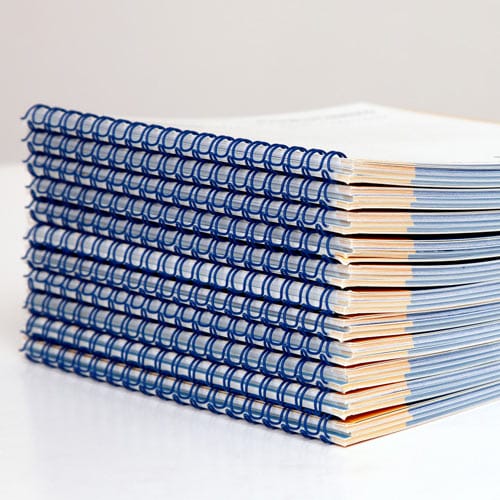
Spec that matters: pages open 360 degrees flat and the wire spine survives repeated flipping without cracking. Agencies producing a group benefits handbook or multi-carrier comparison guide that changes every open enrollment get more mileage from Wire-O than perfect bound — the same year-over-year update problem shows up in financial advisor client guides. Buy for any guide over 40 pages that changes annually.
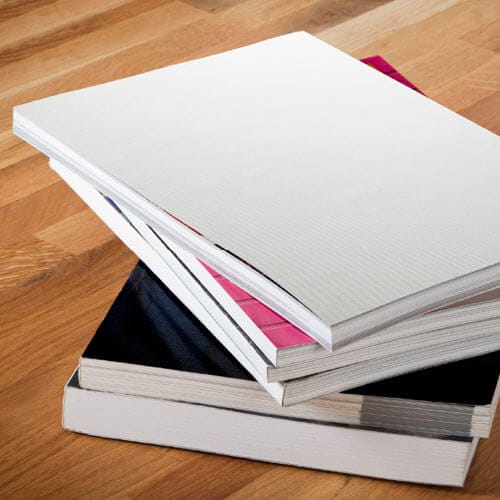
Spec that matters: a printed spine wide enough to read a title on, which only reads well past roughly 80-100 pages. A full commercial policy handbook or a 120-page claims manual gets the bookstore-quality look here, the same weight professional firms use for law firm client guides. Consider it for dense reference documents; Skip it under 60 pages — the spine looks empty.
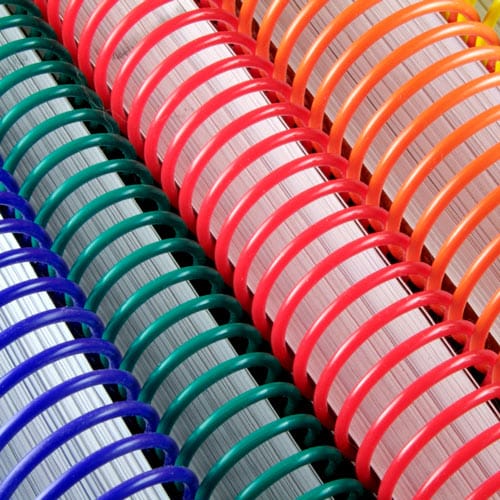
Spec that matters: coil binding lies flat and survives a hole punch better than Wire-O, which matters for agent training booklets that live in a 3-ring binder next to other materials. Buy for internal onboarding guides; Skip it for client-facing pieces where Wire-O reads more polished.
“A 20-page benefits summary in a perfect bound spine looks thinner than it is — saddle stitch fixes that instantly.”
| Binding | Best Page Range | Update Frequency Fit | Verdict |
|---|---|---|---|
| Saddle Stitch | Up to 64 pages | Annual reprint | Buy |
| Wire-O | 40-150 pages | Every renewal cycle | Buy |
| Perfect Bound | 80+ pages | Rarely updated | Consider |
| Plastic Coil | 20-120 pages | Internal/training use | Buy (internal only) |
What’s the best booklet printing for insurance agencies in 2026?
Saddle stitch works best for coverage summaries under 50 pages, and Wire-O is the pick for client guides updated every renewal cycle. Perfect bound only makes sense once a handbook passes 80-100 pages.
Is Wire-O better than perfect bound for client guides?
It depends on page count and update frequency, not preference alone. Wire-O suits 40-150 page guides that change annually, while perfect bound suits static handbooks over 80 pages.
How many pages before saddle stitch stops working?
Saddle stitch is practical up to roughly 64 pages. Past that point the spine gets bulky, pages gap at the fold, and the staple can pull through with repeated handling.
Can I order under 100 copies of a client guide?
Yes — Publishing Xpress prints booklets without a large minimum order requirement, so a 60-copy branch order doesn’t carry the same setup penalty as a 500-copy run.
What paper stock works best for coverage comparison charts?
A 70-80 lb. uncoated or light gloss stock holds ink better on rate tables and comparison grids than a thinner 60 lb. text sheet. Thin stock lets ink show through and makes dense charts harder to read.
Should agent training booklets use the same binding as client guides?
No — plastic coil works better for internal materials that live in a 3-ring binder, while client-facing guides read more polished in Wire-O or saddle stitch depending on page count.
How often should insurance agencies reprint client guides?
Reprint whenever rates, coverage terms, or carrier partnerships change, which for most agencies means every renewal cycle. That update frequency is the main reason Wire-O outperforms perfect bound for these documents.
Does color printing cost more for insurance booklets?
Yes, full-color runs cost more per copy than black-and-white. Reserve color for pages with comparison charts or carrier logos and print plain-text sections in black-and-white to control cost.
The binding decision most agencies get wrong isn't the spine — it's using the same page count template for every product line. A 20-page auto policy summary and a 90-page commercial umbrella handbook shouldn't share a format: print the short one saddle stitch and save the coil or perfect bound spine for the document that actually needs to survive a full year on a shelf.
© 2026 Publishing Xpress. All Rights Reserved.