August 3, 2026
Community rules booklets take a beating: they get mailed to every household, stuffed in binders, argued over at annual meetings, and reprinted every time the board approves an amendment. Booklet printing for HOA handbooks has to survive that cycle without falling apart or costing a fortune per copy.
An HOA handbook isn't a marketing piece — it's a reference document a homeowner pulls out during a fence dispute or a parking complaint. If the binding cracks after six months of glovebox storage, the association reprints early, and that's money the board didn't budget for. Booklet printing for HOA handbooks in 2026 needs to account for update frequency, mailing costs, and the fact that most communities run under 300 copies a year.
Publishing Xpress works with HOA boards and property managers on exactly this kind of short-run job, without pushing associations into print quantities they don't need.
This guide is for HOA board members, community managers, and property management companies who print or reprint rules and regulations booklets, CC&R summaries, welcome handbooks, or architectural guideline booklets for 40 to 1,000 homes. If your community amends its rules once a year and mails updates to every household, the format decisions below directly affect your printing budget and your board's sanity.
HOA handbooks get folded, mailed, and stuffed into binders next to insurance paperwork, so the binding has to hold up without the reader babying it. Saddle stitch is durable and cheap up to roughly 64 pages; past that, the staples strain and pages start to separate at the spine. For handbooks that run longer, with a full CC&R appendix or architectural guidelines attached, perfect binding versus saddle stitch is the decision that determines whether the booklet survives its first year in circulation.
A 5.5" x 8.5" or 8.5" x 11" booklet changes postage cost, envelope compatibility, and whether a homeowner can actually find the thing in a drawer full of HOA mail. Boards that skip this step end up choosing a size after the print run is already ordered, which is backwards. Choosing booklet size for your project before you finalize layout saves a reprint later.
A 90-home HOA doesn't need a 2,500-copy print minimum. Short-run digital printing lets a board order 100 copies this year and 120 next year as new homeowners move in, without eating the cost of a warehouse full of outdated rules booklets.
Most of an HOA handbook is black-and-white text — rules, bylaws, contact info. But plat maps, architectural color-swatch pages, and community logos usually need color to stay legible. Printing the whole booklet in color to cover four pages of maps wastes money; a mixed black-and-white-with-color-insert approach usually wins on cost.
Boards amend rules more often than they'd like to admit — a new fence policy here, a pet rule update there. A printer that turns around a short run in days instead of weeks matters when the annual meeting is already on the calendar.
Any booklet with the association's name on it needs to come out right the first time. A satisfaction guarantee on the print run matters more for a governing document than it does for a flyer, because a bad print run of rules booklets means every household gets the wrong version mailed twice.
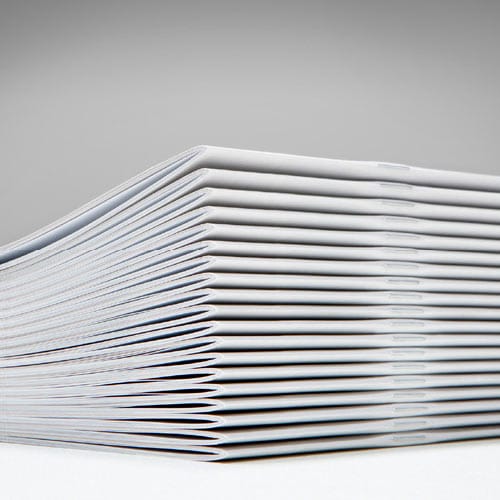
Saddle Stitch Printing — the standard pick. Works cleanly up to about 64 self-cover pages, which covers most single-phase HOA rules booklets, and short-run digital pricing typically lands under a few dollars per copy at 100-copy quantities in 2026. Verdict: Buy for any handbook under 60 pages.
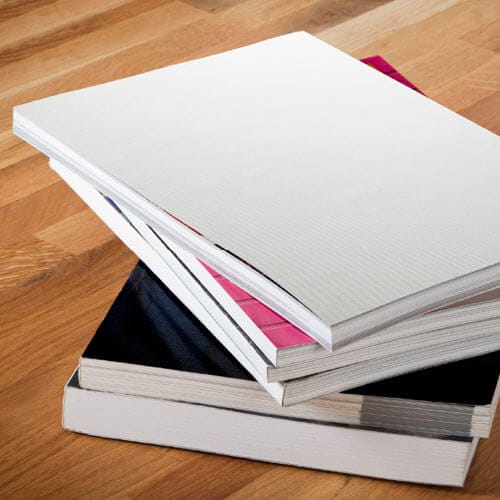
Perfect Bound Printing — the polished pick. Once a handbook crosses 80 pages with bylaws, CC&Rs, and an amendment log bound together, perfect binding gives it a flat spine that reads like a real reference book instead of a stapled packet. Verdict: Consider for master documents that combine multiple governing pieces into one binder-style handbook.
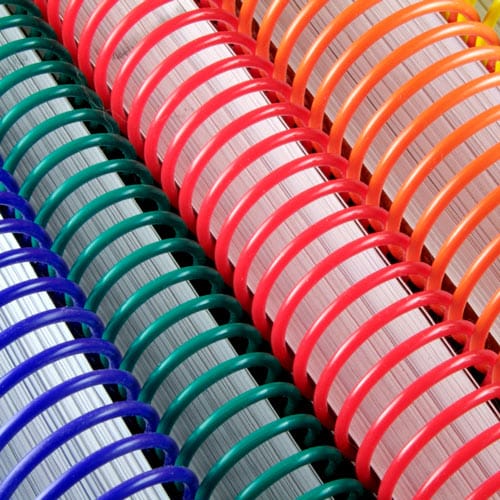
Plastic Coil Printing — the lay-flat pick. Coil binding opens flat on a table and survives a board member flipping back and forth between sections during a meeting, which saddle stitch and perfect bound don't do as well. Verdict: Consider for boards that treat the handbook as a working reference rather than a mail-and-forget document.
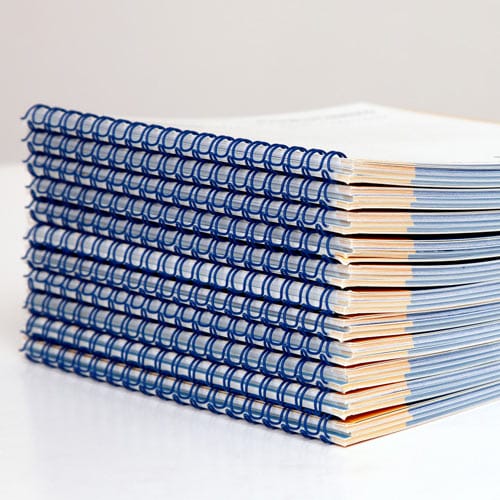
Wire-O Printing — the archival pick. Wire-O looks sharp and lies flat, but the per-unit cost runs higher than coil or saddle stitch for the same page count. Verdict: Skip for a typical single-phase HOA; Consider for large master-planned communities printing several hundred copies a year where the finish matters more.
HOA Directory Printing — the companion pick. Many boards pair a rules handbook with a resident directory listing board members, committees, and contact info. Directory printing for homeowners associations covers the format questions specific to that companion piece. Verdict: Buy if your community mails a directory alongside the handbook.
| Format | Best page range | Lay-flat? | Reprint speed | Verdict |
|---|---|---|---|---|
| Saddle Stitch | Up to 64 pages | No | Fastest | Buy |
| Perfect Bound | 80+ pages | No | Moderate | Consider |
| Plastic Coil | Any length | Yes | Moderate | Consider |
| Wire-O | Any length | Yes | Moderate | Skip unless high volume |
What’s the best binding for an HOA community handbook?
Saddle stitch is the best binding for HOA handbooks under 64 pages because it’s the cheapest and fastest short-run option in 2026. Handbooks over 80 pages with attached CC&Rs usually move to perfect binding for a flatter spine.
How many pages should an HOA rules booklet be?
Most HOA rules booklets run 12 to 40 pages, covering bylaws, architectural guidelines, and contact info. Communities that bundle CC&Rs and amendment logs into one document often exceed 80 pages, which changes the ideal binding format.
Is saddle stitch or perfect bound better for a homeowners association handbook?
Saddle stitch is better for handbooks under 60 pages because it costs less per copy and prints faster. Perfect binding is better once the document exceeds 80 pages, since staples can’t hold that much paper without the spine separating.
How much does booklet printing cost for a 200-copy HOA run?
Short-run digital printing for a 200-copy saddle-stitched booklet typically runs a few dollars per copy in 2026, depending on page count and whether color pages are included. Perfect bound and coil formats cost more per unit at the same quantity.
Can HOA handbooks be printed in black and white to save cost?
Yes, most HOA handbook text prints fine in black and white, which keeps per-copy cost down. Color is worth adding only for pages with maps, plat diagrams, or architectural color swatches that need to stay legible.
How often should HOA boards reprint their rules booklet?
Most boards reprint annually, after the yearly meeting approves rule amendments. Communities with frequent architectural or pet-policy changes sometimes reprint an insert page rather than the full booklet to save cost.
Do HOA handbooks need color for maps and plat diagrams?
Plat maps and community diagrams are usually easier to read in color, especially when they show phase boundaries or amenity zones. A mixed run with black-and-white text and a few color insert pages balances legibility and cost.
What size should an HOA handbook be for mailing?
5.5 x 8.5 inches is a common HOA handbook size because it fits standard mailing envelopes and filing folders without folding. 8.5 x 11 works better for handbooks with detailed diagrams or forms that need full-page space.
The reprint that actually breaks an HOA's print budget usually isn't the rules change — it's the page count creeping past a binding threshold without anyone noticing. A handbook that sat at 58 pages for three years and then picked up a 10-page amendment log crosses from saddle stitch territory into perfect-bound territory, and the per-copy cost jumps accordingly. Check the current page count against the 64-page saddle stitch ceiling before you approve next year's print order, not after.
© 2026 Publishing Xpress. All Rights Reserved.