July 25, 2026
Guided journals and prompt-driven notebooks live or die on how the pages behave under a pen — and that comes down to binding choice, not cover design. Custom journal printing in 2026 means picking the right combination of binding, paper weight, and trim size for a book that gets written in every day, not just read once.
This guide is for coaches, therapists, wellness brands, teachers, and small publishers producing guided journals, gratitude journals, workbooks, or dated planners for clients or retail. If you're printing 50 to 2,000 copies of something people write in daily, the binding and paper decisions below apply directly to your project — not to a novel or a photo book. Publishing Xpress runs plastic coil binding for planners and journals with no large minimum order, which matters when you're testing a guided journal concept before committing to a bigger print run.
A guided journal that won't lay flat gets abandoned by week two. Custom journal printing has different failure points than regular book printing: the spine has to survive daily opening and closing, the paper has to resist bleed-through from gel pens and markers, and the trim size has to match how someone actually carries the thing. Get any of those wrong in 2026 and you'll be reprinting a run instead of selling it.
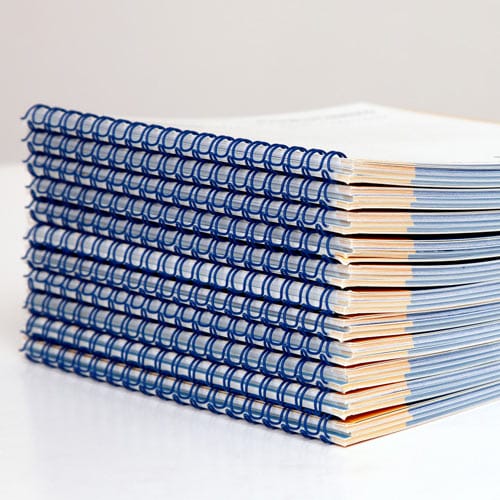
A journal that snaps shut or fights the writer's hand gets used less. Coil and Wire-O bindings open completely flat because the mechanical spine has no glue to crack, which matters for anything meant to sit open on a desk while someone writes in it. Perfect-bound journals under 80 pages often won't stay open without being held down.
Standard 20 lb. copy paper lets gel pens and markers ghost through to the next page, which ruins guided prompts printed on the reverse side. Look for 60 lb. to 70 lb. text weight at minimum for anything designed to be written on with ink, not just pencil.
A pocket gratitude journal at 5.5" x 8.5" behaves differently than a desk-bound annual planner at 8.5" x 11". Pick trim size based on where the journal actually lives — bag, desk, or nightstand — before you finalize interior layout.
A journal gets picked up and set down dozens of times over months. A laminated or UV-coated cover resists the edge-wear and finger oils that a plain matte cover shows within weeks.
Guided journal concepts often need a test batch of 25 to 100 copies before a full retail run. A printer with no large minimum order lets you validate the format and prompts before committing budget to 500 or 1,000 copies.
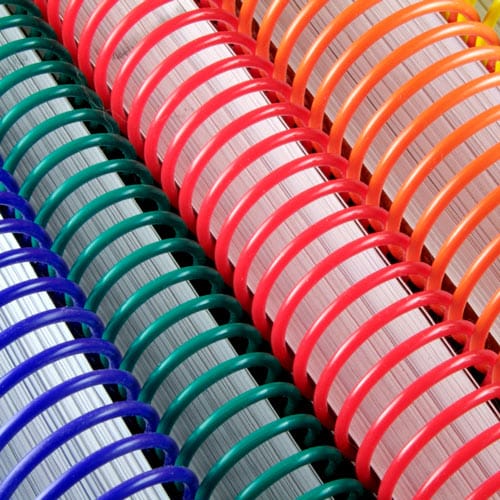
Plastic coil — the safe pick. Coil binding opens a full 360 degrees, which means a guided journal stays flat on a desk through every one of its pages without anyone holding it open. It works from 24 pages up past 300, making it the widest range of any binding option here. Buy it for gratitude journals, daily planners, and any guided journal meant for repeated writing sessions in 2026.
Wire-O — the retail upgrade. Wire-O uses a double-loop metal spine that reads more premium on a shelf than plastic coil, while still opening flat for writing. It handles up to roughly 1.25 inches of spine thickness, which covers most annual guided journal formats. Wire-O bound notebooks built on this binding hold up under office and desk use where the journal changes hands. Buy it if the journal is going to retail shelves or corporate gifting in 2026.
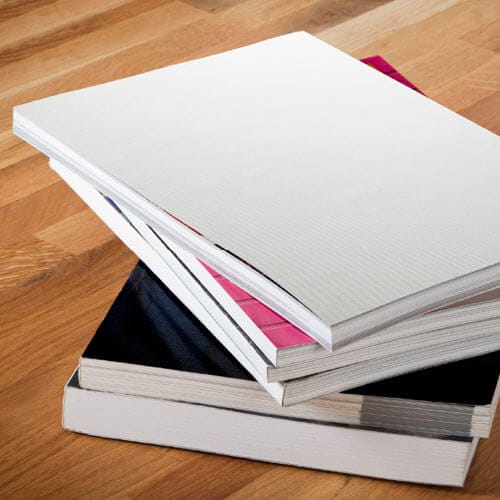
Perfect binding — the bookstore look. A glued spine gives a guided journal the flat-spine, printed-title look of a real book, which matters if you're selling through a storefront that stocks bound titles. It needs enough page count — generally 80 pages or more — to hold a spine width that won't crack under daily flexing. Consider it only for thick, once-a-year guided journal formats; Skip it for anything under 80 pages meant to be written in daily.
Saddle stitch — the short-run minimalist. Two staples through the fold keep cost per unit low for journals under 48 pages, which fits a short workshop companion or a 30-day challenge journal. It won't survive months of daily flexing the way coil or Wire-O will. Consider it for single-use event journals; Skip it for anything meant to last a full year.
See the difference in practice by comparing coil vs Wire-O binding directly before you lock in a spec sheet.
| Binding | Lays flat | Page range | Cost tier | Verdict |
|---|---|---|---|---|
| Plastic coil | Yes, 360° | 24–300+ | Low | Buy |
| Wire-O | Yes, 360° | 24–~250 | Mid | Buy for retail |
| Perfect bound | Partial | 80+ | Mid-high | Consider |
| Saddle stitch | Partial | Under 48 | Lowest | Consider short runs |
“If a guided journal doesn’t lay flat, the prompts inside it never get finished.”
What’s the best binding for custom journal printing?
Plastic coil binding is the best default for custom journal printing in 2026 because it lays flat at any page count and holds up to daily use. Wire-O is the step up when the journal is going to retail shelves.
Is Wire-O better than plastic coil for guided journals?
Wire-O looks more premium and holds a slightly thicker spine, but plastic coil costs less and covers a wider page range. Choose Wire-O for retail or gifting and plastic coil for everyday working journals.
How much does custom journal printing cost per copy?
Cost per copy drops as the print run grows, and binding choice moves the price more than paper stock does. A short 50-copy test run costs more per unit than a 500-copy retail order, which is why testing a small batch first matters.
Can perfect binding work for a guided journal?
Perfect binding works for guided journals only at 80 pages or more, where the spine has enough width to hold up without cracking. Under that page count, perfect binding is not a good fit for daily writing.
What paper weight stops pen bleed-through in a journal?
A text weight of 60 lb. to 70 lb. handles gel pens and markers without bleeding through to the next page. Standard 20 lb. copy paper is too thin for a journal meant to be written in.
What page count works best for a guided journal?
Most guided journals run 48 to 150 pages depending on whether they cover 30 days, 90 days, or a full year. Page count should be decided before binding, since it determines whether coil, Wire-O, or perfect binding fits.
Do I need a minimum order for custom journal printing?
No — short-run printers without a large minimum order let you print as few as 25 to 100 copies to test a guided journal concept before scaling up. That avoids committing budget to a format that hasn’t been validated yet.
The detail most first-time guided journal publishers miss isn't the binding — it's the paper's opacity. A 60 lb. sheet with low opacity lets tomorrow's prompt show through today's page, which reads as unfinished even when the printing itself is flawless. Check opacity, not just weight, before you approve a proof in 2026.
© 2026 Publishing Xpress. All Rights Reserved.