July 26, 2026
A corporate history book turns decades of memos, milestones, and hallway stories into something a board member actually keeps on a shelf — and the binding, paper, and print run decide whether it reads like an archive or gets mistaken for an annual report nobody opens. Corporate history book printing in 2026 comes down to a handful of choices that matter more than the manuscript itself.
A company history isn't a trade book chasing bookstore shelf space. It's a keepsake for a 25th or 50th anniversary, a retirement gift for a founder, a leave-behind for a merger, or a record a family business hands to the next generation. The audience is dozens to a few hundred people, not thousands — which changes every printing decision from binding to paper stock.
Most teams get the writing right and the print specs wrong. A 180-page company history printed on standard stock with saddle stitch binding looks like a stapled report by year two, and that undercuts the exact story it's supposed to tell. Getting corporate history book printing right in 2026 means matching the physical book to how long it needs to last and who's actually going to hold it.
This guide is for internal comms leads, marketing directors, and founders commissioning a book around a company milestone — a 10th, 25th, or 50th anniversary, a leadership transition, or a family business documenting its history for employees, board members, and heirs. If the print run is small, the distribution list is internal or semi-public, and the book needs to survive being handed down rather than sold, this is the buyer profile Publishing Xpress sees most often for legacy projects.
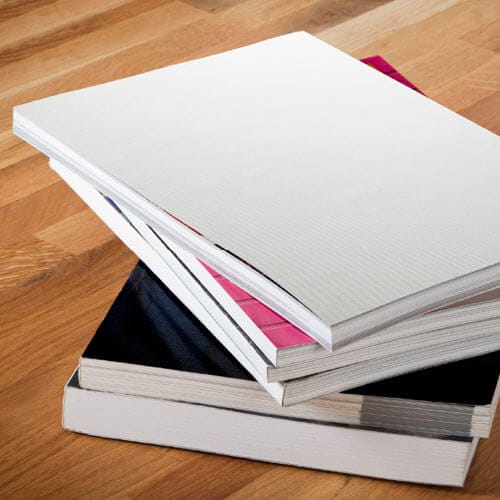
A history that's stapled or spiral-bound reads like an internal memo, not a legacy document. Perfect binding and hardcover options carry the visual weight a milestone deserves, and they hold up through repeated handling over years instead of one conference-room pass. Compare the full breakdown of perfect binding vs. saddle stitch before locking a spec.
Company histories run on scanned photographs, old letterhead, and event shots that were never shot for print. Paper stock and color reproduction quality decide whether those images look like archives or like a bad photocopy. Gloss or matte coated text stock reproduces old photos with more contrast than uncoated office paper.
A legacy book usually goes to board members, retirees, department heads, and maybe a handful of media contacts — not a retail audience. Ordering in small, flexible increments beats padding a print run to hit an arbitrary minimum, and it keeps unit cost proportional instead of wasting budget on copies that sit in a closet.
A legacy book is meant to outlast the anniversary it was printed for. Heavier cover stock and a binding method rated for repeated opening protect against the spine cracking or pages loosening after a few years of being pulled off a shelf.
Anniversary events and retirement dinners don't move. Building in time for proofing rounds — especially with archival photos that need color correction — keeps the print schedule from becoming a rush job in the final week.
The boardroom pick: Hardcover Perfect Bound Corporate History. A cloth or laminated hardcover with perfect binding holds a spine flat through 200-plus pages without cracking, and it's the format that reads as a permanent record rather than a handout. Read the full spec breakdown on hardcover book printing before finalizing page count. Verdict: Buy for board and executive distribution.
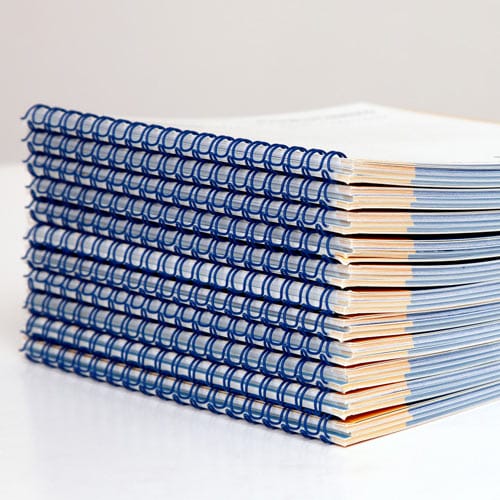
The photo-heavy pick: Wire-O Bound Company Timeline. Wire-O opens flat at 180 degrees, which matters when a two-page photo spread from a 1985 groundbreaking needs to stay uninterrupted by a gutter. It handles higher page counts than most coil formats without the binding becoming unwieldy. Verdict: Consider for image-driven histories, especially anything built around a photo timeline.
The budget-flexible pick: Perfect Bound Softcover Legacy Edition. Same binding logic as the hardcover version, minus the rigid cover — a practical call when the book is going to 50 employees rather than a boardroom. No large minimum order requirement means a short run doesn't get penalized the way it would with a mass-market print shop. Verdict: Buy for internal distribution, skip it if the book is headed to retail or a gift shop where a hardcover reads more premium.
The narrative pick: Memoir-Style Perfect Bound History. Built around founder voice and long-form storytelling rather than a straight timeline, this format borrows structure from personal memoir printing — see the approach to memoirs and personal histories for pacing and chapter structure that translates directly to a founder-driven company history. Verdict: Buy when the story is carried by one voice instead of a committee.
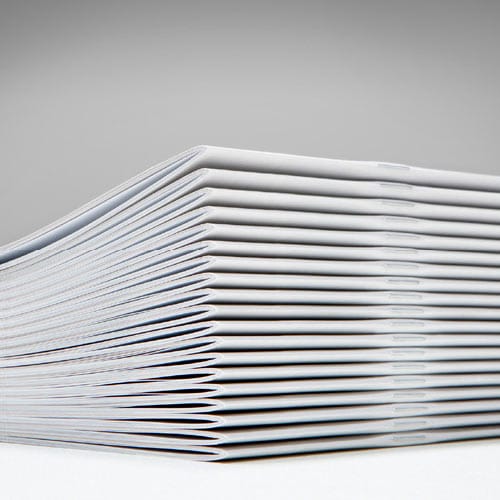
The quick-turn pick: Saddle Stitch Anniversary Booklet. Saddle stitch is fast and cheap, but the format only holds up cleanly under roughly 64 pages before the spine starts to strain. It works as a highlight reel or program insert for the anniversary event itself. Verdict: Skip for anything over 64 pages, consider it as a companion piece to the full book.
| Pick | Binding | Best page count | Best for | Verdict |
|---|---|---|---|---|
| Hardcover Perfect Bound History | Hardcover / perfect | 80-250 | Board & executive distribution | Buy |
| Wire-O Bound Timeline | Wire-O | 60-300 | Photo-heavy histories | Consider |
| Perfect Bound Softcover | Perfect bound | 60-200 | Internal / employee copies | Buy |
| Memoir-Style Perfect Bound | Perfect bound | 100-250 | Founder-voice narrative | Buy |
| Saddle Stitch Booklet | Saddle stitch | Under 64 | Anniversary handout | Skip past 64 pages |
“If the binding can’t survive being pulled off a shelf every anniversary for the next fifty years, it isn’t a legacy edition — it’s a handout.”
What’s the best binding for a corporate history book?
Hardcover or softcover perfect binding is the best binding for most corporate history books in 2026, especially past 80 pages. Perfect binding holds a flat spine and reads as a permanent record rather than an internal handout.
How much does corporate history book printing cost in 2026?
Cost depends on page count, paper stock, binding, and print run size rather than a single fixed price. A 100-page hardcover history costs more per copy than a 60-page saddle stitch booklet, so pricing against your actual specs beats guessing from a generic quote.
Is hardcover necessary for a company legacy book?
No, hardcover isn’t strictly necessary, but it’s the stronger choice when the book goes to a board, executive team, or gets handed down across generations. A perfect bound softcover works fine for internal or employee-facing copies where budget matters more than shelf presence.
How many copies should a company print for an anniversary book?
Print to your actual distribution list — board members, retirees, department heads, and select stakeholders — rather than padding the run to hit a bulk minimum. Short-run corporate history book printing doesn’t require large minimums, so a 40-copy order isn’t penalized the way it would be at a mass-market printer.
Can you print a corporate history book with lots of archival photos?
Yes, but paper stock matters more here than in a text-only book. Coated gloss or matte text stock reproduces scanned photos and old letterhead with far more contrast than standard uncoated office paper.
How long does corporate history book printing take?
Lead time depends on page count, proofing rounds, and binding method, especially when archival photos need color correction. Building in extra weeks before a fixed anniversary date keeps proofing changes from turning into a last-minute rush.
What page count works best for a legacy book?
Most corporate histories run 80 to 250 pages, which fits comfortably in hardcover or perfect bound softcover formats. Anything under 64 pages fits saddle stitch, but past that the binding needs to switch to perfect bound or Wire-O.
Is Wire-O or perfect binding better for a company timeline?
Wire-O binding is better when the book leans on full-spread photo timelines, since it opens flat at 180 degrees with no gutter interruption. Perfect binding is better when the book is text-heavy or narrative-driven and needs a spine that reads as a finished book on a shelf.
A corporate history running past 250 pages needs its spine width calculated before the cover file gets finalized — get that wrong and the front and back panels bow inward once the book sits flat on a shelf for a year. That single spec, more than the writing inside, is usually what separates a legacy book that still looks sharp in 2036 from one that's already curling at the edges.
© 2026 Publishing Xpress. All Rights Reserved.