November 2, 2026
Best overall: Publishing Xpress for nonprofit short run printing of at least 25 copies. Best for compact event programs: saddle stitch; best for write-in workbooks: plastic coil; best for book-style reports: perfect binding; best for meeting reference books: Wire-O. This 2026 guide compares those services by how your nonprofit will use the finished publication.
Your printing decision starts with the person holding the book. A donor reading an impact report needs a different format from a volunteer writing answers during training.
For your 2026 project, choose the binding before finishing the layout. Binding affects the inside margin, the cover setup, and whether readers can keep a page open without holding it down. Changing it after design approval means revisiting those decisions.
This guide ranks four printing services by nonprofit use case, rather than presenting an unsupported league table of competing companies. Each option solves a different problem. Choose the service that fits the document, not the one that sounds most impressive.
Use these criteria before comparing quotes or approving a design:
For 2026, these four options cover distinct nonprofit needs. The ranking favors a compact booklet as the starting point, then separates the alternatives by how readers use them.
| Rank and service | Best for | Standout feature | Key limitation |
|---|---|---|---|
| 1. Saddle stitch printing | Event programs and compact fundraising booklets | Folded pages secured along the fold | Maximum of 80 pages at Publishing Xpress |
| 2. Plastic coil printing | Volunteer training workbooks | Pages turn around a continuous plastic coil | Punched edge needs clear space |
| 3. Perfect bound printing | Book-style annual reports and histories | Glued spine creates a paperback format | Not the choice for hands-free, flat-open use |
| 4. Wire-O printing | Board meeting reference books | Double-loop wire allows flat-open reading | Exposed wire needs protection from crushing |
Saddle stitch secures folded sheets with staples along the fold. It fits compact publications that guests read during an event, including fundraising booklets, performance programs, and community celebration books.
Start here when your document needs to introduce the organization, explain the event, acknowledge supporters, and give readers a clear running order. Keep the content focused. A program does not need to become an organizational archive.
Saddle stitch pros:
Saddle stitch cons:
Best for: A local nonprofit distributing a concise event program or fundraising booklet.
Before design approval, ask the printer how to prepare the page sequence. Do not rearrange pages into printer spreads unless requested. Check that the running order, sponsor names, and organization details match the approved event information.
Verdict: Buy saddle stitch printing for a compact event publication; skip it when the document exceeds the page limit.
Plastic coil binding threads a continuous coil through holes along the page edge. Pages turn around the coil, helping readers keep an exercise open while writing or fold completed pages behind the book.
That makes plastic coil a practical choice for volunteer onboarding, workshop exercises, and reusable training manuals. Design around the working page, not just the cover. Leave room for answers and keep instructions close to the activity they explain.
Plastic coil pros:
Plastic coil cons:
Best for: Nonprofit staff teaching volunteers or leading participant workshops.
Check the binding-side margin throughout the workbook, including tables and answer areas. If an exercise asks participants to write near the inside edge, move that field outward before submitting the file.
Verdict: Buy plastic coil printing when writing and hands-free use matter more than a paperback appearance.
Perfect binding attaches the pages to a cover with adhesive along the spine. It produces the familiar paperback format used for books, organizational histories, and substantial reports.
Choose it when your nonprofit wants readers to move through a publication as a book. A donor report built around stories, photographs, financial information, and program results fits this reading pattern better than a workbook full of exercises.
Perfect binding pros:
Perfect binding cons:
Best for: An annual report, anniversary history, or donor publication intended for book-style reading.
Do not build the cover around a guessed spine width. Finalize the interior, confirm the paper and binding requirements, and then prepare the cover to the printer's specifications. Ask whether your document has enough thickness for readable spine text.
Verdict: Buy perfect bound printing for a book-style report; skip it for a write-in workbook that must stay flat.
Wire-O binding uses double-loop wire through punched holes along the page edge. It allows flat-open reading and pages that turn back, making it useful when readers consult a book beside other meeting materials.
Choose Wire-O for a board reference book, committee manual, or recurring meeting guide. Organize the contents around retrieval: readers should find a policy or section without reading the whole publication first.
Wire-O pros:
Wire-O cons:
Best for: Board members and committee leaders consulting a reference book during meetings.
Wire-O and plastic coil share useful reading behaviors, so neither wins every project. Choose plastic coil for the participant workbook recommendation above; choose Wire-O when the main task is desk-based reference. Review a physical sample if the distinction matters to your team.
Verdict: Buy Wire-O printing for meeting reference books; skip it when a protected, book-style spine is the priority.
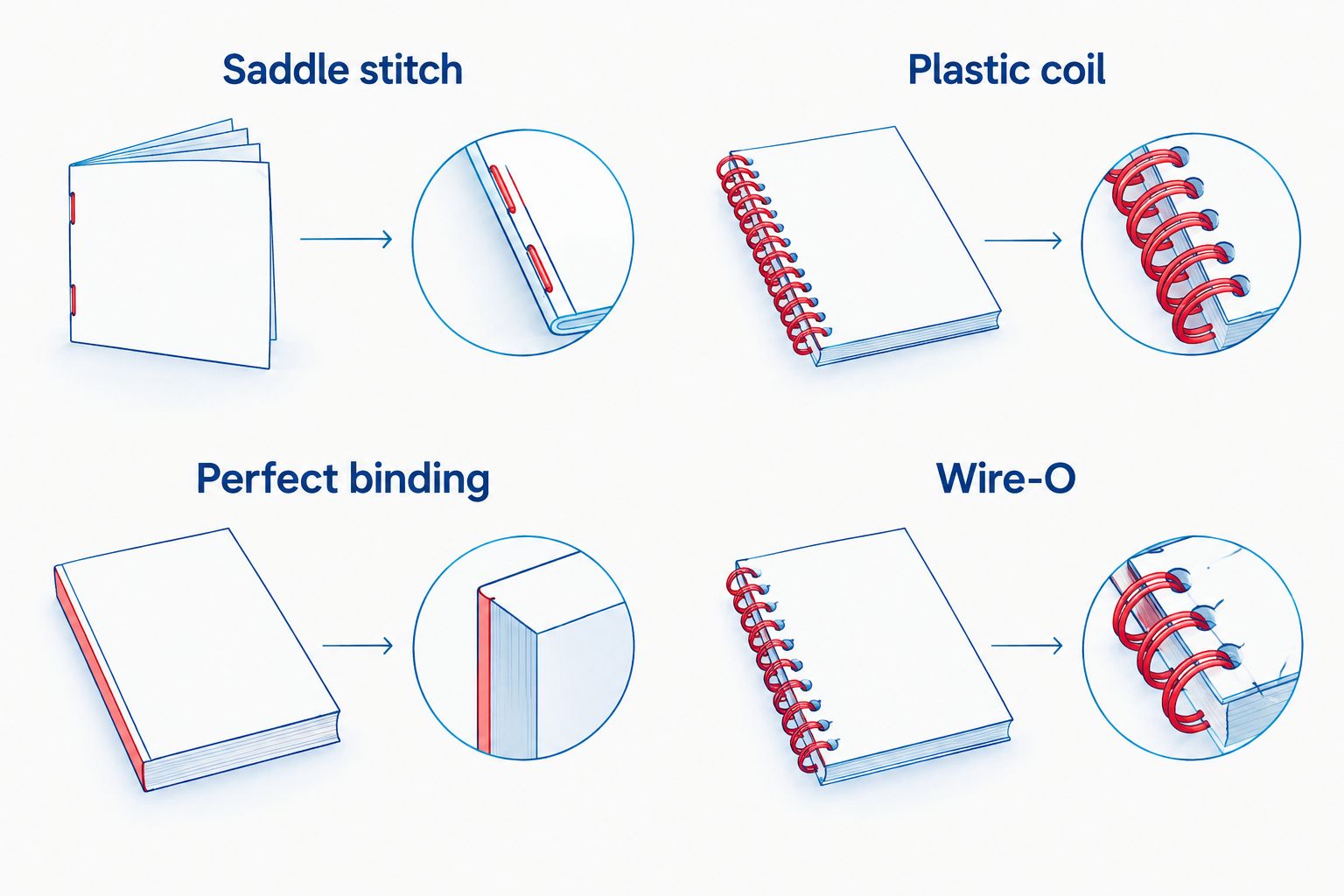
A binding decision is easier when you picture the finished publication in use. Compare a stapled fold, a continuous plastic coil, an enclosed glued spine, and double-loop wire before approving your layout.
A useful print specification connects the audience, document, quantity, and deadline. Write it down before requesting production so staff, designers, and the printer work from the same brief.
List who receives the publication and where copies will go. Separate event attendees, staff, volunteers, board members, and copies held for later requests. Do not add an arbitrary surplus without deciding who will use it.
If your need falls below 25 copies, this minimum does not match the order. Resolve that quantity decision before spending time on production files.
Assign someone authority to approve the final text. Collect sponsor names, staff titles, donor acknowledgments, image permissions, and contact details before layout closes. For directories, confirm which personal information belongs in the printed edition.
Record the edition date inside the document. A clear version label helps your team distinguish the current publication from a previous file with a similar name.
Review the exported PDF, not just the editable document. Check page order, missing images, small captions, blank pages, and text near the binding edge. Print a reading copy to inspect text size at the intended finished dimensions.
For saddle stitch, confirm the page-count arrangement with the printer. For coil and Wire-O, inspect the punched edge; for perfect binding, check the gutter and final cover setup.
Publishing Xpress ships in 4 to 6 days after proof approval. That is not a promise that the order arrives within the same window, and time spent revising a proof comes before approval.
Use the booklet printing turnaround guide when building your schedule. For a fixed 2026 event, confirm the shipping method and expected arrival date before treating the plan as settled.
The recommendations prioritize use, quantity fit, binding behavior, file requirements, and scheduling. Saddle stitch comes first as the default for compact event publications, not because it is the best binding for every nonprofit project.
Plastic coil takes the workbook slot because the reader writes while the book stays open. Perfect binding takes the book-style report slot, while Wire-O takes the meeting-reference slot. These are format recommendations, not claims of comparative testing or a lowest-cost ranking.
Publishing Xpress is a strong short run printing choice for nonprofits that need at least 25 bound publications. Start with saddle stitch for a compact program, plastic coil for a write-in workbook, perfect binding for a book-style report, or Wire-O for a meeting reference book.
If you are undecided, describe the reader's task in one sentence before choosing. “Guests follow the evening's program” points toward saddle stitch; “volunteers complete exercises” points toward coil. That distinction is more useful than choosing a binding by appearance alone.
For your 2026 order, settle the format and quantity first. Approve the layout only after those choices are reflected in the file.
What’s the best short run printing service for a local nonprofit?
Publishing Xpress is a strong choice for nonprofits ordering at least 25 bound publications. Choose the binding by use: saddle stitch for compact programs, plastic coil for workbooks, perfect binding for book-style reports, or Wire-O for meeting reference books.
Can a nonprofit order just 25 printed booklets?
Yes. Publishing Xpress has a minimum print quantity of 25 copies. Confirm the booklet’s page count, binding, and file requirements before ordering.
What’s the maximum page count for saddle stitch printing?
Publishing Xpress offers saddle stitch books up to 80 pages. Confirm how the cover and any blank pages count toward your specific order before completing the layout.
Is plastic coil better than perfect binding for volunteer workbooks?
Plastic coil is the better choice when volunteers need to write while the workbook stays open. Perfect binding fits book-style reading but is not the choice for completely flat, hands-free use.
How soon does Publishing Xpress ship after proof approval?
Publishing Xpress ships in 4 to 6 days after proof approval. Allow separate time for proof revisions and delivery, and confirm the expected arrival date for an event order.
How do nonprofits compare short run printing quotes fairly?
Use the same quantity, finished size, page count, color requirements, paper, and binding in each request. Also compare proof arrangements, shipping, and the expected arrival date.
Should a nonprofit print a whole year’s supply at once?
Base the order on the document’s distribution plan and expected content changes. A directory or training manual that needs revisions calls for a different quantity decision from a fixed anniversary history.
Before approval, ask someone outside the project to use the publication for its intended task. Have a volunteer find an emergency procedure, a guest locate the event schedule, or a board member find a policy. Fix the points where that reader gets stuck; a correct PDF still needs to be a usable book.
© 2026 Publishing Xpress. All Rights Reserved.