October 30, 2026
Best overall for trade show handouts: saddle stitch printing. Best for substantial product catalogs: perfect bound printing. Best for hands-on demonstrations: plastic coil printing. Best for tabletop presentations: Wire-o printing. This 2026 guide compares four booklet printing services from Publishing Xpress by how exhibitors use them, rather than treating every binding as interchangeable.
Your booklet has a different job from your booth display. The display starts a conversation; the booklet should help a buyer remember the relevant product, explain it to colleagues, and take the next step after the show.
Choose the format around that job. A compact handout needs easy page turning and practical packing. A demonstration manual needs to stay open while someone handles equipment. A detailed catalog needs clear sections, readable specifications, and a binding suited to its thickness.
For your 2026 event plan, settle those decisions before finishing the layout. Changing the binding afterward means revisiting margins, covers, and page arrangement—not simply selecting a different checkout option.
Use these criteria before choosing a service or requesting a quote:
Choose the binding that serves the reader, then compare matching print specifications. Comparing different page counts, paper choices, or quantities does not tell you which quote fits the same project.
The ranking below compares binding services for different exhibitor tasks. It is not a tested ranking of competing printing companies.
| Rank and service | Best for | Standout feature | Key limitation |
|---|---|---|---|
| 1. Saddle stitch printing | Concise booth handouts | Folded pages secured through the center | Maximum 80 pages |
| 2. Perfect bound printing | Substantial product catalogs | Glued spine and wraparound cover | Does not naturally lie flat |
| 3. Plastic coil printing | Hands-on demonstration manuals | Pages turn around a continuous coil | Requires space for punched binding holes |
| 4. Wire-o printing | Tabletop sales presentations | Facing pages stay open flat | Exposed wire can bend if crushed |
The useful distinction is not which binding looks most expensive. It is which format supports the conversation you want your sales team to have.
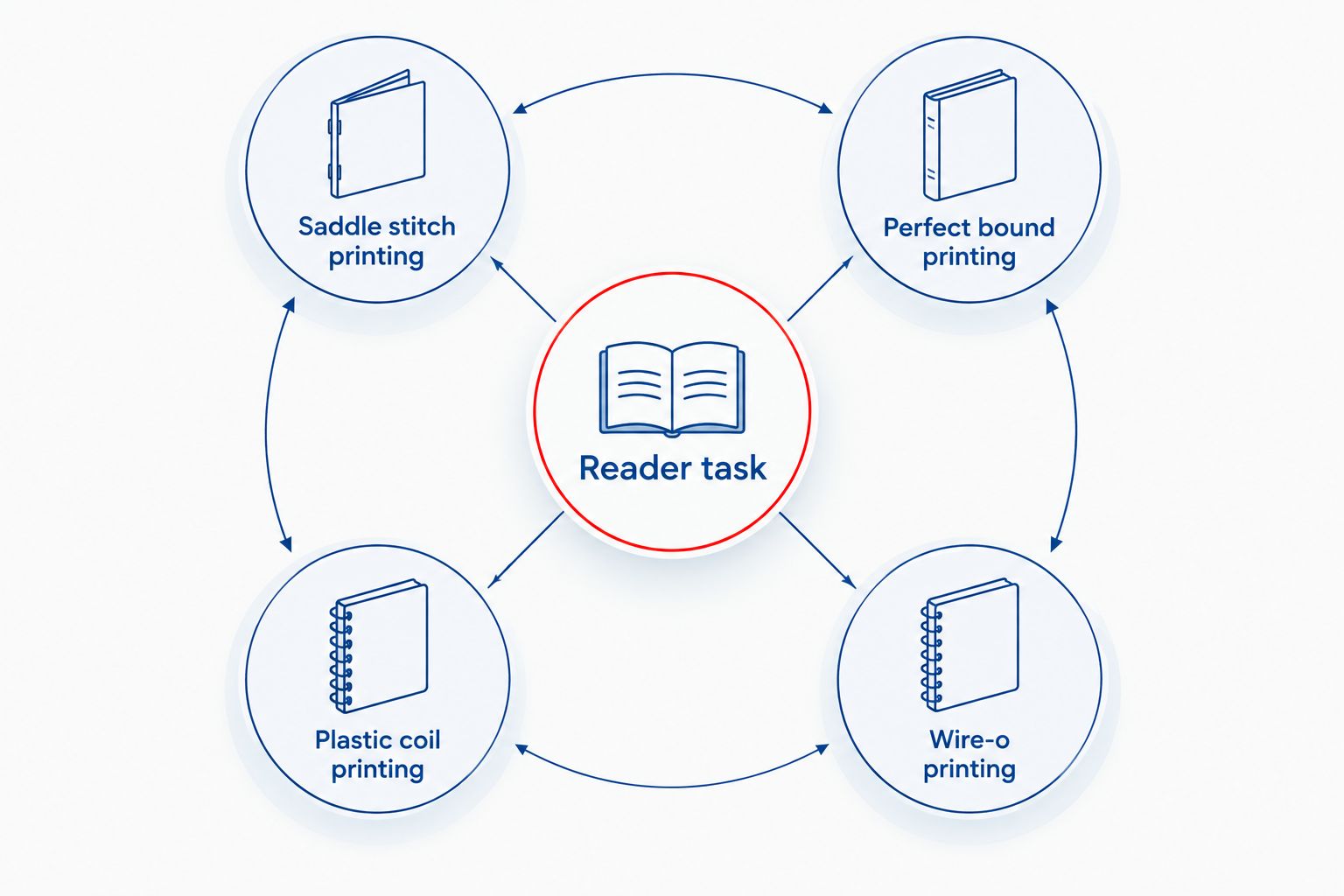
Saddle stitch printing secures folded sheets with staples through the center fold. Choose it for a focused product overview, a service explanation, or a compact selection guide that visitors can take away.
Saddle stitch printing is the default recommendation for an exhibitor's concise takeaway booklet. It keeps the document straightforward without adding an exposed coil or wire edge.
Saddle stitch printing pros:
Saddle stitch printing cons:
Do not fill the available pages just because you can. Start with the buyer's problem, show the relevant products, and finish with a clear follow-up action. Remove repeated company background before shrinking the text.
Best for: General booth distribution and concise product introductions.
Verdict: Buy saddle stitch printing for your main handout when the page count and content fit.
Perfect bound printing glues the pages into a wraparound cover, creating a squared spine. Choose it when a product catalog needs enough depth to function as a reference after the event.
The spine gives the finished piece a book-like structure. It does not make a short document automatically suitable: confirm that the page count and paper combination support perfect binding before designing the cover.
Perfect bound printing pros:
Perfect bound printing cons:
For a 2026 catalog, keep event-specific details separate from enduring product information. A booth number printed throughout the document makes later reuse awkward. Give product names, application notes, and contact details more space than temporary event messaging.
Best for: Detailed product catalogs and substantial company reference books.
Verdict: Buy perfect bound printing when catalog depth justifies the format; skip it for a brief overview.
Plastic coil printing threads a continuous plastic spiral through punched holes along the binding edge. Pages can turn around the coil, allowing the booklet to stay open or fold back during use.
Choose plastic coil printing when your team needs to follow procedures while demonstrating a product. The binding supports a working document rather than a conventional sales catalog.
Plastic coil printing pros:
Plastic coil printing cons:
Keep instructions close to their illustrations, and leave room for notes where participants need them. Do not run small captions into the punched margin. A document that folds back neatly still fails if the binding obscures essential instructions.
Best for: Product demonstrations, technical walkthroughs, and exhibitor-led workshops.
Verdict: Buy plastic coil printing for active use; skip it when the booklet only needs to be handed out.
Wire-o printing uses paired wire loops through punched pages. The booklet opens flat, making it suitable for a sales representative presenting facing pages across a table.
Choose Wire-o printing for a deliberately paced presentation: an application example, a comparison, then supporting specifications. Build each spread around a complete point rather than spreading one explanation across several page turns.
Wire-o printing pros:
Wire-o printing cons:
Pack Wire-o presentation copies so other materials do not press into the loops. A flat-opening binding is useful at the meeting table, but it needs different handling from a stack of stapled booklets.
Best for: Scheduled buyer meetings and tabletop sales presentations.
Verdict: Buy Wire-o printing for presentation copies; skip it as the automatic choice for general distribution.
This ranking prioritizes reader task, page count, open-page behavior, file preparation, and event logistics. Saddle stitch comes first because the main recommendation addresses a concise exhibitor handout; the other bindings serve distinct jobs.
No print-quality testing or competitor performance scores are claimed. The service facts here are Publishing Xpress's stated minimum of 25 copies, saddle stitch maximum of 80 pages, and shipping 4 to 6 days after proof approval.
Before requesting your 2026 print quote, write down what an attendee should understand without your salesperson present. Use that answer to organize the booklet—not your company's internal department structure.
Open with the problem your product addresses and the situations it fits. Then explain the relevant options in plain language. Put supporting technical detail where a buyer can find it without reading every introductory paragraph.
A purchasing manager and an equipment operator do not necessarily need the same explanation. Label sections by the questions they answer so each reader can find the right material.
Use consistent terms, units, and headings across product entries. If you include dimensions or performance specifications, take them from approved product documentation rather than rewriting them from memory.
Keep body text readable at the finished size. Print a layout sample on paper and check the smallest table, diagram labels, and contact details before approving the production file.
Tell readers what to do next: request a consultation, discuss an application, or ask for a product demonstration. Keep the action specific to the booklet's purpose.
If you add a QR code, test the printed code at its actual size. Include readable contact information beside it so the next step does not depend entirely on scanning.
For a 2026 trade show, work backward from the date your materials must be received—not from the morning the exhibition opens. Include your internal review and correction time before approving the proof.
Publishing Xpress ships in 4 to 6 days after proof approval. Transit and venue receiving are separate from that window. Rush options are offered, but confirm the details for your order rather than building a schedule around an assumption.
Your booklet and display materials also follow different production paths. Planning for last-minute trade show signage should not replace an earlier approval deadline for a bound catalog; a display correction and a reprinted booklet involve different files and finishing steps.
Use this approval sequence:
The distinction between production and delivery deserves its own check. Review how long it takes to print a booklet while setting the approval deadline, then confirm the order-specific schedule.
Export the PDF using the printer's file instructions. Do not rearrange pages into printer spreads unless requested; the layout you use for reading and the arrangement used for production are different concerns.
For saddle stitch, check the total page count and intentional blanks. For perfect binding, finalize the interior specifications before creating the full cover. For plastic coil and Wire-o, keep text, captions, and diagrams away from the punched edge.
A physical layout check helps you catch mistakes that are easy to miss on a screen. Fold or stack sample pages in reading order and inspect the opening spread, section transitions, and final contact page.
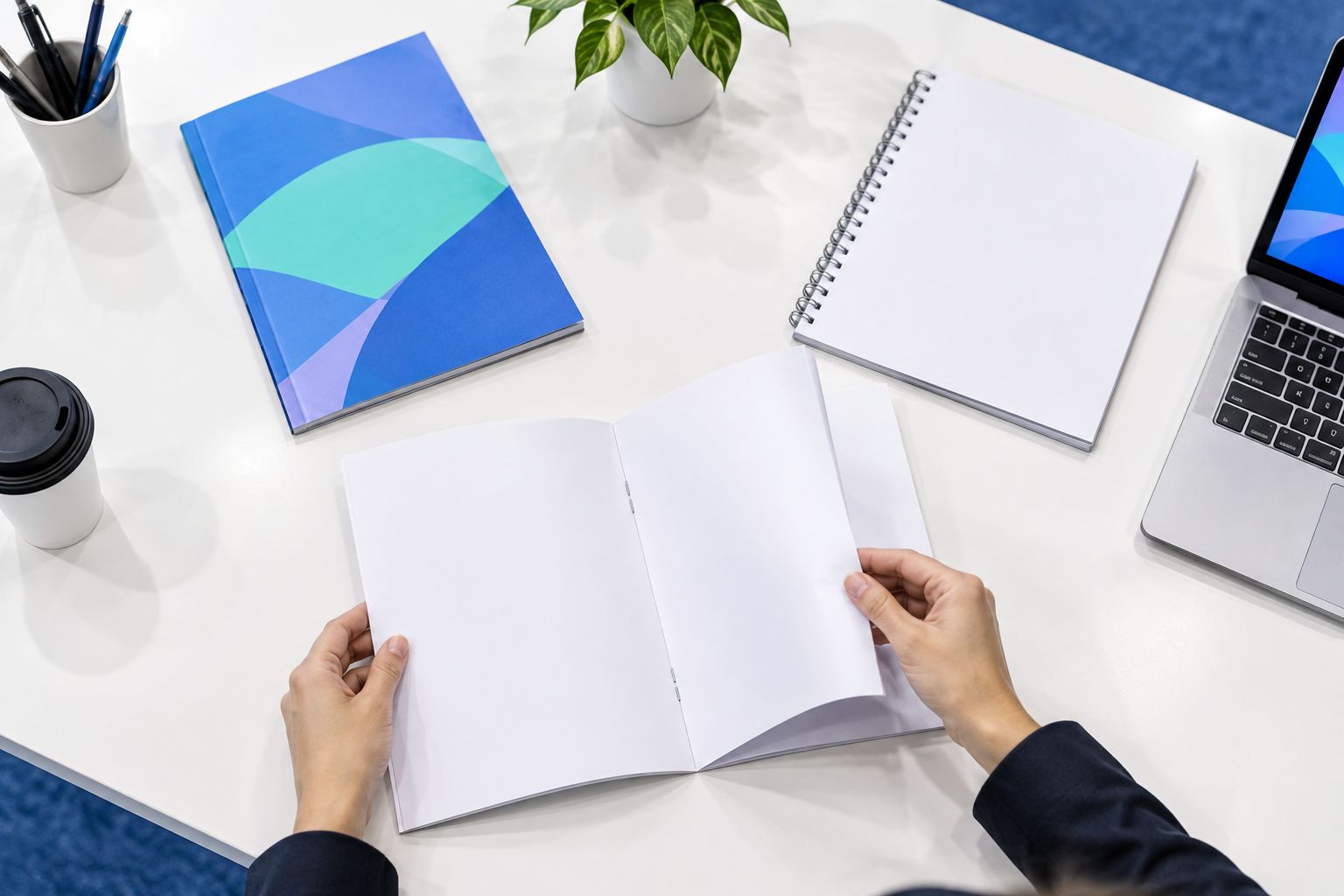
Ask another person to follow the booklet without verbal help. If the sequence needs explanation, revise the headings or page order before printing. Binding cannot repair an unclear argument.
Choose saddle stitch printing unless your content has a clear reason to need another binding. Move to perfect bound printing for a substantial catalog, plastic coil printing for hands-on instructions, or Wire-o printing for a presentation that stays open on a table.
Publishing Xpress is best for exhibitors who need short-run booklet printing with a choice of bindings and can order at least 25 copies. Match the format to the task, confirm the specifications, and approve the proof against your event receiving deadline.
What’s the best booklet printing service for trade show handouts?
Saddle stitch printing is the default choice for a concise trade show handout. Publishing Xpress offers saddle stitch booklets with a maximum of 80 pages and a minimum order of 25 copies.
Is perfect binding better than saddle stitch for a product catalog?
Perfect binding is the better fit when a substantial catalog needs a glued spine and book-like structure. Saddle stitch is the simpler choice for a shorter overview, provided the page count fits its requirements.
What’s the minimum order for Publishing Xpress booklet printing?
The minimum print quantity is 25 copies. Plan your order around the number you intend to distribute, retain for sales meetings, and use after the event.
How long does booklet printing take before a trade show?
Publishing Xpress ships in 4 to 6 days after proof approval. Allow separate time for proof corrections, transit, and event receiving, and confirm the schedule for your order.
Can I saddle stitch a booklet longer than 80 pages?
Publishing Xpress does not offer saddle stitch books above 80 pages. For a longer document, discuss perfect binding, plastic coil, or Wire-o based on how readers will use it.
Which booklet binding works best for a product demonstration?
Plastic coil printing is the recommended choice for a hands-on demonstration manual because it stays open and allows pages to fold back. Keep instructions and diagrams clear of the punched binding edge.
Should I submit booklet pages as printer spreads?
Submit pages according to the printer’s file instructions rather than creating printer spreads by default. Confirm page order, cover setup, bleed, and binding margins before exporting the final PDF.
Your best booklet is not necessarily the one you give to everyone. Separate the concise takeaway from the detailed working document when they serve different conversations.
Before your 2026 order, ask a colleague to find a relevant product, explain its application, and locate the next step using only the booklet. Watch where they stop. Fix that page before adding more content or choosing a more elaborate binding.
© 2026 Publishing Xpress. All Rights Reserved.