October 30, 2026
Best for photo-led publishing: Blurb. Best for short runs of 25 copies or more: Publishing Xpress. Best for Amazon sales: Amazon KDP. For photo books in 2026, the right print on demand book printing company depends on whether you need individual order fulfillment, books for an event, or bookstore distribution.
Print on demand and short-run printing solve different problems. Print on demand produces books as orders arrive; short-run printing produces a batch you distribute yourself. Neither model automatically produces a better photograph.
A photographer preparing an exhibition needs a different service from an author selling an illustrated travel memoir online. Start with how readers will receive your book, then compare the printing options that support that plan.
This 2026 shortlist separates those jobs rather than declaring every service interchangeable. It also includes a short-run alternative because individual order fulfillment is unnecessary when you already know who needs copies.
Use these criteria before choosing a company or uploading your finished layout:
A good photo book printer fits your photographs and your delivery plan. A familiar company name is not a substitute for checking both.
The table ranks each company for a distinct job. It does not rank print quality: that requires examining comparable printed books.
| Rank | Company | Best for | Standout fit | Key limitation |
|---|---|---|---|---|
| 1 | Publishing Xpress | Planned short-run batches | Four binding options and a 25-copy minimum | Not a one-copy POD ordering model |
| 2 | Blurb | Photo-led publishing | Photo book creation and printing | Photo book and trade book formats need separate evaluation |
| 3 | Lulu | Independent publishing workflows | Book printing with publishing and distribution options | Distribution eligibility depends on the selected format |
| 4 | Amazon KDP | Selling through Amazon | Print-on-demand publishing connected to Amazon | Paperback production constraints shape the layout |
| 5 | IngramSpark | Bookstore and library distribution | Connection to Ingram's trade distribution network | Distribution does not guarantee retailer orders |
Publishing Xpress provides short-run digital printing for photo books, portfolios, books, and other bound documents. Its minimum order is 25 copies, with perfect bound, saddle stitch, Wire-o, and plastic coil binding options.
Publishing Xpress is best for photo book creators who need at least 25 copies for planned distribution. That includes books for an exhibition, a family gathering, an organization, or a direct-sales launch where you handle the copies yourself.
For a 2026 exhibition book, decide whether readers will browse at a table or take home a conventional paperback. That choice changes the binding, inside margins, and placement of full-page photographs.
Best for: Photographers and organizations distributing a known batch themselves.
Verdict: Buy for planned batches; skip for individual order fulfillment.
Blurb offers photo book creation and printing alongside other book formats. Start here when the photographs determine the page design rather than simply illustrating a text manuscript.
The important distinction is format. Evaluate the actual photo book you intend to produce; do not assume every book format uses the same paper, binding, or distribution route.
Blurb pros:
Blurb cons:
Inspect a sample or proof that matches the intended format. A beautiful sample in a different format does not answer whether your own book's paper and binding suit its photographs.
Best for: Photographers building a book around visual sequencing and page design.
Verdict: Buy for a photo-first project after checking the exact format.
Lulu combines book printing with self-publishing and distribution options. It belongs on the shortlist when your photo book is part of a wider publishing plan, such as an illustrated guide, travel narrative, or photography instruction book.
Start by choosing the finished format and intended sales channel. Then check whether that combination supports the publishing route you want.
Lulu pros:
Lulu cons:
For a 2026 illustrated guide, consider the reading experience as well as the pictures. Captions, maps, text, and photographs need to remain legible together at the chosen trim size.
Best for: Independent publishers combining photographs with substantial written content.
Verdict: Buy when Lulu's format and publishing route match your book.
Amazon Kindle Direct Publishing offers print-on-demand paperback publishing connected to Amazon. It fits an illustrated book whose main sales destination is Amazon, rather than a private batch distributed at an event.
Design for KDP's print specifications from the beginning. A photo-rich paperback needs a layout built around its permitted trim sizes, color options, margins, and page-count requirements.
Amazon KDP pros:
Amazon KDP cons:
Keep faces, captions, and important details away from the binding edge. A dramatic image on your monitor loses its effect if readers must force the book open to see its subject.
Best for: Authors selling photo-rich paperback books primarily through Amazon.
Verdict: Buy for Amazon-focused paperback sales; skip if the required format does not fit.
IngramSpark offers print-on-demand publishing connected to Ingram's book distribution network. It suits publishers who want bookstores and libraries to be able to order a photo-rich title through trade channels.
Treat that distribution connection as an ordering route, not a promise of placement. Booksellers still decide what to order, and your book still needs suitable metadata, production files, and a sales plan.
IngramSpark pros:
IngramSpark cons:
Choose IngramSpark because trade ordering serves your audience, not because distribution sounds like a complete marketing plan. A privately shared family photo book has no automatic need for that infrastructure.
Best for: Publishers seeking bookstore and library ordering channels.
Verdict: Buy for a trade distribution plan; skip for private circulation alone.
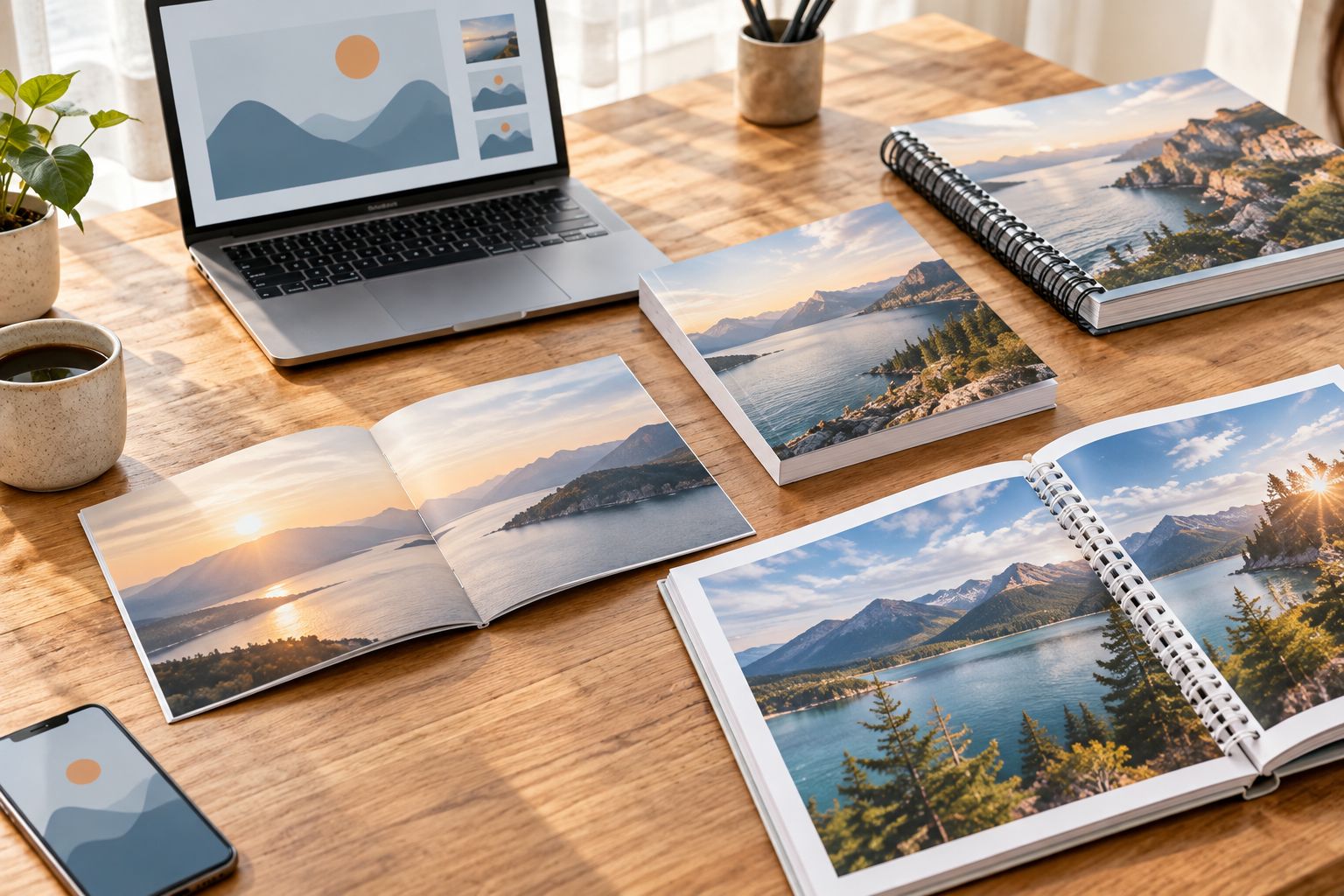
Binding changes how readers see the page. Choose it before placing photographs across spreads, because a continuous image and a book that opens flat are not the same requirement.
| Binding | Best for | Practical advantage | Design limitation |
|---|---|---|---|
| Perfect bound | Shelf-ready photo essays | Conventional paperback form | Important detail needs clearance from the gutter |
| Saddle stitch | Short photo zines | Folded pages fastened through the fold | Page-count and paper-thickness limits apply |
| Wire-o | Tabletop portfolios | Pages open flat | Binding holes interrupt the inside edge |
| Plastic coil | Frequently handled reference books | Pages turn around a continuous coil | The coil occupies the binding edge |
Do not describe a Wire-o or coil-bound spread as an uninterrupted image. The pages open flat, but the binding still separates them. Keep the main subject on a single page when that separation would weaken the photograph.
For your 2026 project, work through these stages in order. Changing the trim size after finishing the layout creates avoidable crop and margin work.
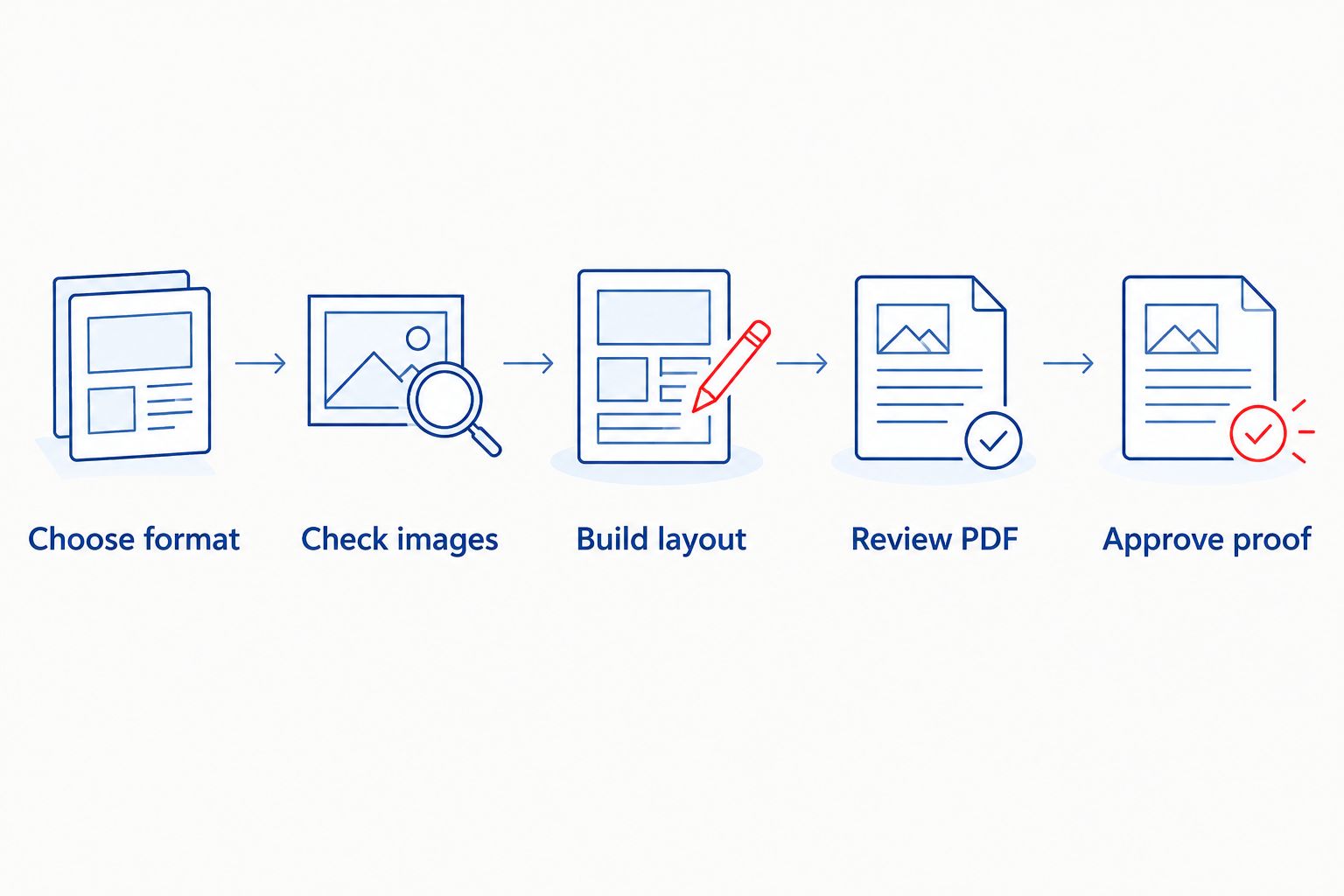
A useful proof includes the photographs most likely to reveal problems: dark scenes, pale highlights, skin tones, and subtle gradients. Check those deliberately rather than approving the book after looking only at the cover.
For image sequences, review facing pages together. A strong photograph can still feel misplaced when its brightness, color, or subject clashes with the adjacent page.
This ranking matches each company to an ordering model and publishing purpose. It does not claim hands-on testing, measured color accuracy, or a universal winner on image quality.
The criteria are format fit, image review, ordering model, sales channel, file preparation, and schedule. For a 2026 decision, confirm current specifications for the exact book you plan to order; company-level descriptions cannot replace format-level requirements.
Choose Publishing Xpress for photo book printing when you need a batch of 25 copies or more and will distribute it yourself. Choose Blurb when the starting point is a photo-led book design.
For individual customer orders, choose the sales route next: Amazon KDP for Amazon-focused publishing, IngramSpark for trade distribution, or Lulu when its independent publishing options fit your format. Do not add distribution complexity to a book intended only for private sharing.
The final check is physical. Approve the photographs and binding together, not as separate decisions.
What’s the best print on demand book printing company for photo books?
Blurb is the starting point for photo-led publishing, while Amazon KDP, Lulu, and IngramSpark serve different publishing and distribution needs. Choose the exact format and sales route before comparing printed proofs.
Is Publishing Xpress a one-copy print-on-demand service?
Publishing Xpress has a minimum order of 25 copies, so it fits short-run batch printing rather than one-copy ordering. Choose it when you need a planned quantity to distribute yourself.
Is Blurb better than Amazon KDP for a photography book?
Blurb is the stronger starting point for a photo-first design, while Amazon KDP fits Amazon-focused paperback sales. Compare the exact format specifications and inspect a proof before deciding.
Can I use saddle stitch for a long photo book?
Publishing Xpress limits saddle stitch books to 80 pages. For a longer project, discuss another binding and confirm its page-count and paper requirements before laying out the book.
Which binding is best for a photo portfolio that opens flat?
Wire-o and plastic coil are useful choices when a portfolio needs to open flat. Both have a visible binding edge, so keep important photographic details clear of the punched area.
How long does Publishing Xpress take to ship a photo book?
Publishing Xpress ships in 4 to 6 days after proof approval. Allow separate time for preparing files, reviewing the proof, making corrections, and transit.
Will IngramSpark get my photo book into bookstores?
IngramSpark provides a trade ordering route, not guaranteed bookstore placement. Booksellers make their own purchasing decisions, so distribution still needs a sales plan.
Proof the darkest photograph, not just your favorite photograph. A bright cover image tells you little about whether shadow detail survives inside the book. Mark the difficult images before reviewing your proof, then check them under consistent lighting.
© 2026 Publishing Xpress. All Rights Reserved.