October 12, 2026
Custom notebook printing costs depend on your quantity, page count, paper, color choices, and binding; get a quote for the exact notebook you plan to print in 2026. Confirm whether that quote includes delivery, applicable tax, proofing, and any file preparation before treating it as your complete budget. Compare the total for matching specifications, not an advertised cost per notebook.
A notebook is a writing tool, not just a printed cover. A quote only helps you make a decision when it describes what the recipient will actually use: the writing surface, usable page space, and way the notebook opens.
For gifts and event handouts, start with the purpose described in this guide to custom notebook printing for corporate gifts and events. Decide whether you need an everyday notebook, a brief workshop companion, or a guided journal before requesting estimates.
The practical rule for your 2026 budget is simple: define the useful notebook first. Then compare the printing choices that deliver it without adding features your recipients do not need.
Custom notebook printing requires a project-specific quote rather than a universal rate. The meaningful comparison is the complete order total divided by the number of finished notebooks, with the same specifications used for every estimate.
Use this breakdown to check what you are comparing. It is a quote checklist, not a list of charges every printer applies.
| Budget component | What to specify or confirm | Why it matters |
|---|---|---|
| Printed interior | Finished dimensions, page count, paper, and ink choice | Defines the writing pages you receive |
| Cover | Cover paper, artwork, and any requested finish | Separates cover requirements from interior requirements |
| Binding | Plastic coil, Wire-O, saddle stitch, or perfect bound | Changes construction and how the notebook opens |
| File preparation | Who supplies finished files and handles corrections | Clarifies responsibility before production |
| Proofing | Proof format and approval process | Establishes what you review before printing |
| Delivery and tax | Destination and what the estimate includes | Makes the total useful for budgeting |
Your comparison is only valid when the quantity and specifications match. If one estimate uses a different interior paper or excludes delivery, resolve that difference before deciding which offer fits your budget.
Keep cover printing and interior printing separate in your request. A color cover does not automatically mean you need color on every writing page.
Divide the complete quoted order total by the number of finished notebooks. Include the same budget components in each calculation; do not compare a production-only figure with a delivered order total.
Also record the total commitment. A larger order can look attractive per copy while requiring you to buy notebooks you do not need.
For a 2026 event, base your quantity on your distribution plan. Identify who receives a notebook, whether staff need copies, and whether you have a real use for extras rather than choosing an arbitrary buffer.
Plastic coil passes through holes along the binding edge and allows the notebook to open flat or fold back. Best for: working notebooks, guided journals, and pages you use while taking notes. Its main advantage is access to the writing surface.
The trade-off is the exposed coil and the space needed for punched holes. Keep lines, checkboxes, and instructions away from that edge so the binding does not interrupt the content.
Choose plastic coil because the opening behavior serves the user, not because you assume it is always the least expensive binding. Request it with your actual paper and page count so the estimate describes your notebook.
Wire-O uses double-loop wire through punched holes and lets pages lie flat when opened. Best for: meeting notebooks, desktop planners, and structured note-taking pages. It gives you accessible spreads without relying on an adhesive spine.
The limitation is the exposed metal binding, which can bend if handled roughly. The punched edge also needs clearance, just as it does with plastic coil.
Compare Wire-O and plastic coil using the same interior and cover specifications. Ask about the finished construction rather than treating the binding name alone as a complete description of the notebook.
Saddle stitching secures folded sheets with staples through the fold. Best for: slim event notebooks and short workshop handouts. It provides a compact format without an exposed coil or wire edge.
Its limitation is thickness: it is not a substitute for every long journal or substantial notebook. As folded sheets accumulate, the construction and layout need attention.
A folded sheet creates 4 pages, so conventional saddle-stitched interiors are arranged in multiples of 4 pages. Include intentional blank writing pages in your file and confirm the required page arrangement before finalizing the design.
Perfect binding attaches the interior at an adhesive spine and creates a book-style appearance. Best for: journals where a continuous spine matters more than folding the notebook back. It avoids an exposed coil or wire.
The limitation is opening behavior: a standard perfect-bound notebook does not behave like a coil-bound notebook. Writing close to the spine is less convenient, so allow enough inner margin for the intended use.
Confirm that your page count and paper suit this construction. Do not choose perfect binding solely for appearance if recipients need to write across open spreads throughout a session.
| Binding | Best for | Main advantage | Main limitation |
|---|---|---|---|
| Plastic coil | Everyday writing and guided journals | Opens flat and folds back | Exposed coil; punched-edge clearance required |
| Wire-O | Meeting notebooks and desktop planners | Flat, accessible writing spreads | Metal loops can bend; punched-edge clearance required |
| Saddle stitch | Slim workshops and event handouts | Compact folded construction | Limited suitability for thick notebooks |
| Perfect bound | Book-style journals | Continuous adhesive spine | Less convenient for writing near the spine |
None of these bindings is the automatic budget winner for every project. Choose the construction that fits the writing task, then compare matching quotes. Removing a useful binding feature can leave you with a notebook that meets the budget but frustrates the recipient.
These specifications change what the printer must produce. Set them before comparing estimates, then change one at a time when evaluating alternatives.
For your 2026 comparison, keep a single specification sheet beside every estimate. Mark each difference directly on that sheet rather than trying to remember which version used which paper.
One interior sheet has 2 sides; when both sides count as pages, it represents 2 pages. A page count and a sheet count therefore describe different things, even before you consider folded binding formats.
Write the interior page count explicitly and describe whether printing appears on both sides. Ask the printer how blank pages should appear in the submitted file so the finished notebook matches your layout.
Avoid counting the cover as interior writing space. A notebook with an introductory page, divider pages, and instructions has less free writing space than another notebook with the same total page count and none of those elements.
Build your request around the finished object. A clear brief lets you compare production choices without repeatedly revising an undefined project.
The strongest request also includes your needed delivery date and destination. Ask for the production schedule tied to file approval rather than assuming the ordering date starts every stage.
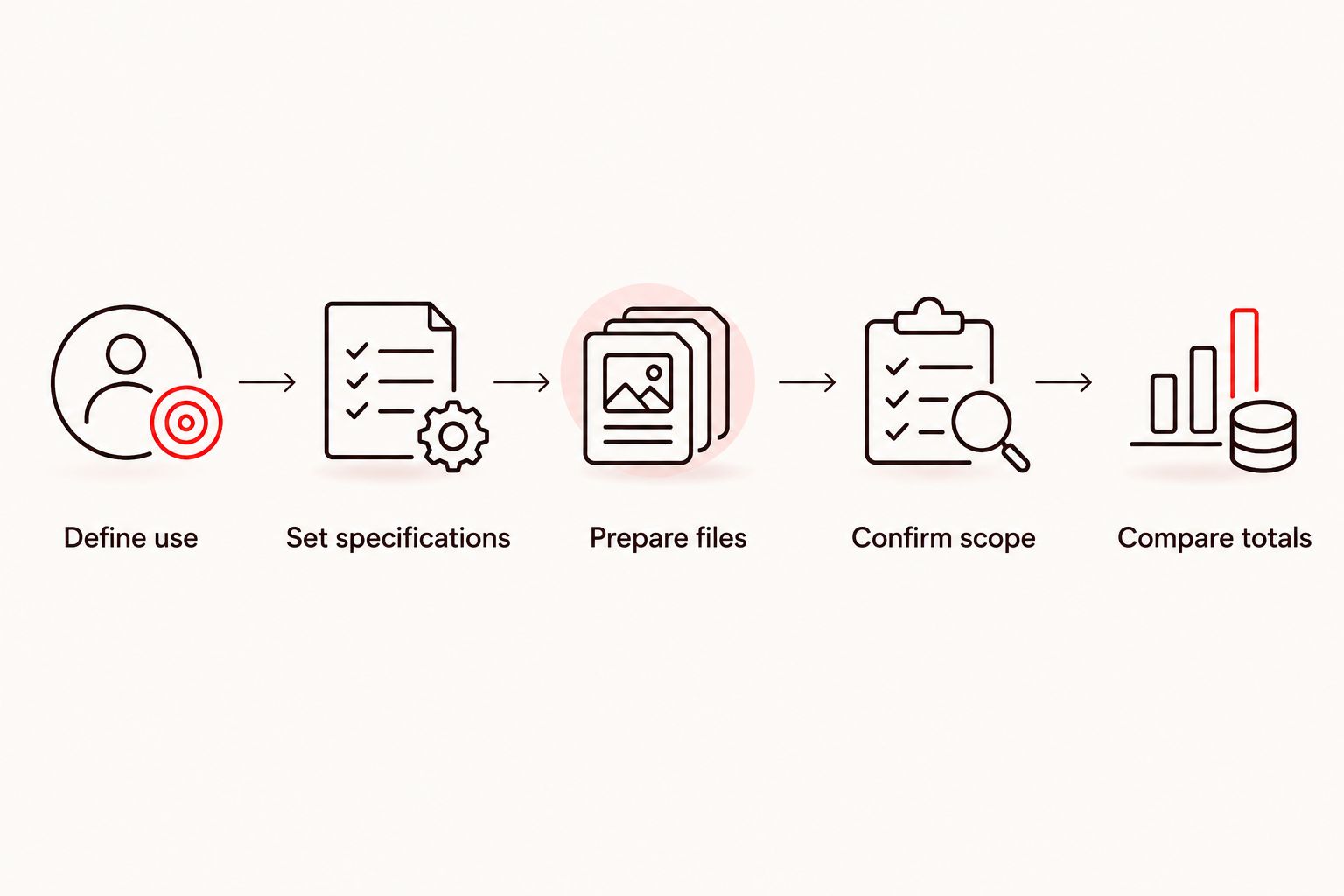
Before placing your 2026 order, save the approved specifications with the final files. If you reorder later, that record gives you a precise starting point instead of relying on a description such as the same notebook as last time.
Simplify the notebook before sacrificing its writing function. Remove pages that have no clear purpose, use interior color only where it helps, and choose a size that gives recipients enough room without unnecessary bulk.
Ask for an alternative quote with one specification changed. That isolates the effect of the change and lets you judge whether the trade-off is acceptable.
Do not reduce the binding margin just to squeeze in more content. A crowded writing page is not an improvement, and artwork that conflicts with punching or trimming needs correction before production.
A larger quantity is better value only when the complete order fits your budget and the extra notebooks have a purpose. Compare the total commitment alongside the cost per finished copy.
For an event-specific cover, consider whether leftover copies will still be useful after the event. For a reusable design, consider your storage and distribution plans before increasing the order.
Use interior color when it helps recipients understand or use the pages. Color-coded sections, instructional artwork, and visual exercises have a functional reason for color; ordinary writing lines do not require it.
Request the cover and interior choices separately. You can evaluate a color cover with a black-and-white interior without assuming the whole notebook needs the same printing treatment.
Publishing Xpress is a fit for self-publishers, nonprofits, and organizations seeking short-run digital printing without large minimum order requirements. Its four binding options are perfect bound, saddle stitch, Wire-O, and plastic coil, with black-and-white or color printing.
The advantage is having several constructions to consider for the project. The limitation is that the service description alone does not determine your notebook's paper suitability, finished specifications, or delivery schedule; confirm those details for your order.
Start with Publishing Xpress once your notebook brief is ready. Request specifications that match the way recipients will write, not just the way you want the cover to look.
How much does custom notebook printing cost in 2026?
Custom notebook printing needs a quote based on quantity, dimensions, page count, paper, color, and binding. Compare complete order totals for matching specifications and confirm whether delivery, tax, proofing, and file preparation are included.
What’s the best binding for a notebook that lies flat?
Plastic coil and Wire-O suit notebooks that need to lie flat while you write. Both require clearance between the punched edge and the writing content.
Is Wire-O better than plastic coil for custom notebooks?
Wire-O is not automatically better than plastic coil. Both provide flat opening; compare their construction, handling needs, and matching project quotes before choosing.
Do blank pages count in a custom notebook?
Blank interior pages count toward the notebook’s physical page total. Include them in your specifications and confirm how the printer wants them represented in your files.
Can I print a color cover with black-and-white notebook pages?
Specify cover color and interior printing separately when requesting a quote. Publishing Xpress offers black-and-white and color printing; confirm the combination and paper choices for your project.
How do I compare custom notebook printing estimates?
Compare identical quantities, dimensions, page counts, papers, color choices, and bindings. Then check the complete order total and whether each estimate includes the same services and delivery scope.
Does Publishing Xpress require a large notebook order?
Publishing Xpress provides short-run digital printing without large minimum order requirements. Confirm the quantity and construction requirements for your specific notebook before ordering.
Check the notebook with the pen your recipients will actually use. Ask how to evaluate the proposed interior paper for show-through, ink behavior, and writing comfort rather than relying on a paper name alone.
For your 2026 project, also review a representative page at finished size. Attractive artwork cannot compensate for lines that feel cramped or a binding edge that takes away the space where someone needs to write.
© 2026 Publishing Xpress. All Rights Reserved.