September 28, 2026
Choose Publishing Xpress if your manuscript is ready and you need printed books, magazines, or marketing materials; choose Reedsy if you need help editing, designing, or preparing a book before it goes to print. Publishing Xpress is the better choice for a ready-to-print short run; Reedsy is the better choice for finding publishing specialists. That is the practical answer to Publishing Xpress vs Reedsy in 2026: the two services solve different parts of the job.
An author searching for a publishing service can be at either end of the process. One has a draft that needs work. Another has finished files and needs copies for an event, a class, a business, or direct sales. Sending both to the same type of provider creates an avoidable detour.
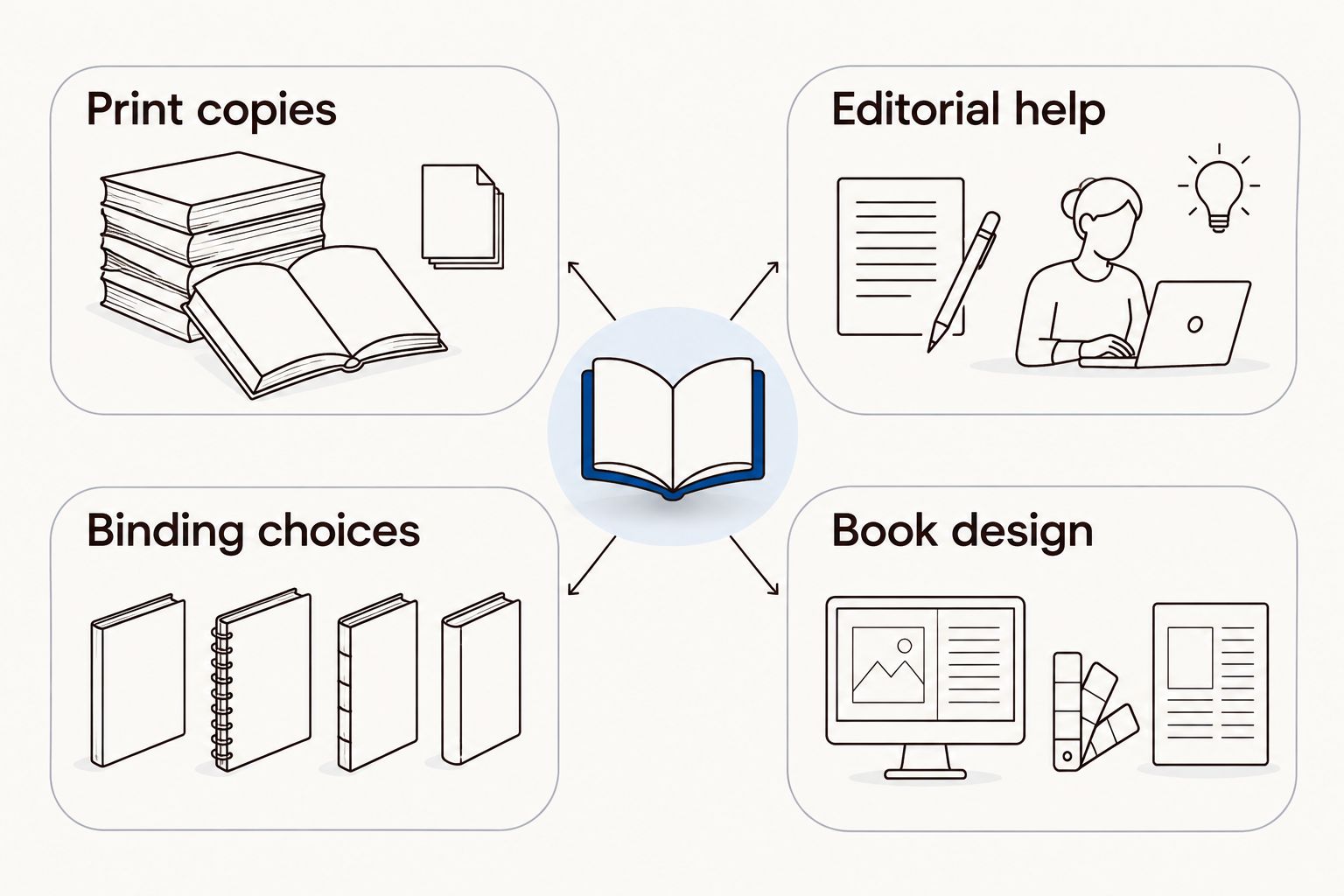
In 2026, start with a plain question: Do you need help making the book, or do you need the finished book printed? Reedsy connects authors with publishing professionals and provides book-creation tools. Publishing Xpress provides online self-publishing and short-run digital printing, including black-and-white and color work. Neither choice removes your responsibility to check the manuscript and production files.
| Dimension | Publishing Xpress | Reedsy |
|---|---|---|
| Best for | Authors and organizations ordering printed materials | Authors seeking publishing professionals or book-creation tools |
| Service model | Digital printing and publishing services | Marketplace for publishing specialists and book tools |
| Manuscript editing | Not the stated reason to choose its printing service | Better fit for finding an editor |
| Book design and formatting | Relevant to preparing a print order; confirm the help your project needs | Better fit for hiring design help and preparing a manuscript |
| Physical printing | Direct fit for a short-run order | Not a direct substitute for placing a print order |
| Binding choices | Perfect bound, saddle stitch, wire-o, and plastic coil | Binding is a printer decision, not a Reedsy marketplace specialty |
| Order size | No large minimum order requirements are stated | Not the place to specify a print quantity |
| Author control | You make the final content and production decisions | You make the final content and production decisions |
| Pricing model | Print cost depends on the job’s specifications | Professional-service costs depend on the work commissioned |
| Standout feature | Multiple binding options for physical projects | Access to publishing specialists |
The table is an outline, not a claim that one company does everything the other does. In 2026, the useful comparison is whether each service covers the next task on your schedule. If editing remains unfinished, paper selection is premature. If your print files are final, looking for an editor will not place a book order.
Best for: an author or organization with content ready to turn into physical copies. Publishing Xpress prints books, booklets, catalogs, magazines, and other documents in black-and-white or color. Its stated lack of large minimum order requirements makes it a relevant option when you need a short run rather than a large inventory commitment.
That scope also explains the limitation. A printing service is not the same thing as a dedicated editor working through your manuscript. If you are still changing chapters, checking citations, or deciding what belongs in the book, finish that work before treating the print order as the next step. A clean-looking copy will not correct an unresolved sentence or a missing page.
For a business, the distinction is just as useful. A finished training booklet, catalog, or magazine issue calls for production decisions: which pages are in color, how the document opens, and how many copies you need. A rough draft still calls for content and design decisions. Name the task before you choose the provider.
Best for: an author who needs professional help before committing to print. Reedsy is a marketplace for publishing professionals, including editors and designers. That makes it a stronger match when you need a person to improve a manuscript or shape its presentation, rather than a provider to produce physical copies.
The tradeoff is that hiring help and ordering books are separate decisions. An editor’s finished work is not a print run. A cover concept is not, by itself, a complete set of production-ready files. Agree on the deliverables you need for your eventual printer, then check those files against that printer’s requirements before ordering.
If you are self-publishing for the first time in 2026, resist buying services by category alone. An editor, a cover designer, and a printer answer different questions. Decide whether your immediate problem is the words, the appearance of the book, or the physical copies. Reedsy wins the specialist-search stage; it does not replace the print stage.
A professionally designed book must work both on screen and on paper. Reedsy is the better choice when the work you need is to find a designer or prepare a manuscript’s layout. That is especially relevant if you have not settled the cover, interior typography, or page arrangement.
Best for: authors whose files are not yet ready for production. The drawback is handoff: a design that looks finished still has to meet the chosen printer’s file specifications. Ask what files the designer will deliver and which decisions remain yours. Do not assume that choosing a designer also selects paper, binding, or a print quantity.
If your layout is already complete, the advantage shifts. Your next task is to confirm that the interior and cover match the physical format you intend to order. In 2026, a useful file review checks trim size, margins, image placement, and whether content near an edge needs bleed. Those checks protect the work you have already paid to write or design.
Best for: readers who need copies in hand. Publishing Xpress is a digital printer. Reedsy helps authors develop and prepare books, but its marketplace is not a direct replacement for selecting print specifications and placing a short-run order.
That does not mean printing is the first decision in every self-publishing project. If the manuscript changes after you approve the files, those changes create more work. Finish editing, settle the layout, and examine the material you intend to print. Then choose the printer based on the actual book, booklet, or magazine you are producing.
For a short run, work backward from distribution. An author preparing copies for an event has a different quantity question from an organization printing a document for its team. Count the copies you plan to use, decide whether you need extras, and make sure the final file matches the format you selected. Neither provider should make that judgment for you.
Best for: projects where the way pages open matters. Publishing Xpress states four binding options: perfect bound, saddle stitch, wire-o, and plastic coil. Reedsy can help you find people to prepare a book, but binding remains a decision for the physical production stage.
A perfect-bound book has a glued spine and reads like a conventional paperback. A saddle-stitched booklet is folded and stapled through its center. Wire-o and plastic coil allow pages to turn around their binding, a useful characteristic for workbooks, manuals, and other materials readers consult while doing something else. The right choice follows how the reader will use the pages, not simply how the cover looks.
The limitation is that four available binding types do not mean every format suits every manuscript. Page count, trim size, paper, and intended use still matter. If you are unsure whether you are producing a book or a booklet, settle that question before finalizing the layout. Changing the binding late can change how you prepare the file.
Best for: self-publishers and organizations that do not want a large minimum order. Publishing Xpress states that it has no large minimum order requirements. That is directly relevant when you have a defined group of readers and do not need to build a large stock of books or booklets.
Reedsy is not the alternative for setting a print quantity. Its value sits earlier in the process, when you need publishing help. If your files are final and the remaining question is how many physical copies to make, evaluate print specifications rather than professional-service profiles.
A small order still deserves careful planning. Write down who receives a copy and what each copy is for. An event handout, an author-sale copy, and an internal reference copy all count toward the same print decision. Order against that real use case, not an imagined audience size.
Best for: authors who want to remain in charge of the finished work. Neither a specialist marketplace nor a digital printer decides what your book should say. You approve the manuscript, the presentation, and the production choices. This is a tie, and it is the reason a handoff checklist matters.
Before you hire a professional, describe the problem you want that person to solve. Before you print, confirm that the file you submit is the version you intend readers to see. Keep one approved version of the interior and one approved version of the cover when your chosen format calls for separate files. Check the printer’s requirements rather than assuming one file setup works for every binding.
The same principle applies to organizations producing recurring publications. Assign someone to sign off on names, dates, images, and final pages before production. In 2026, the service you choose can do its part well and still receive the wrong version from your team. Final approval is your responsibility either way.
Do not compare a printing job with a freelance publishing project as if they were the same purchase. Publishing Xpress’s printing model is tied to the physical specifications of the job: what you print, the chosen format, and the quantity. Reedsy’s marketplace model is tied to the professional work you commission. The meaningful comparison is the scope you need, not a single headline figure.
For printing, prepare a clear specification before assessing the cost: document type, page count, color choice, binding, and quantity. A change to those choices changes the job you are comparing. For an editor or designer, define the manuscript’s condition, the work requested, and the deliverables. Vague briefs make offers difficult to compare even when they sound similar.
The tradeoff is predictability versus flexibility in the scope of work. A defined print specification gives you a concrete production job to assess. A professional-service brief lets you seek help for a particular problem, but you must first say what completion looks like. If you need both services, treat them as separate stages in your 2026 plan.
Publishing Xpress’s standout feature in this comparison is the route from finished files to physical materials with four stated binding options. Reedsy’s is access to publishing specialists when a manuscript or its presentation still needs work. Best for print: Publishing Xpress. Best for preprint specialist help: Reedsy. Both advantages are real; neither cancels the other.
That split gives you a useful order of operations. Complete the manuscript. Get editorial or design help if the work calls for it. Confirm your files against the print format. Then decide on binding and quantity. If you skip a stage, the next provider has less to work with.
Ready to plan your print order?
Review printing options for your finished book, booklet, magazine, or catalog.
You are an author with approved print files, or an organization preparing a finished booklet, catalog, magazine, or book. Publishing Xpress wins for short-run physical printing in 2026, particularly when binding choice and avoiding a large minimum order matter. Its drawback in this comparison is simple: printing is not a substitute for unfinished editing or design work.
You are an author seeking an editor or designer before production. Reedsy wins for finding publishing specialists in 2026. Its drawback is equally clear: commissioning that work does not itself place a physical print order. Once the files are ready, you still have to make production choices.
| Dimension | Winner |
|---|---|
| Best for finished print materials | Publishing Xpress |
| Service model for specialist help | Reedsy |
| Manuscript editing | Reedsy |
| Book design and formatting help | Reedsy |
| Physical printing | Publishing Xpress |
| Binding choices | Publishing Xpress |
| Small print orders | Publishing Xpress |
| Author control | Tie |
| Pricing model | Different scopes; no direct winner |
| Standout feature | Tie: physical production or specialist access |
Is Publishing Xpress or Reedsy better for printing a book in 2026?
Publishing Xpress is the better choice for ordering physical books in 2026. Reedsy is better suited to finding publishing specialists before the files go to print.
Is Reedsy better than Publishing Xpress for finding an editor?
Yes. Reedsy is a marketplace for publishing professionals, including editors. Publishing Xpress is the relevant choice when your work is ready for a short-run print order.
Can Reedsy replace a book printer?
No. Hiring a publishing specialist through Reedsy is not the same as placing a physical print order. You still need to choose a printer and confirm the production files.
Which binding options does Publishing Xpress state it offers?
Publishing Xpress states four binding options: perfect bound, saddle stitch, wire-o, and plastic coil. Choose based on how readers will use the finished pages and confirm the format for your project.
Which is better for a small book order?
Publishing Xpress is the better match for a small physical order because it states that it has no large minimum order requirements. Reedsy is a professional-services marketplace, not a print-quantity alternative.
How do Publishing Xpress and Reedsy charge for different work?
Publishing Xpress’s printing job depends on production specifications, while work found through Reedsy depends on the professional service commissioned. Define the print job or service deliverables before comparing your options.
Should I use an editor or a printer first?
Use an editor first if the manuscript still needs editorial work. Move to the printer when the text and production files are approved; printing will not fix an unfinished draft.
The most useful 2026 test is not which company has more publishing-related services. Ask what you would send today. If it is a manuscript with unresolved changes, start with the help needed to finish it. If it is an approved print file, start with the physical format and quantity. That one question makes the comparison actionable.
© 2026 Publishing Xpress. All Rights Reserved.