October 23, 2026
Yes—print on demand is worth it for a first book in 2026 when you want to test reader demand without ordering inventory in advance. It does not remove editing, design, proofing, or marketing work, and short-run printing is the better fit when you already have readers waiting for physical copies.
Your first printing decision should solve a practical problem: getting the right book to the right reader. It should not force you to predict a large audience before you have evidence that audience exists.
Print on demand for self-published authors separates printing from an advance inventory order. That helps when readers buy individually over time, but it does not replace a plan for launch events, signed copies, or classroom distribution.
For a first book in 2026, separate the publishing decision from the inventory decision. You can finish a professional book without committing to a large batch, then choose how to produce copies for each sales channel.
Print on demand is worth it when avoiding unsold inventory matters more than keeping books on hand. Short-run printing fits a different situation: you have a defined use for a batch and want to manage those copies yourself.
Neither method creates readers. Your manuscript, presentation, promotion, and route to buyers still determine whether people want the book.
| Printing approach | Best for | Main advantage | Main limitation | Verdict |
|---|---|---|---|---|
| Print on demand | First-time authors testing individual reader demand | Books are produced in response to orders rather than a speculative batch | Each order depends on the provider's production and fulfillment process | Choose for uncertain demand |
| Short-run printing | Authors with events, direct buyers, or group orders | You receive a planned batch for your own distribution | You store and manage the copies you order | Choose for a defined batch |
| Combined approach | Authors selling online and distributing copies directly | Each channel gets an appropriate production method | You coordinate separate orders and file requirements | Choose when both channels have a purpose |
Compare the actual book specifications, not just the printing labels. A text-led paperback, an illustrated children's book, and a writing workbook have different production needs even when each is an author's first publication.
Print on demand fits a first novel, memoir, or nonfiction title when you cannot yet predict sales. You do not need to fill a storage space with finished books before discovering whether readers respond to the cover, description, and subject.
The advantage is inventory control. You commit to preparing the book, then let orders determine production instead of choosing a speculative batch.
The limitation is that printing is only part of publishing. Check what the specific provider handles: file preparation, ordering, customer delivery, sales reporting, and distribution are separate functions. Do not assume every service includes them.
Print on demand also does not make an unfinished manuscript ready for readers. A typo in the uploaded file remains a typo in the printed copy, and a weak cover remains a weak cover.
Choose print on demand when demand is uncertain and you do not need a batch in hand. Keep editing and proof approval as firm publication requirements, not tasks to complete after launch.
Short-run printing fits a first book when you know where the copies will go. A workshop, family-history project, community fundraiser, or author event gives the order a concrete purpose.
You receive books together and control their direct distribution. That supports signing copies, handing out course materials, or supplying an organization with its planned order.
The trade-off is responsibility. You need somewhere to store the books and a process for packing and sending any copies sold directly. Copies without an assigned purpose remain your inventory.
Start with confirmed needs rather than an optimistic sales forecast. Separate paid orders, copies promised to contributors, review copies, and books intended for events so the same demand does not appear twice in your plan.
Choose short-run printing when the batch has a destination. A specific distribution list is a stronger reason to print than a general hope that having books nearby will encourage sales.
You do not have to use the same production method for every copy of your first book. Print on demand can serve individual orders while a short run supplies copies for an event or an established group.
This approach makes sense when both channels already have a job. It is less useful when you are adding complexity without a clear reason to hold inventory.
The main drawback is coordination. Different printers can require different cover dimensions, templates, or file settings, even when the interior content is the same. Check each specification rather than sending an unchanged package everywhere.
Keep a clearly named master manuscript and track which print files belong to each supplier. When you correct the text, update every active edition that needs the correction.
Choose a combined approach when online orders and direct distribution both matter. Do not print an extra batch simply because a print-on-demand edition exists; give those physical copies a separate purpose.
The useful question is not whether print on demand is universally better. It is which method matches your book, your readers, and the work you want to handle.
For your 2026 publishing plan, write down the strongest reason for choosing each method. If your only reason is that other authors use it, return to the reader and distribution questions.
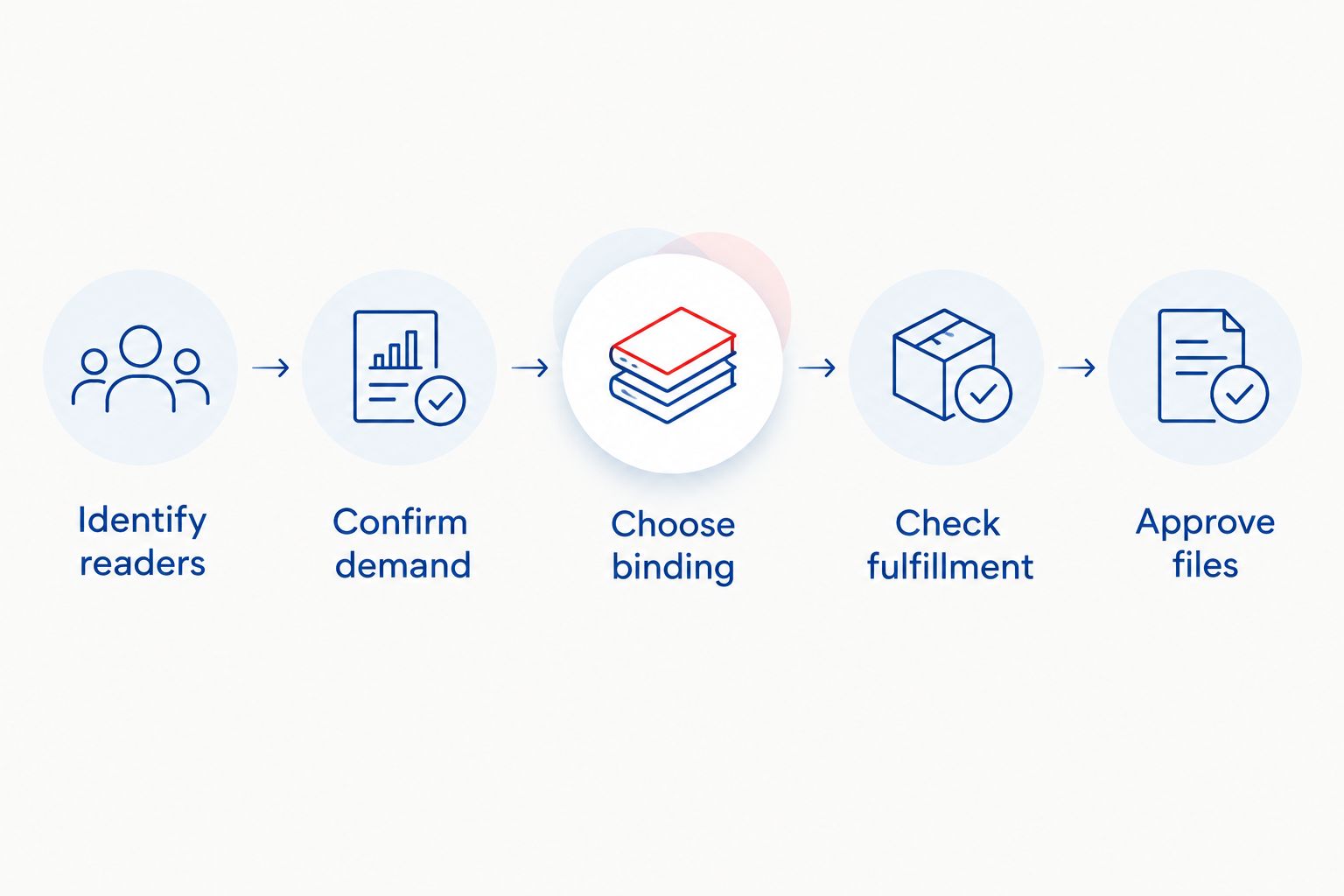
Follow this sequence before you upload the final files. It keeps the decision tied to actual readers rather than assumptions about what publishing should look like.
Name the people who will receive the book and how they will get it. Distinguish readers who will order individually from people receiving copies through your event, organization, or direct sales.
Be specific about the channel. An audience interested in your writing is not automatically a list of people who have committed to buying a printed book.
Record actual orders and distribution commitments separately from possible sales. If you have no dependable batch requirement, print on demand avoids making that inventory decision prematurely.
If a group has requested copies, confirm the quantity and delivery expectations. A clear order is more useful than an informal promise to help promote the book.
Decide how the reader will use the finished book. Perfect binding suits paperback reading, while plastic coil and Wire-O deserve consideration for books that need to stay open during use.
Saddle stitch suits shorter publications, but it has page-count limits. Select the structure before finalizing margins and cover files, because binding affects the space available near the spine or punched edge.
Ask who receives the order, who produces the book, and who sends it to the reader. Confirm those responsibilities for each sales channel rather than assuming printing includes distribution.
For direct sales, include your own handling tasks. You need a repeatable way to track orders and send the correct edition to each buyer.
Review the finished interior and cover together. Check page order, chapter openings, image placement, margins, and any text near the trim or binding edge.
Do not approve a proof because the publication date feels close. Resolve visible problems before production; the printing method does not correct the content for you.
Once those decisions are written down, compare providers against the same specification. Changing the binding, interior color, or quantity between quotes makes the comparison less useful.
Publishing Xpress is best for first-time authors who need short-run book printing of at least 25 copies. That makes it relevant when you have a planned batch, rather than a need for individual customer orders to trigger single-copy production.
Publishing Xpress offers perfect bound, saddle stitch, plastic coil, and Wire-O binding, with black-and-white or color printing. The choice lets you match a paperback, booklet, or workbook to its intended use; it does not mean every binding fits every page count.
The minimum order is 25 copies, and saddle stitch books have a maximum of 80 pages. Those are practical selection limits: if your project falls outside them, change the binding or choose a different production arrangement rather than forcing the file to fit.
For scheduling, Publishing Xpress ships in 4 to 6 days after proof approval. Shipping is not arrival, so include transit time and your own proof-review time when planning a 2026 event.
The benefit is a defined short-run printing option with several binding choices. The limitation is equally clear: a batch order leaves storage and direct distribution with you. Review Publishing Xpress when that arrangement matches your project.
Print on demand does not guarantee profit; it avoids committing to a speculative print inventory. Your result still depends on reader demand, production expenses, selling arrangements, and the work required to prepare and promote the book.
Evaluate each sales channel separately. A direct event sale and a sale handled through a publishing platform involve different responsibilities, so a single headline return does not explain the whole project.
Wait for evidence of demand before ordering speculative inventory, but order deliberately when you have a defined use for copies. A scheduled reading, workshop, or confirmed group order is a reason to plan a batch before public sales begin.
For a 2026 launch, tie the order to a distribution plan. Keep promotional copies separate from copies you expect to sell so your inventory records reflect their actual purpose.
Is print on demand worth it for a first book if I have no audience?
Yes, print on demand fits a first book with unproven demand because you avoid ordering speculative inventory. You still need a finished manuscript, suitable design, proof review, and a plan to reach readers.
Is print on demand better than short-run book printing?
Print on demand is better for uncertain individual orders; short-run printing is better for a defined batch. Choose according to how readers will receive the book, not whether this is your first publication.
Can I use print on demand and short-run printing together?
Yes, you can use print on demand for individual orders and short-run printing for direct distribution. Check each provider’s file requirements and keep corrections consistent across the active editions.
Can I order fewer than 25 copies from Publishing Xpress?
No, Publishing Xpress has a minimum print quantity of 25 copies. Choose a different production arrangement if your project requires fewer copies.
What is the maximum page count for saddle stitch printing?
The maximum saddle stitch book length at Publishing Xpress is 80 pages. A longer manuscript needs another binding option rather than an assumption that saddle stitch will accommodate it.
Does print on demand include editing and book marketing?
Do not assume print on demand includes editing or book marketing. Check the provider’s stated services and arrange any remaining work before publication.
Should I choose print on demand for a workbook?
Choose a workbook printer by the binding and page requirements first, then by the order method. A book intended for writing or desk use needs a structure suited to that activity.
Your first book does not need a permanent printing strategy. It needs a sensible method for the orders you can identify now.
The overlooked task is version control. If you use different printers or sales channels, a correction is not complete until every relevant production file contains it. Keep a simple edition record showing the approved manuscript, cover, supplier, and approval date.
That habit protects the reader's experience under either printing method. Start with the least complicated arrangement that meets your actual needs, then change it when the evidence changes.
© 2026 Publishing Xpress. All Rights Reserved.