October 19, 2026
Yes, plastic coil binding is durable enough for daily use in planners, workbooks, cookbooks, and reference manuals. The flexible coil supports repeated page turning and lets you fold the cover behind the book, but it does not protect paper from tearing or spills. For a daily-use book in 2026, judge the paper, covers, punched holes, and coil together—not the binding alone.
A daily-use book has a different job from a book you read once and shelve. You need pages that stay open, enough room to write, and a binding that does not fight you every time you turn a sheet.
For a 2026 planner or training workbook, usability belongs in the durability decision. A book that lies flat is easier to use without forcing its spine. Start with the layout requirements in this guide to setting up a spiral-bound book for printing, then evaluate the finished construction.
Plastic coil binding is a practical choice for repeated everyday handling, provided the finished book has suitable paper, protective covers, and a correctly fitted coil. Its continuous plastic spiral threads through holes along the binding edge. Pages turn around that spiral rather than pulling against a glued spine.
The distinction matters: binding durability and page durability are separate. An intact coil cannot keep a sheet attached after the paper between its punched holes and outer edge has torn away.
Use this comparison when choosing a daily-use binding in 2026:
| Binding | Best for | Daily-use advantage | Main limitation |
|---|---|---|---|
| Plastic coil | Planners, workbooks, and frequently handled manuals | Flexible spiral; lies flat and folds back | Exposed coil can snag; punched paper can tear |
| Wire-O | Desk references and presentation documents | Lies flat and allows fold-back use | Metal loops can become distorted under pressure |
| Perfect bound | Reading books that need a printable spine | Continuous cover and familiar bookshelf format | Does not offer the same unrestricted fold-back movement |
| Saddle stitch | Thin guides and short booklets | Simple stapled construction without an exposed spiral | Not suitable for thick documents |
There is no universal winner. Choose plastic coil when readers need to work in the book, not just read it. Choose another format when shelf presentation, a printable spine, or a thin booklet structure matters more.
For a working book, durability means pages turn freely, covers remain attached, and the binding stays usable during ordinary handling. It does not mean the book withstands being pulled by a page, trapped under heavy objects, or soaked.
Plastic coil allows a 360-degree fold-back, so you can place the front cover behind the back cover. That is useful on a crowded desk or beside a mixing bowl. It also removes the need to hold a glued book open while you work.
Best for: books you write in while referring to an open page. Plastic coil lets a planner or workbook sit flat, and folding it back reduces the space it occupies on your desk.
The trade-off is at the punched edge. A worksheet pulled sideways still puts stress on the paper around its holes. Keep answer spaces, checkboxes, and instructions away from that edge so readers do not have to press their pens against the coil.
For student materials, consider how the book travels as well as how it opens. A workbook carried loose among other objects needs protection for its covers and exposed binding. A desk-only workbook faces a different kind of wear.
Verdict: choose plastic coil for writing access, but design the page around the punched margin. A convenient binding cannot fix an answer box placed too close to the holes.
Best for: books you consult while both hands are busy. A coil-bound recipe book or manual stays open without requiring you to hold the pages down. Its 180-degree opening supports a flat spread; fold-back use exposes a single working page.
The limitation is environmental protection. Plastic binding does not make the interior paper resistant to water, grease, or dirt. If the book will sit near food preparation or workshop materials, discuss suitable cover and paper choices with the printer.
A cover finish protects only the surfaces it covers. Do not assume that a protected front cover also protects exposed page edges or interior sheets.
Verdict: choose plastic coil for hands-free reference, then address spills and surface wear separately. Binding selection and moisture protection are different decisions.
Two books with plastic coils can wear differently because the binding is only part of their construction. These are the factors to assess before approving a daily-use book:
Do not select a coil diameter from page count alone. Paper thickness, cover thickness, and any inserted materials affect the actual thickness of the finished book. Have the printer match the coil to that complete page block.
The same principle applies to paper weight. A heavier sheet is not automatically the right answer for every workbook; you also need comfortable page turning and paper suited to the intended writing tools.
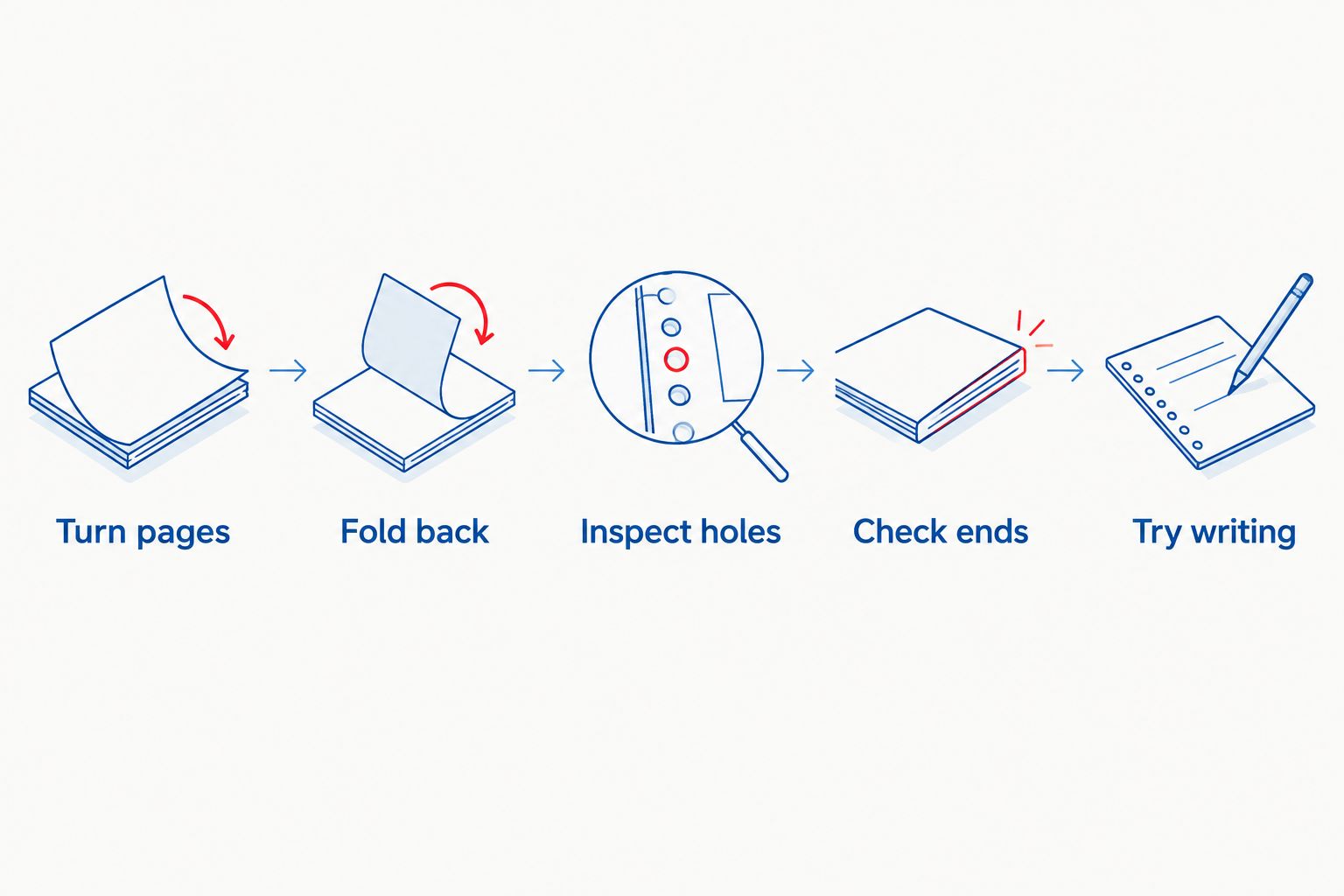
For a daily-use book you plan to print in 2026, check a finished bound sample or proof when that option is offered. A screen preview shows layout, but it cannot show how the pages move around the coil.
Turn pages near the front, middle, and back. They should travel around the coil without repeated catching or a need to pull them into place.
Try both individual sheets and small groups of pages. If movement feels restricted, ask the printer to check coil fit and punching before approving the job.
Fold the cover behind the book as you would during normal use. Check that the pages remain usable and the cover does not obstruct the working area.
Do not deliberately crush or sharply twist the binding. The purpose is to assess normal handling, not invent a stress test with no connection to how readers use the book.
Look along the punched edge for torn paper, incomplete holes, or pages that catch. Check the covers as well as the interior sheets.
Then inspect the nearby content. A cleanly punched book still needs enough space between the binding and text, diagrams, or writing areas.
Inspect the top and bottom ends of the spiral. Ask the printer about any end that appears unfinished or starts to work out during ordinary page turning.
Also check that the covers and all pages are captured by the coil. A missing or misaligned sheet is a construction issue, not a reason to reject the entire binding method.
Use the book in its intended position and write near the binding side. Check whether your hand rests comfortably and whether the page layout leaves enough usable space.
For a workbook, complete a representative exercise. For a manual, follow a procedure while the book sits open. Approve the book in use, not just closed on a table.
Turn pages around the coil rather than pulling them away from it. Carry the book by its covers and page block, not by the exposed spiral or a single sheet.
Keep loose objects from catching in the coil during transport. Avoid packing the book where heavy objects press directly against the binding, and keep ordinary paper interiors away from spills.
If a page begins catching, inspect the cause instead of forcing it. A damaged hole, displaced coil end, or trapped object needs attention; pulling harder puts more stress on the paper.
These habits do not make a book indestructible. They keep everyday handling from becoming avoidable damage.
Plastic coil is the stronger fit when flexibility during handling is your priority; Wire-O remains useful for flat-opening desk documents. Plastic spirals flex, while metal loops can retain a distorted shape after pressure.
Neither binding protects paper from tearing around its holes. Compare finished samples with similar paper and covers before treating the binding material as the deciding factor.
Plastic coil binding has no universal daily-use lifespan. Paper, covers, finishing, transport, and reader handling all affect how long the complete book remains usable.
For a 2026 workbook project, base approval on construction and realistic use rather than an unsupported promise of years. Ask how the printer will fit and finish the coil for your actual document.
Publishing Xpress is a fit for self-publishers and organizations that need short-run plastic coil binding. It offers online printing with plastic coil among its binding options, making it relevant when your project needs a printed working book rather than a digital-only document.
The limitation remains the format itself: Publishing Xpress plastic coil binding does not provide the printable spine of a perfect-bound book. Choose it because your readers need flat-opening pages and fold-back use, not because every book benefits from a spiral.
When discussing your project with Publishing Xpress, describe how readers will use and carry it. Include the finished page count, intended paper and covers, and whether readers will write in it. Those details give the printer a clearer brief than simply requesting a durable book.
Is plastic coil binding durable enough to use every day?
Yes, plastic coil binding is suitable for everyday page turning and fold-back use. The complete book still needs suitable paper, covers, clean punching, and properly finished coil ends.
Will pages tear out of a plastic coil-bound workbook?
Pages can tear out if the paper around the punched holes is damaged or pulled hard enough. The coil holds the punched edge; it does not reinforce the paper itself.
Can I fold a plastic coil-bound book all the way back?
Yes, plastic coil binding allows a 360-degree fold-back, placing the front cover behind the back cover. Check a finished sample to confirm comfortable movement with your chosen paper and covers.
Is a plastic coil-bound cookbook waterproof?
No, plastic coil binding does not make a cookbook waterproof. Interior paper, covers, and exposed page edges need separate consideration wherever spills are likely.
Is plastic coil better than perfect binding for a workbook?
Plastic coil is better suited to workbooks that need flat-opening pages and fold-back use. Perfect binding offers a printable spine but does not provide the same unrestricted page movement.
Does a thicker coil make a book more durable?
A larger coil is not automatically more durable or more suitable. The coil must fit the finished page block with enough clearance for comfortable turning.
Does Publishing Xpress offer plastic coil binding?
Yes, Publishing Xpress offers plastic coil binding alongside perfect bound, saddle stitch, and Wire-O options. Select the binding around how readers will use the finished book.
Check the punched paper before you blame the coil. If the spiral remains intact but a page is coming loose, changing binding materials alone does not address the damaged attachment point.
Before approving your 2026 daily-use book, turn through it while completing a real task. The best final check is whether you can read, write, and move between pages without fighting the construction.
© 2026 Publishing Xpress. All Rights Reserved.